


Iran’s grip on Hormuz reshapes global oil shipping routes
3 min read



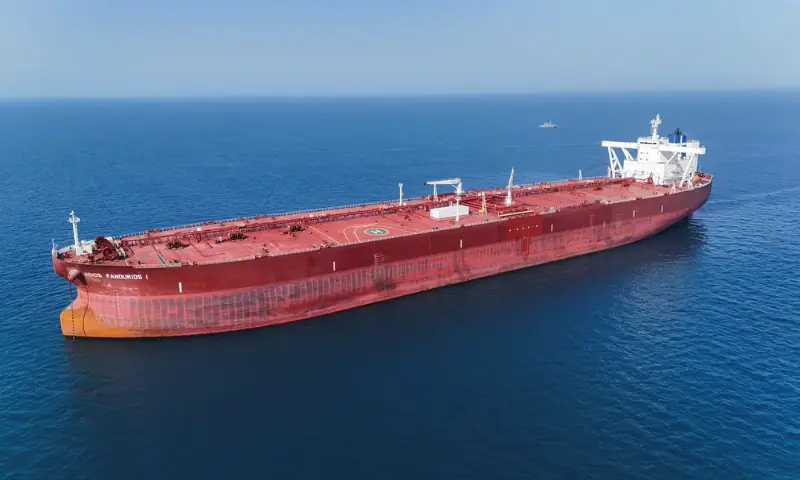
The tanker crew gathered their courage and carefully navigated along a route designated by Iran, hugging the coastline and moving between island checkpoints through the Strait of Hormuz.
The 330-metre-long Agios Fanourios I, laden with Iraqi crude oil and bound for Vietnam, had been stranded off Dubai since late April. On May 10, it set off for the strait after a direct deal with Iran overseen by Iraq’s prime minister.
Iran’s instructions were part of a multi-tiered mechanism for clearing vessels through the Strait of Hormuz.
With Iran now in de facto control of the strait, the system can involve government-to-government arrangements, vetting by Iranian authorities and, in some cases, fees for safe passage, Reuters has found.
In Vietnam, Iraq, Greece and elsewhere, the ship’s progress was closely monitored. Periodically, its transponder went dark, but the vessel continued its journey.
On the same day, another ship was hit by a projectile, causing a small fire, according to a British maritime safety agency.
Late on May 10, the Agios Fanourios I was stopped near Hormuz Island by Islamic Revolutionary Guard Corps (IRGC) speedboats, according to an Iranian official.
The vessel was suspected of carrying smuggled cargo and was ordered to halt for inspection.
Several hours later, it was allowed to proceed, turning what is typically a five-hour transit into a two-day ordeal.
No payments were made, said the ship’s manager, Eastern Mediterranean Shipping and several people with knowledge of the passage.
The manager said there were reasons to believe Iran allowed the transit following pressure from Iraq and Vietnam.
Iran did not comment on the system or the vessel’s journey.
Iran’s control of the Strait of Hormuz, through which about a fifth of global oil supply passes, has disrupted global shipping.
Reuters spoke to multiple sources, including shipping officials and Iranian and Iraqi sources, and reviewed documents and vessel movements to understand how the system operates.
By early May, thousands of sailors were trapped in the Gulf, according to US military estimates.
The shipping bottleneck stems from Iran’s ability to disrupt traffic in the strait.
The US Navy has responded with its own enforcement measures outside the waterway.
Only a limited number of vessels have passed through in recent weeks. Before the war, around 120 to 140 ships crossed daily.
The US Treasury has warned of sanctions risks for payments made for safe passage.
Non-compliance could expose companies to penalties under sanctions regimes.
The system includes preferential treatment for vessels linked to allies such as Russia and China, followed by countries with closer ties to Tehran, and then government-to-government arrangements.
Two European shipping sources said some vessels outside formal agreements are paying Iranian authorities for safe passage.
Under international maritime law, strait passage should not be subject to discriminatory fees, though security-related charges may apply if treated equally.
The US Treasury warned it is prepared to take action against foreign companies supporting Iranian-linked transactions.
The vetting process involves the IRGC reviewing ship details, including cargo, ownership, flag, crew, and route.
The process can take about a week and may include inspections.
Bilateral arrangements require coordination between foreign governments and Iranian authorities, with final approval communicated through Iranian security bodies, including the IRGC.
For the Agios Fanourios I, Iraq’s state oil marketer worked with Iran under government supervision to arrange passage. Crew and cargo details were transmitted before transit.
Other countries, including India, also maintain arrangements through diplomatic and naval channels, with ships receiving approved routes and instructions from Iranian authorities.
For many vessels, transit involves passing multiple Iranian-controlled checkpoints in the region.
The Agios Fanourios I passed checkpoints before being stopped near Hormuz Island, and was later released after inspection.
Even after leaving Iranian waters, vessels may face further disruptions.
The tanker was later intercepted by US forces enforcing restrictions before being released and continuing toward Vietnam with 2 million barrels of crude.
For the latest news, follow us on Twitter @Aaj_Urdu. We are also on Facebook, Instagram and YouTube.









Comments are closed on this story.