


Oil at four-year high sends shockwaves through markets
3 min read



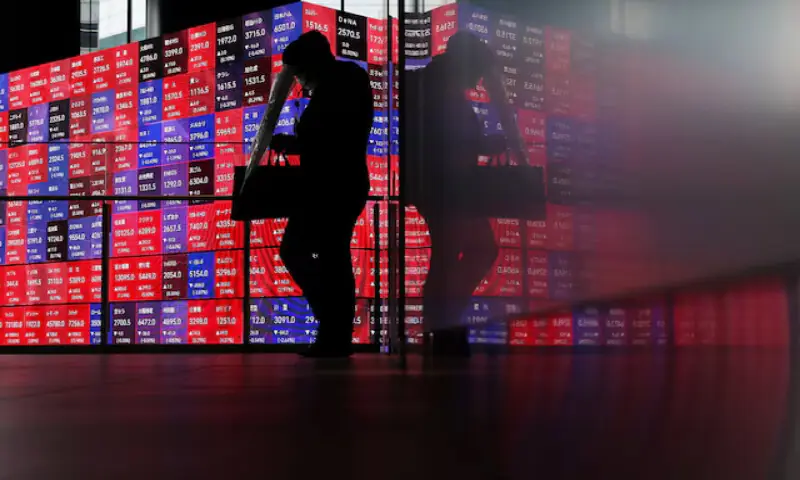
Asian shares fell on Thursday as oil prices vaulted to four-year highs due to the risk that the US may strike Iran again, with mostly positive earnings from tech giants providing only limited comfort to investors ahead of Apple’s results.
European stocks are bracing for a lower open, with the pan-regional stock futures gauge down 0.8%.
Investors fear the European Central Bank and Bank of England will likely warn of higher rates later in the day after the Federal Reserve kept interest rates steady.
But three Fed board members voted to drop the central bank’s easing bias in the most divided decision since 1992.
Outgoing Chair Jerome Powell also confirmed he would stay on as a governor for now to defend the institution’s independence as his successor, Kevin Warsh, picked by low-rate advocate US President Donald Trump, moves toward confirmation.
The latest spike in oil prices was a cause for concern, as Brent crude futures jumped over 6% on Thursday to a four-year high of $125 a barrel following a report that the US is considering additional military action against Iran.
As a result, MSCI’s broadest index of Asia-Pacific shares outside Japan slid 1% on Thursday, but was still set for a 15% gain this month.
Japan’s Nikkei fell 1.4% but was up 16% in April.
South Korea’s KOSPI hit another all-time high before turning 0.8% lower.
China’s blue chips were flat and Hong Kong’s Hang Seng index dropped 1.2%.
“The future path of the Iran conflict is still extremely uncertain … All outcomes are still on the table: escalation, impasse and peace, with starkly different implications,” said Luke Yeaman, chief economist at the Commonwealth Bank of Australia.
“Central banks are waiting to see which outcome prevails before taking decisive steps in any direction. Much like ships transiting the Strait of Hormuz, they’re steering through a minefield, with danger lurking at every turn.”
In Asia, Wall Street futures reversed earlier tech-driven gains.
Nasdaq futures were last down 0.3%.
Earnings from Google parent Alphabet topped forecasts, sending its shares up 7% in extended trading.
Results from Microsoft and Amazon.com were also solid, raising hopes for Apple later on Thursday.
Meta Platforms disappointed as it raised its annual capital spending forecast to plough billions more into artificial intelligence infrastructure; its shares fell 7%.
Battered bonds
Global bonds took a beating on Thursday after the oil spike and a hawkish Fed fuelled a selloff in Treasuries.
Markets were quick to price out any rate cuts from the Fed this year, and there is a roughly even chance of a hike by next spring.
US Treasury yields rose to a one-month high and the dollar gained broadly, topping 160 yen.
Benchmark US Treasury yields climbed 1 basis point to 4.4298%, having jumped 6 bps overnight to 4.434%, the highest since late March.
The yield on 10-year Japanese government bonds rose 4 bps to 2.500%, the highest since June 1997.
Australia’s 10-year government bond yields jumped 6 bps to 5.066%.
The US dollar popped up with higher yields, hovering near its highest level in more than two weeks.
It inched up 0.1% to 160.50 yen after jumping 0.4% overnight to 160.48 yen, edging closer to levels that have previously triggered intervention.
The Japanese currency has fallen more than 2% since the US-Israeli war on Iran began on February 28, and investors have built the biggest short yen position in nearly two years in a bet that neither rate hikes nor risk of intervention will come to its rescue.
For the latest news, follow us on Twitter @Aaj_Urdu. We are also on Facebook, Instagram and YouTube.














Comments are closed on this story.