


Trump strategy document revives Monroe Doctrine, slams Europe
3 min read


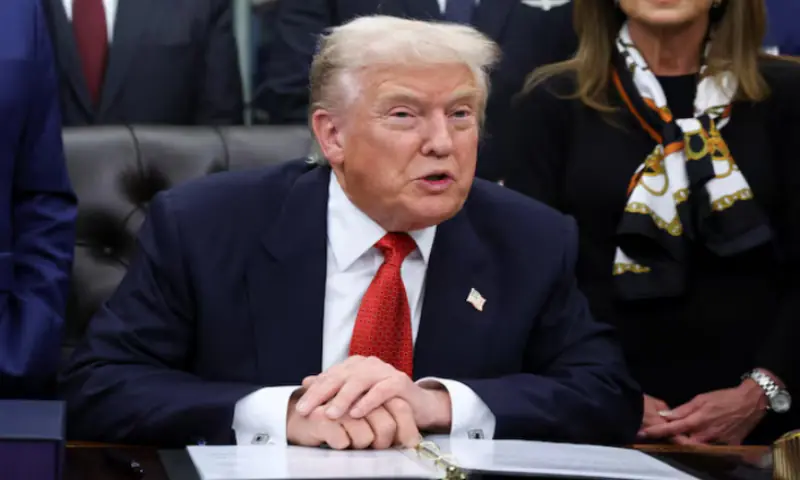
The United States will reassert its dominance in the Western Hemisphere, build military strength in the Indo-Pacific, and possibly reassess its relationship with Europe, President Donald Trump said on Saturday in a sweeping strategy document that seeks to reframe the country’s role in the world.
The National Security Strategy, released overnight, described Trump’s vision as one of “flexible realism” and argued that the US should revive the 19th-century Monroe Doctrine, which declared the Western Hemisphere to be Washington’s zone of influence.
It also warned that Europe faces “civilizational erasure” and must change course.
The document is the latest - and clearest - expression of Trump’s desire to shake up the post-World War Two order led by the United States and built on a network of alliances and multilateral groups, and redefine it through his “America First” lens.
“President Trump’s foreign policy is pragmatic without being ‘pragmatist,’ realistic without being ‘realist,’ principled without being ‘idealistic,’ muscular without being ‘hawkish,’ and restrained without being ‘dovish,’” the 29-page document says.
“It is motivated above all by what works for America.”
The paper, which is released by every new administration and guides the work of many government agencies, said Trump would “restore American preeminence” in the Western Hemisphere and put the region at the top of the administration’s foreign policy priorities.
“This ‘Trump Corollary’ to the Monroe Doctrine is a common-sense and potent restoration of American power and priorities, consistent with American security interests,” the document says, suggesting that the large US military build-up in the region is not temporary.
Since taking office in January, critics have said Trump’s rhetoric evokes modern-day imperialism in the Western Hemisphere.
He spoke early on, in vague terms, of retaking the Panama Canal and annexing Greenland and Canada.
More recently, the growing US military presence in the Caribbean and threats of land strikes in Venezuela and in other countries where drug cartels operate have added to concerns in a region where Washington has a troubled history of military interventions.
The United States has sent more than 10,000 troops to the Caribbean, along with an aircraft carrier, warships and fighter jets.
“The new National Security Strategy points out pretty clearly that we’re not going to go back to the way things were,” said Jason Marczak, a senior Latin America analyst with the Atlantic Council think-tank in Washington.
The document also alludes to China’s growing economic clout in Latin America, which has been of concern to successive US administrations, and the goal of countering that.
In Asia, the document said, Trump aims to deter conflict with China over Taiwan and the South China Sea by building up the US and its allies’ military power.
“Deterring a conflict over Taiwan, ideally by preserving military overmatch, is a priority,” according to the document.
The issue has been an irritant in US-China relations for years.
But Trump has a history of unconventional foreign policy moves, making it hard to predict how this formalisation of national security themes could translate into concrete actions.
For the latest news, follow us on Twitter @Aaj_Urdu. We are also on Facebook, Instagram and YouTube.










Comments are closed on this story.