


When India’s youth became cockroaches
7 min read



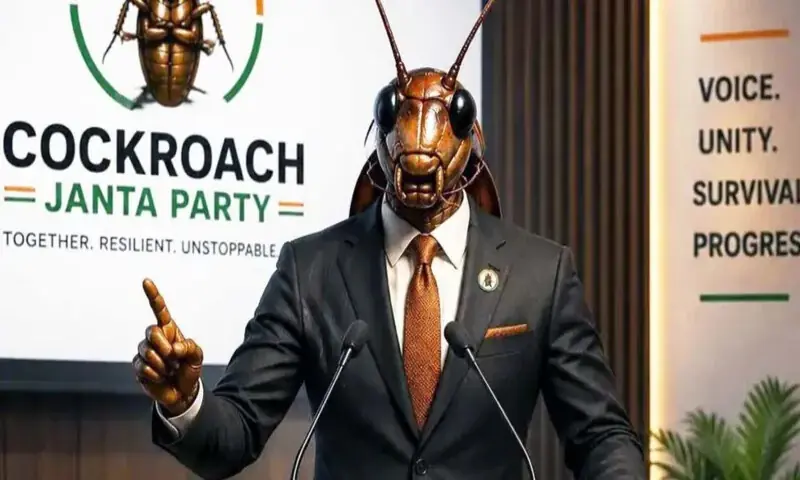
It started with an insult. On May 15, 2026, India’s Chief Justice Surya Kant was presiding over a Supreme Court hearing on a contempt petition related to senior advocate designations when he made a remark that would shake the country.
According to Outlook India, he said from the bench: “There are youngsters like cockroaches, who don’t get any employment and don’t have any place in the profession. Some of them become media, some of them become social media, some of them become RTI activists, some of them become other activists, and they start attacking everyone.”
The Chief Justice clarified the following day that his remarks were directed specifically at individuals who had entered professions using fake and bogus degrees, not at India’s youth in general.
He called young Indians “pillars of a developed India.”
India TV News reported that he subsequently told lawyers not to take his remarks “so sentimentally.”
For millions of young Indians, however, the clarification arrived too late. The wound was already open.
Within days, the Cockroach Janta Party was born.
A joke that became a mirror
Abhijeet Dipke, a 30-year-old political communications strategist, founded the Cockroach Janta Party (CJP) on May 16, a day after the Chief Justice’s remarks.
The name was a deliberate, satirical jab at the ruling Bharatiya Janata Party (BJP), and its logo, a cockroach on a mobile phone, wore the insult as a badge of honour.
Its self-declared mission is to be the “Voice of the Lazy and Unemployed.”
What happened next stunned even its founder.
In less than a week, the CJP amassed over 22 million Instagram followers, more than double the BJP’s own Instagram audience, which sits below nine million despite the party claiming to be the world’s largest political organisation.
Over 350,000 people signed up formally.
Volunteers took to the streets dressed in cockroach costumes for protests and clean-up drives.
A joke had become a phenomenon.
The CJP’s manifesto pulled no punches.
It called for cancelling the broadcast licences of media houses owned by Mukesh Ambani and Gautam Adani, two of India’s wealthiest industrialists widely perceived as being in the government’s corner, to, as the manifesto put it, “make way for a truly independent media.”
It was the language of satire, yes, but also the language of a generation that has stopped pretending everything is fine.
The world’s largest democracy and its smallest dreams
To understand why millions rallied behind a cockroach, you need to understand what daily life looks like for India’s Gen Z.
Urban youth unemployment in India stands at 14 per cent, nearly three times the national average of around 5 per cent.
For a country that produces millions of graduates every year and has long promised its young people that education is the ladder to prosperity, this is not a statistic. It is a broken contract.
The wounds go deeper. A survey by polling agency CVoter found that more than 60 per cent of Indians aged 18 to 24 feel anxious about their future.
Six in ten respondents said the CJP reflected real frustrations, over unemployment, over inflation, over the leaking of exam papers, including a national medical entrance test that directly affected some 2.3 million candidates.
Young people who had studied for years, who had sacrificed and scraped, found their futures compromised by corruption and incompetence at the highest levels.
This is the India that Modi’s economic narrative — of a rising Vishwaguru, a global power, a $5 trillion economy in the making — has left behind.
The skyline gets shinier; the ground floor gets harder. And when its own Chief Justice looks down at the unemployed youth scrambling on that ground floor and calls them cockroaches, something snaps.
Why the BJP felt the sting
The BJP did not invent India’s problems.
Unemployment, inequality and institutional decay have deep roots that predate Modi.
But after more than a decade in power nationally, and fresh off electoral victories in key states, the party cannot escape ownership of the present.
Power comes with accountability, and accountability is precisely what the CJP was demanding — loudly, irreverently and, crucially, in a language young people actually speak.
The BJP’s discomfort was visceral and telling.
Union Minister Sukanta Majumdar claimed, without credible evidence, that 49% of CJP followers were from Pakistan and only 9 per cent from India, a claim Dipke demolished by posting his own Instagram demographic data showing over 94 per cent of followers were Indian.
Senior BJP leader Kiren Rijiju dismissed the movement by pitying those who “seek social media followers from outside the country,” stopping just short of calling Indian youth anti-national.
Dipke responded sharply: “Why is a union minister labelling Indian youth as Pakistani?”
It is a familiar playbook. When the BJP cannot answer a question, it questions the questioner’s patriotism.
When citizens organise, they become foreign agents. When young Indians express frustration, they are told they are being manipulated by Pakistan, by the opposition, by shadowy foreign hands.
It is a tactic that has worked before. Whether it works on a generation raised online, fluent in irony and deeply suspicious of official narratives, is another matter.
The crackdown and what it reveals
Then came the harder edge of the state.
The CJP’s website was taken down. Its X account was withheld in India following what appears to have been a legal order.
Its Instagram account was compromised. Dipke said his family received threats.
The government has not confirmed any action.
But the Digital Freedom Foundation condemned the X account’s blocking as an arbitrary suppression of free speech.
And the sequence of events — rapid growth, viral manifesto, state shutdown — is a pattern Indians have seen before.
What makes this crackdown particularly indefensible is not just what was silenced, but how.
The CJP was not organising violence. It was not spreading disinformation. It was wielding satire, the oldest and most legitimate tool of political dissent, to hold a mirror up to power.
That the mirror made the government uncomfortable is not a reason to smash it. It is a reason to look harder.
A government confident in its record does not need to shut down satirical Instagram accounts.
A ruling party secure in the love of its people does not need to call those people Pakistani.
The BJP’s reaction to the CJP was not the response of a party wrongly accused.
It was the response of a party that recognised, in 22 million cockroaches, a reflection it could not afford to let others see.
The deeper rot
The BJP has long built its identity on cultural nationalism, Hindu pride and the promise of a strong, decisive leader who would restore India’s greatness.
For many, particularly in the early Modi years, that promise felt real. It generated genuine enthusiasm, genuine hope.
But ideology is not a substitute for governance. Cultural pride does not pay rent. National greatness does not employ graduates.
And when a government uses nationalism as a shield against accountability — when it brands every critic a traitor, every satirist a foreign agent, every unemployed young person a cockroach — it is not practising ideology. It is practising deflection.
The CJP’s manifesto, for all its satirical packaging, identified real targets: a captured media, a compromised judiciary, a political culture that treats the poor as props and the young as inconveniences.
These are not fringe concerns. They are structural. And no amount of Hindutva pageantry changes the fact that a 22-year-old with a degree and no job is not going to feel the glory of a rising civilisation.
Cockroaches survive
The CJP’s founder himself warned that the movement must move beyond social media to survive, that digital followings are fragile, and that real change requires ground-level organisation.
He is right. Viral moments are not revolutions. Twenty-two million Instagram followers do not automatically translate into votes, policy change or accountability.
But what the CJP has done, even if it fades tomorrow, is significant.
It has shown that India’s young people are not apathetic. They are not disengaged. They are not satisfied. They took an insult thrown at them by one of the country’s most powerful judges and turned it into a symbol of defiance that outpaced the ruling party’s own digital presence within a week.
There is a reason the cockroach has survived 300 million years.
It is not because it is loved. It is because it is resilient, adaptable and impossible to fully exterminate, no matter how many boots come down.
India’s Gen Z has chosen its symbol well.
The writer is a seasoned journalist covering the economy and international affairs.
For the latest news, follow us on Twitter @Aaj_Urdu. We are also on Facebook, Instagram and YouTube.














Comments are closed on this story.