


Gulf war batters India’s glass heartland, testing New Delhi’s manufacturing drive
4 min read



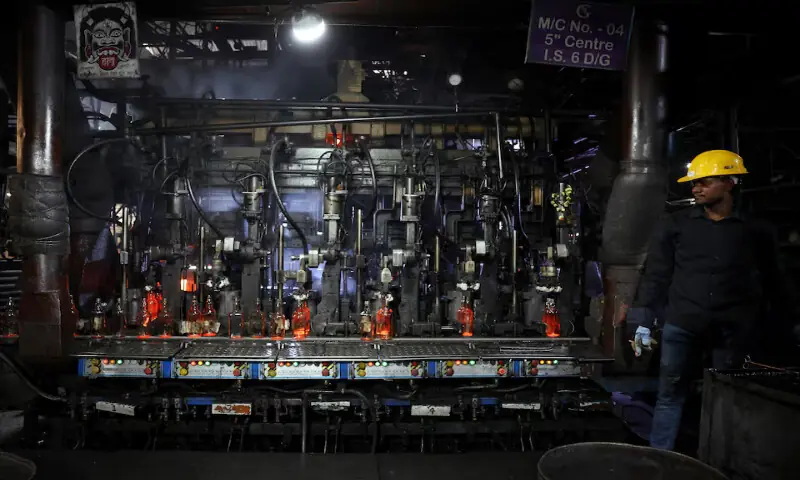
Famed as India’s “Glass City” with a four-century tradition of glassmaking, Firozabad’s furnaces are now burning low, putting thousands of day labourers out of work in what would normally be peak season.
The industry has been crippled by the war in the Middle East because of its intense energy needs.
Gas-fired heat chambers need to run constantly at above 1,000 degrees Celsius to keep the glass molten and prevent defects.
India’s heavy reliance on gas across the economy — businesses of all sizes, households, agriculture, public transport — makes its factories among the most vulnerable in Asia.
New Delhi stockpiles oil but not gas, and when supply dwindles, it cuts off industry first.
With the war extending into a second month, Firozabad may be a harbinger of what is to come throughout Indian manufacturing, from textiles to high tech, dealing a blow to India’s goal of increasing manufacturing’s share of the economy to 25% from around 17% currently.
HSBC’s India manufacturing flash PMI slumped to a four-and-a-half-year low in March as the Middle East conflict triggered instability in markets and uncertainty among consumers.
Shuttered shops, idle labourers
Just a short drive east of the Taj Mahal, Firozabad’s glassmaking furnaces sit mostly apart from the colourful marketplaces where tourists haggle over the city’s hallmark glass bangles, which typically sell for about a dollar a dozen.
Jobless labourers loitered near the kilns they would ordinarily be toiling over, scrolling on mobile phones.
Furnace operator Somesh Yadav said a unit that had employed more than 500 workers until last month now had jobs for fewer than 200.
Many smaller glass artisans had shuttered their shops as they waited for gas to become available and affordable.
Some 200,000 people work in Firozabad’s glassware industry, according to the Uttar Pradesh Glass Manufacturers’ Syndicate, rising to about 500,000 when including indirect workers such as vendors, sellers and suppliers of broken glass to factories.
“If the war drags on another month, our entire production season could be wiped out,” said Rajkumar Mittal, an official at the industry group.
The effect of the gas shortage isn’t linear.
Furnace operators say supply cuts of more than 20% since early March have knocked output down by 40%.
Crisis hits at peak season for exports
India’s glassware exports were on pace to rise some 3% in the financial year ended on March 31 from $4 billion in the previous period, but shipments tumbled as much as 20% last month, according to industry estimates.
Mukesh Kumar Bansal, a Firozabad manufacturer supplying retailers in the US and Europe, said output had dived by more than a third at his factory.
“Usually from March to August we ramp up for Christmas and Halloween orders,” he said.
“This year, not a single container has moved in March.”
That’s not solely the result of scarce gas and crimped production.
India — unlike Japan, South Korea and Taiwan — depends on Gulf shipping routes to move its products, and those routes have become prohibitively expensive as freight and insurance costs spike.
Nomura economist Sonal Varma called India “one of the most vulnerable countries in Asia to the blockade of the Strait of Hormuz”, and manufacturers across industries spoke of merchandise stranded in shipping containers at ports in Mumbai and elsewhere.
Bansal said the price of shipping a 40-foot container to Europe has soared more than 60% since the war began, while exports to Gulf nations have stalled completely.
Containers stranded
The United Arab Emirates is India’s biggest export destination after the US, taking mainly refined petroleum products, jewellery and engineering goods, a category that includes machinery, electrical equipment and auto parts.
The non-profit Association of Indian Entrepreneurs said that some 17% of more than 20 million small manufacturing and exporting units are facing sharp increases in energy, chemical and transport costs that threaten their survival.
“Thousands of units may struggle if conditions do not improve soon,“ said K.E. Raghunathan, the association’s chair.
“Hundreds of thousands of workers may have already lost jobs.”
Textile manufacturers at the opposite end of the country to Firozabad spoke of even steeper freight inflation.
Stiffenbabu Raju, managing director of Home Lines Textiles in Karur, which exports about $5 million worth of goods annually to Europe and the US, said charges for so-called high-cube containers have climbed to about $4,000 from around $1,200 a month ago.
As a result, his company’s shipments have fallen 20%.
“We have agreements with buyers, but they aren’t willing to accept the new rates, so all shipments are suspended,” he said.
“Right now, we are just going to absorb losses so we can keep our customers, and not think about profits.”
For the latest news, follow us on Twitter @Aaj_Urdu. We are also on Facebook, Instagram and YouTube.
















Comments are closed on this story.