


Dollar dips as court ruling upends US tariff wall
3 min read



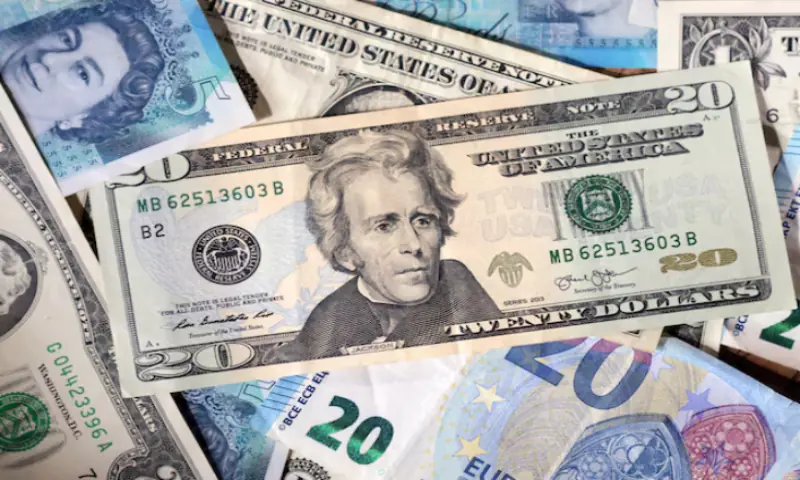
The dollar fell on Monday as traders took the US Supreme Court’s decision to strike down a slew of President Donald Trump’s tariffs as supportive for global growth, though confusion and risk of conflict with Iran kept moves cautious.
The euro was up 0.4% to $1.1820 and sterling rose by 0.3% to $1.3516 through the Asia session, which was lightened a little by a holiday in Japan and China’s Lunar New Year break. The dollar fell 0.4% to 154.40 yen .
The Supreme Court found on Friday Trump’s sweeping tariffs exceeded his authority. Trump has responded by lashing out at the court and imposing a blanket 15% levy on imports, as well as insisting that higher-tariff deals with trade partners should stay.
“It weakens the dollar in the sense that it potentially benefits non-US growth,” said Sim Moh Siong, currency strategist at OCBC Bank in Singapore.
He said longer-run foreign exchange implications were less clear, with a hit to US revenues potentially negative for the fiscal position and the dollar, while a check on Trump’s power may be a positive, by limiting a source of policy volatility.
The New Zealand dollar was a little higher at just shy of 60 cents, while the Aussie dipped a little as the US had previously imposed only a 10% tariff on Australian goods, leaving it at $0.7070.
The safe-haven Swiss franc jumped 0.5% to 0.7727 francs per dollar.
“This decision is another chip away at Trump’s power … so that’s a positive for markets,” said Jason Wong, strategist at BNZ in Wellington.
“But there are so many factors, there are all these moving parts, it’s not tradable.”
Besides tariffs, markets have an eye on a US military buildup in the Middle East as it pressures Iran to drop pursuit of nuclear weapons, and are looking ahead to Trump’s State of the Union address Tuesday.
TRUMP CONSTRAINED
Trump’s replacement levies run for 150 days, and it is not clear if the US owes importers refunds on duties already paid, with the Supreme Court making no ruling on that issue.
Analysts expect years of litigation and another bout of activity-crimping confusion while Trump seeks other means to replace the raft of global tariffs more permanently.
“It does reflect on the fact that the administration’s strategy to raise revenue is built on sources that could face significant uncertainty, while the propensity to spend continues to be high,” said Tai Hui, Asia-Pacific chief strategist at J.P. Morgan Asset Management.
“So this could keep bond investors on the lookout regarding fiscal discipline.”
The European Commission demanded on Sunday that the US stick to a deal reached last year with the EU, which includes zero tariffs on some products such as aircraft and spare parts.
US trading partners in Asia were cautiously weighing fresh uncertainties, as were investors who have already been wrong-footed by markets’ responses to Trump’s trade levies, which have incidentally failed to close the US trade deficit.
In the lead-up to Trump’s election, investors had bet on tariffs lifting the dollar, assuming the rest of the world would try to weaken their currencies to offset a hit to exports.
But through 2025, the dollar fell - the dollar index dropped more than 9% - as markets ended up focusing instead on anticipating interest rate cuts, worrying about the US fiscal deficit and Trump’s unnerving policy swerves.
“The key issue … is that the Trump administration will be much more constrained in their ability to use tariffs in general,” ANZ’s group chief economist Richard Yetsenga said on the bank’s podcast.
“I don’t think this will change too much about the global economy.”
For the latest news, follow us on Twitter @Aaj_Urdu. We are also on Facebook, Instagram and YouTube.















Comments are closed on this story.