


Economists, policymakers call for structural reforms at KLF
2 min read

Pakistan’s leading economists, policymakers and business leaders on Saturday called for deep structural reforms, fiscal discipline and policy continuity to reset the country’s economy, warning that tactical fixes would no longer work.
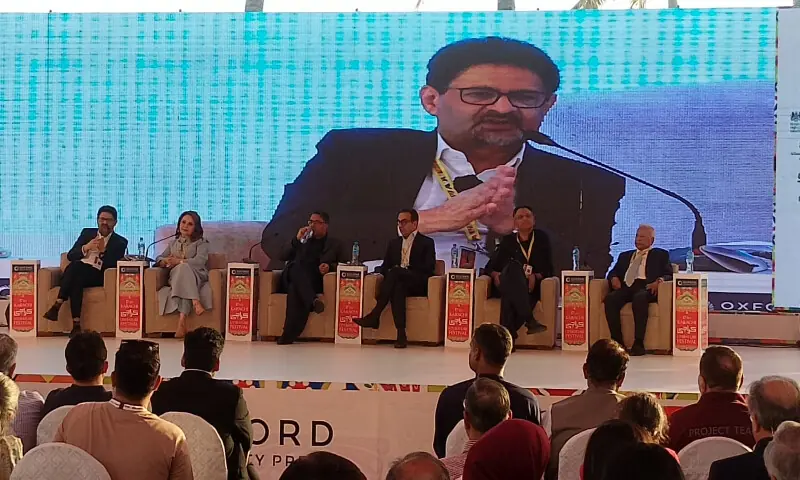
The discussion, titled “Fixing the Fundamentals: Pakistan’s Economic Reset,” was held during the 17th Karachi Literature Festival (KLF) at the Beach Luxury Hotel.
The panel brought together Adviser to the Prime Minister on Privatisation Muhammad Ali, former finance ministers Asad Umar and Miftah Ismail, economist and former State Bank governor Dr Ishrat Husain, and Pakistan Business Council Chairperson Zeelaf Munir. Former investment minister Muhammad Azfar Ahsan moderated the session.
The panel focused on weak macroeconomic fundamentals, fiscal imbalances, privatisation, investment climate reforms and the need to restore institutional credibility.
Muhammad Ali said Pakistan’s economic problems could not be solved through short-term measures. He stressed the need for structural reforms, better documentation of the economy to address taxation, a reduced government footprint, higher exports, greater participation of women in the workforce, smaller provinces and empowered local governments.
Asad Umar said resetting the economy required a fundamental change in economic and industrial structures. He argued that Pakistan was not producing what global markets demanded and said reducing the size of the state was more critical than privatisation alone. He also linked sustainable growth to fair competition and an effective democratic system.
Miftah Ismail said economic growth depended on a secure environment, adding that lasting progress would remain elusive without the complete eradication of terrorism.
Dr Ishrat Husain warned that Pakistan had become overly dependent on raw materials and imports. He called for investment in sectors such as steel, petrochemicals, pharmaceuticals and lithium batteries, and urged a shift towards services-led growth.
Zeelaf Munir said forums like KLF allowed more honest debate. She emphasised trust, transparency and accountability as core elements of fixing economic fundamentals.
In his opening remarks, Azfar Ahsan said Pakistan needed to confront economic realities honestly and adopt a long-term policy framework, cautioning against ad hoc decision-making.
Panellists broadly agreed on the need for consensus-driven reforms, export-led growth, better governance of state-owned enterprises and sustained policy continuity to put Pakistan on a more stable and inclusive growth path. The session drew a large and engaged audience.
The event was presented in collaboration with Oxford University Press, with the Government of Sindh as the title sponsor. Now in its 17th edition, the Karachi Literature Festival continues to serve as a key platform for dialogue on literature, culture, public policy and national development.
For the latest news, follow us on Twitter @Aaj_Urdu. We are also on Facebook, Instagram and YouTube.







Comments are closed on this story.