


Passengers delighted to ride UAE's first ever passenger train
3 min read



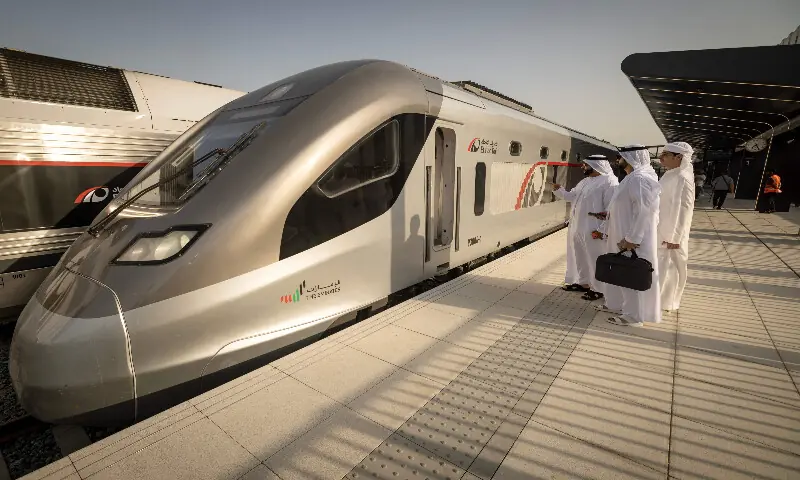
It’s 7:13 am on a sultry June morning, and a passenger train pulls into the station in Abu Dhabi, oil-rich capital of the United Arab Emirates. An unremarkable scene in many cities, but here, the first of its kind.
The UAE’s inaugural passenger service, from sleepy Fujairah, carried enthusiastic travellers who watched Thursday’s sun rise as they sped across the desert, relaxing on brand-new upholstery.
“We got to see landscapes you do not usually see from the road, some things you don’t really see from the road trips and cars,” said Gunjan Chaurasia, 42, who drove more than 100 kilometres (60 miles) from Dubai to Fujairah to be among the first passengers.
In a country whose flashy infrastructure includes the Burj Khalifa, the world’s tallest building, and the busiest airport by international traffic in Dubai, the slow arrival of passenger trains is a curiosity.
The UAE has well-advanced plans to launch flying taxis, and Dubai, its commercial hub, is working with Elon Musk’s Boring Company to build Dubai Loop, a high-speed underground transport network.
Yet the humble passenger train remains unusual in the Gulf. The UAE’s Etihad Rail is just the second intercity service in the wealthy region, after Saudi Arabia.
A rail network linking the Gulf countries was announced nearly 20 years ago. But in a region whose royal rulers do not always rub along, it has yet to become reality.
National cohesion
Rawdha, from Fujairah, which has a port and small beach resorts on the UAE’s eastern Gulf of Oman coast, was excited by the possibilities of the UAE’s Etihad Rail.
“For us in Fujairah, the journey used to be very long,” she said after the 1hr 40min journey. The trip takes about an hour longer by car.
“Now Abu Dhabi and the other areas are much closer to us, and it no longer feels like such a long or difficult trip as it did before.”
Further routes will follow: nine more stations are due to open by the end of next year, including one in Dubai.
The diesel-powered train has a maximum speed of 200 kilometres (124 miles) per hour, and the stations remain a drive away from city centres.
In a country of cheap petrol and abundant six-lane highways, the railway is not a clear alternative to the ubiquitous car.
Etihad Rail is also working on a high-speed electric train project linking Abu Dhabi and Dubai, which is scheduled to enter service in a few years.
And the national network is presented as a way to more closely unite the UAE’s seven emirates, some of them overlooked compared to Abu Dhabi and Dubai.
“This is a historic moment for the Emirates,” says Athraa Al Mansoori, executive director for commercial and support at Etihad Rail Mobility.
“It will transform the way cities are designed and how residents get around.”
The project’s economic benefits could top 90 billion dirhams ($24.5 billion) over the next 50 years, she said.
Back on track?
The UAE’s roughly 900 kilometres of railway was previously used only for freight transport, and proved a strategic advantage during the Middle East war.
Faced with Iran’s blockade of the Strait of Hormuz, some goods were redirected through Fujairah, which sits beyond the narrow waterway on the Indian Ocean.
The train lines were originally meant to be part of a regional network more than 2,000 kilometres long taking people and goods between Saudi Arabia, the UAE, Qatar, Kuwait, Bahrain and Oman.
But so far, only the section linking the UAE to Sohar, a port in northern Oman, is under construction.
Pan-Gulf projects are likely to keep running up against regional rivalries, particularly between the UAE and Saudi Arabia, who fell out publicly over an insurgency in Yemen at the turn of the year.
“The most important factor in completing this (regional rail) project has been institutional will,” said Samriddhi Vij, associate fellow at the Dubai-based ORF Middle East think-tank.
“A domestic launch signals confidence and demonstration of this will.”
For the latest news, follow us on Twitter @Aaj_Urdu. We are also on Facebook, Instagram and YouTube.














Comments are closed on this story.