


Any conflict over Taiwan would risk US-China nuclear escalation, study finds
3 min read


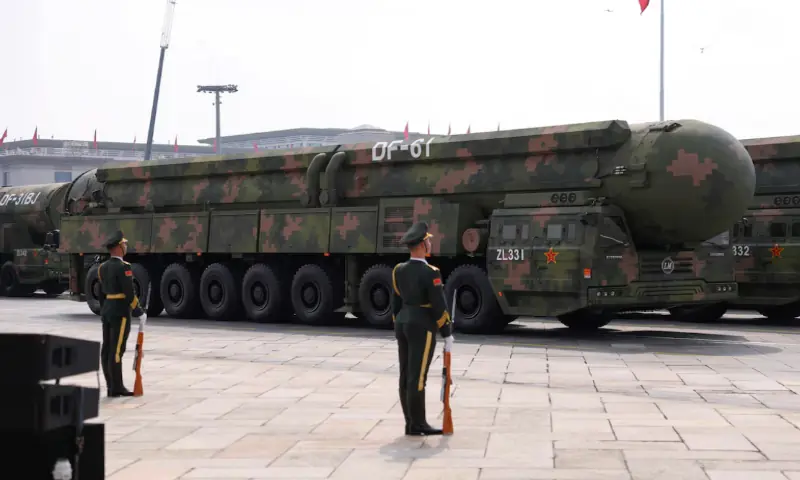
A conflict between the US and China over Taiwan would risk a nuclear escalation with both militaries likely to stage sweeping operations targeting rival command and communications hubs, a leading defence research centre said on Thursday.
In a strategic assessment ahead of Asia’s biggest annual defence meeting in Singapore this weekend, the London-based International Institute for Strategic Studies (IISS) said the world was on the cusp of a new nuclear arms race “with the Asia-Pacific at its core”.
“Regional states and those with strategic interests are expanding their nuclear arsenals, while non-nuclear weapons states pursue long-range conventional-strike capabilities: both challenging strategic stability,” the IISS assessment said.
Taiwan, along with the conflict in Iran and uncertainties about US commitments to the region, are expected to surface prominently at the IISS’ Shangri-La Dialogue.
The informal conference runs from May 29 to 31, drawing an eclectic mix of ministers, generals, intelligence chiefs, diplomats, analysts and weapons makers.
The event follows a summit between Chinese President Xi Jinping and his US counterpart Donald Trump in Beijing earlier this month, which led to some concern in Taipei about the US commitment to help the democratically ruled island defend itself.
Beijing has never ruled out the use of force to take control of Taiwan, but has also said it would prefer “peaceful reunification”. Taiwan’s government rejects Beijing’s sovereignty claims.
China has ramped up pressure on Taiwan by increasing its military presence around the island, keeping Taipei on high alert for further Chinese moves following the summit.
Lack of guardrails
Trump’s Defence Secretary Pete Hegseth will be speaking at the Singapore conference on Saturday. China has yet to confirm that its Defence Minister Dong Jun will be attending.
The 156-page IISS assessment examines evolving military doctrines across the region as well as how a conflict over Taiwan might play out.
While US and Chinese forces had different aims in a Taiwan scenario - the Chinese to keep the US and its allies at bay while the US bolsters Taiwan’s resilience - the two sides could be expected to launch vast operations across military domains.
“Conflict with China would risk escalation, potentially to a nuclear level, given the strategic importance of Taiwan to Beijing,” the document says.
“There is currently little public evidence to suggest that both militaries understand the necessary guardrails to prevent, or rules of engagement that would restrict, both sides potentially targeting each other’s key command, control, communications, computers, intelligence, surveillance and reconnaissance nodes,” the assessment says.
“The prospect of nuclear escalation will thus continue to loom large in a major US-China conflict.”
While both the US and Russian nuclear arsenals still dwarf China’s stockpiles, US officials and arms control analysts say China is expanding and improving its atomic weapons capabilities faster than any other nuclear power.
A Pentagon report released in December said China was on track to field 1,000 warheads by 2030.
The Federation of American Scientists estimates that Russia and the US field 4,400 and 3,700 active warheads, respectively, while China has 620.
For the latest news, follow us on Twitter @Aaj_Urdu. We are also on Facebook, Instagram and YouTube.








Comments are closed on this story.