


SpaceX's Starship flight hits most targets in pre-IPO test
5 min read


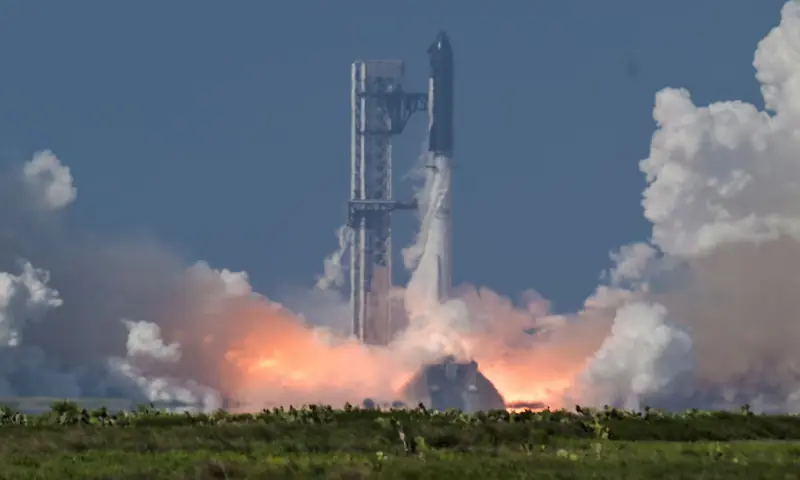
SpaceX completed a largely successful test flight of its next-generation Starship rocket on Friday, deploying a clutch of mock satellites and executing a controlled splashdown in the Indian Ocean in a high-stakes debut of the newly upgraded vehicle as Elon Musk’s company prepares to go public.
The latest uncrewed launch of Starship — designed to enable more frequent Starlink satellite launches and to send future NASA missions to the moon — achieved a key milestone for the vehicle following months of testing delays.
The outcome could also boost investor confidence ahead of SpaceX’s initial public offering next month, expected to be the largest in history.
Starship, which SpaceX has spent more than $15 billion developing as a fully reusable spacecraft, is critical to Musk’s goals of cutting launch costs, expanding his Starlink business and pursuing ambitions ranging from deep-space exploration to orbital data centres — all factored into his targeted $1.75 trillion IPO valuation.
Friday’s launch marked SpaceX’s 12th test flight of a Starship prototype since 2023 and the first of its V3 iteration, a major upgrade of both the cruise vessel and its Super Heavy booster, as well as the first blast-off from a launch pad specially designed for the new rocket.
‘Meaningful step forward’
SpaceX was counting on a successful test flight to reinforce its case that the largest and most powerful rocket ever flown is nearing commercial readiness after years of explosive setbacks and development delays.
Friday’s test appeared to have achieved most of its major objectives.
The towering vehicle, consisting of the upper-stage Starship astronaut vessel stacked atop a Super Heavy booster rocket, blasted off around 5:30pm CT from SpaceX facilities in Starbase, Texas, on the Gulf of Mexico near Brownsville.
Minutes later, the two stages cleanly separated, leaving the Starship vehicle to soar on to its cruise phase despite the loss of one of its six engines, then release its simulated satellite payload before surviving a fiery atmospheric re-entry and splashdown. Its flight lasted just over an hour in all.
The lower-stage Super Heavy came down separately in the Gulf about six minutes after blast-off, as expected, but the booster rocket failed to complete a planned boost-back burn of its engines after separating from Starship.
Musk welcomed the outcome with a message posted to his X platform, congratulating his “SpaceX team on an epic first Starship V3 launch & landing!”
Kathleen Curlee, a research analyst at Georgetown University’s Centre for Security and Emerging Technology, hailed the flight as “another meaningful step forward in SpaceX’s broader strategy of building the launch capacity needed to support the company’s expanding ambitions in space.”
Although the flight encountered “some anomalies,” Curlee said, “the test appears to have achieved several key objectives and will provide SpaceX with significant operational and engineering data moving forward.”
A live SpaceX webcast of the liftoff showed the rocketship, more than 40 stories tall, climbing from the launch tower as the Super Heavy’s cluster of 33 Raptor engines thundered to life in a ball of flames and billowing clouds of vapour and exhaust.
The test ended about 65 minutes later when the Starship vehicle blazed through Earth’s atmosphere and landed in the Indian Ocean, nose up as planned, before keeling over in the sea and exploding in a fireball, to the raucous cheers of SpaceX employees who gathered to watch the flight webcast.
SpaceX said before the launch it would not attempt a safe return landing or recovery of either the booster or the Starship upper stage, even if all else went as planned.
During its suborbital cruise phase, Starship successfully released its payload of 20 mock Starlink satellites one by one, plus two actual modified satellites that scanned the spacecraft’s heat shield and transmitted data back to operators on the ground during the vehicle’s descent.
Given the failure of one of Starship’s six engines early in the flight, mission controllers opted not to attempt a planned in-space engine re-ignition before re-entry.
But the vehicle did execute a return-landing burn at the very end of its flight, along with several manoeuvres deliberately intended to place the spacecraft under maximum stress. Starship completed those moves intact for its controlled final descent.
Investor scrutiny ahead of IPO
Test flight 12 in the Starship campaign was being closely watched by investors three weeks ahead of the initial public offering, which could become the first US market debut above $1 trillion and immediately transform SpaceX into one of the world’s most valuable publicly traded companies.
The future of SpaceX’s most lucrative businesses, centred on its Starlink operation and plans for orbital data centres, hinges largely on Starship getting them to space.
While Musk has publicly taken previous test-flight setbacks in stride, it remains to be seen how investors reconcile the billionaire entrepreneur’s appetite for short-term risk-taking with his longer-term aspirations for lunar and interplanetary space travel.
SpaceX’s engineering culture, considered more risk-tolerant than many of the aerospace industry’s more established players, is built on a flight-testing strategy that pushes newly developed spacecraft to the point of failure, then fine-tunes improvements through frequent repetition.
Musk, who founded his California-based rocket company in 2002, said one year ago that he foresaw Starship making its first uncrewed voyage to Mars at the end of 2026, a goal now clearly beyond reach.
The V3 features a host of upgrades designed to perfect the vehicle’s functionality for missions beyond the low-Earth orbit realm of SpaceX’s current workhorse launch system, consisting of a Falcon 9 or Falcon Heavy rocket booster with a Dragon capsule.
One of the principal improvements to the Super Heavy booster is a revamping of its Raptor engines to produce greater thrust from a design that weighs significantly less.
The propulsion system of the upper-stage Starship likewise has been refined for long-duration missions, with mechanisms to allow for ship-to-ship docking, refuelling in space and increased manoeuvrability.
Multiple Starship tanker vessels would be required to conduct the in-orbit refuelling operation — a risky and unproven procedure required under SpaceX’s strategy for its first lunar-landing mission, planned for 2028.
All of that was incorporated into the $3 billion-plus contract SpaceX won in 2021 under NASA’s Artemis programme, the US effort to return astronauts to the surface of the moon later this decade for the first time since 1972.
Those plans put Starship at the centre of a new space race with China, which aims for a crewed lunar landing of its own in 2030.
For the latest news, follow us on Twitter @Aaj_Urdu. We are also on Facebook, Instagram and YouTube.
















Comments are closed on this story.