


No one can threaten Pakistan, says DG ISPR
4 min read


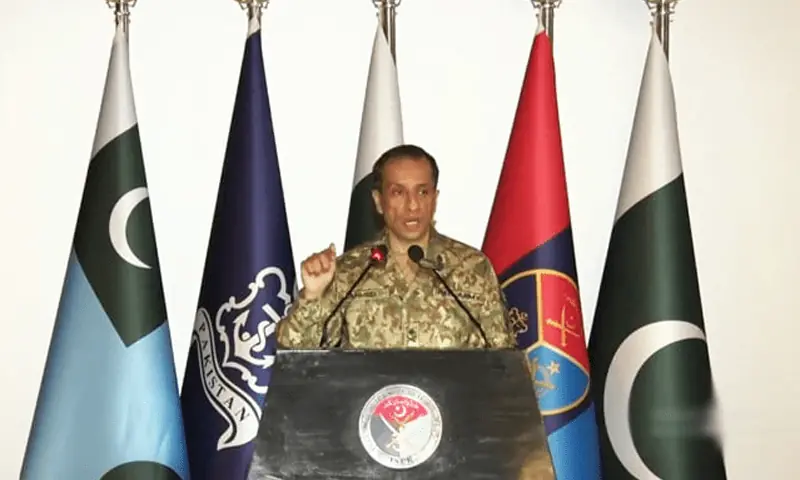
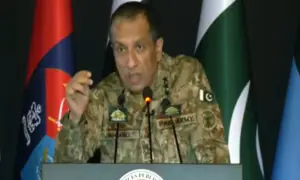
Inter-Services Public Relations (ISPR) Director General Lt-Gen Ahmed Sharif Chaudhry has said that the country’s armed forces had lived up to the nation’s expectations and defeated a numerically superior enemy through multi-domain operations during last year’s Marka-e-Haq.
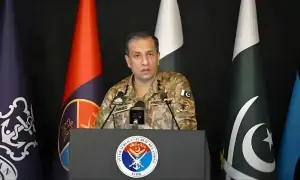
Lt-Gen Chaudhry was speaking at a press conference on Thursday alongside senior officers of the Pakistan Air Force (PAF) and Navy to mark the first anniversary of Marka-e-Haq, the military operation in which Pakistan decisively repelled Indian aggression.
Addressing the media, Lt-Gen Chaudhry congratulated the nation on the triumph, saying that “by the grace and blessings of Allah, our armed forces have once again lived up to the aspirations of the nation, defeating a numerically superior enemy on all fronts and humbling its arrogance.”
He described the operation as a multi-domain campaign in which Pakistan demonstrated its capability across land, air, sea, cyber, and psychological warfare.
“The events of Marka-e-Haq are known not only to Pakistanis but also to the children of India — though they refuse to acknowledge it,” he said.
Strong message to India
Lt-Gen Chaudhry sharply criticised India’s military and political leadership, saying that what was once considered a professional military has now become politicised.
“India’s politicians appear less like statesmen and more like warmongers,” he said.
He warned that Pakistan is ready to confront any aggression, conventional or unconventional, with full force.
The ISPR chief also condemned India’s self-presentation as a “global net-security provider,” calling it instead “the world’s largest terrorist,” responsible for grave atrocities in occupied Kashmir.
He accused New Delhi of falsely blaming Pakistan for terrorism while continuing to use proxies and secret operations to pursue political objectives.
Unresolved questions about Pahalgam
Highlighting the Pahalgam incident, Lt-Gen Chaudhry noted that a year has passed, yet the questions raised by Pakistan remain unanswered.
“Who carried out these acts? Which terrorist camps were targeted? India must provide answers,” he said.
He reaffirmed that Kashmir is an internationally recognised disputed territory and that the voices of its people cannot be suppressed.
Unity and resilience of Pakistan
The ISPR chief emphasised that the success of Marka-e-Haq demonstrates that numerical superiority means nothing when faced with faith, professionalism, and unity.
He praised the joint efforts of the Army, Air Force, and Navy as a symbol of institutional cohesion in defending the homeland.
He warned that modern warfare now reaches neighbourhoods and minds, asserting bluntly: “No one can even think of threatening Pakistan.”
He also cautioned that a full-scale war between two nuclear powers is unimaginable, and anyone who believes otherwise is mistaken.
Lt-Gen Chaudhry stressed that the nation and armed forces remain united like “a wall of steel,” and that Indian attempts to use proxies and subversive tactics were thwarted by Pakistani resolve.
“Marka-e-Haq proved that the enemy’s aggression is met with strength and unwavering national solidarity,” he said.
He urged India to acknowledge the truth and respect international law, reiterating that Pakistan will not allow oppression in Kashmir to continue and that its forces will always safeguard the nation’s sovereignty and dignity.
Navy remained prepared to counter aggression
Deputy Chief of Naval Staff, Rear Admiral Ali, speaking during the briefing, said the Pakistan Navy had remained fully prepared during the conflict and closely monitored Indian naval movements in the Arabian Sea.
He claimed India had attempted several times to deploy the aircraft carrier INS Vikrant to increase pressure on Pakistan, but the Pakistan Navy had safeguarded maritime routes and remained ready to respond.
“We were fully prepared to sink Vikrant, and the enemy knew that crossing the line would come at a heavy price,” he said.
The naval official added that strong coordination among the armed forces had neutralised India’s numerical advantage.
PAF claims ‘0-8’ score in aerial combat
Meanwhile, the Deputy Air Chief of the Pakistan Air Force, Air Vice Marshal Ghazi, claimed Pakistan maintained air superiority during Marka-e-Haq and said the aerial combat score remained “0-8” in Pakistan’s favour.
“Our score in Marka-e-Haq remained 0-8. Pakistan suffered no losses while eight Indian aircraft were shot down,” he said.
According to the official, Pakistan’s cyber capabilities provided timely intelligence and disrupted Indian satellite systems during the conflict.
He claimed that four Rafale fighter jets, one Su-30 aircraft, one MiG aircraft and one Mirage aircraft were destroyed, along with a multi-role aerial system and two S-400 missile defence batteries.
The Deputy Air Chief said J-10, JF-17 and F-16 fighter jets remained on high alert throughout the operation and prevented Indian aircraft from entering Pakistani airspace.
He added that Pakistan’s response had delivered a “memorable lesson” to the Indian Air Force.
“I can tell you much more, but let some things remain so that we can surprise the enemy next time,” he said
For the latest news, follow us on Twitter @Aaj_Urdu. We are also on Facebook, Instagram and YouTube.









Comments are closed on this story.