


Pakistan reaffirms commitment to Middle East peace through dialogue
4 min read

Pakistan on Thursday reiterated its commitment to promoting peace and stability in the Middle East and the Persian Gulf region, saying that its diplomatic objective remained “unwavering and unambiguous” to achieve peace and stability through mediation and dialogue.
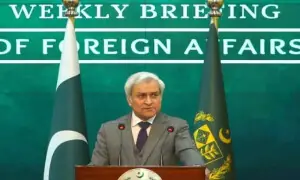
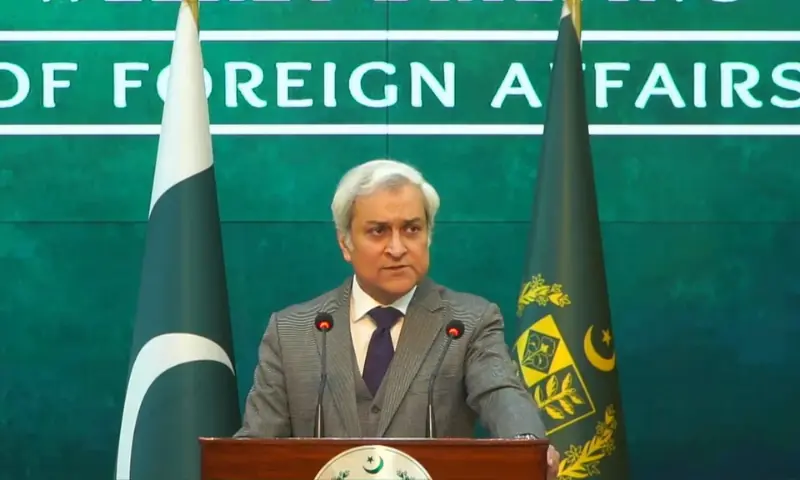
Foreign Office spokesperson Tahir Andrabi, in a weekly briefing, said that Prime Minister Shehbaz Sharif had already conveyed his readiness to play a constructive role by facilitating or hosting talks to de-escalate tensions.
He urged all the concerned not to speculate about unverified reports about the talks. “Details regarding the time and venue of any potential dialogue will be shared once finalised”, he added.
He said Pakistan fully supported dialogue aimed at reducing regional tensions and emphasised that the country had consistently advocated peace and stability.
He highlighted that Prime Minister Shehbaz Sharif was personally leading diplomatic outreach efforts and had engaged with a wider international audience. “Deputy Prime Minister and Foreign Minister Ishaq Dar has also been in contact with his counterparts,” he added.
The spokesperson stressed that diplomacy required confidentiality and patience, urging all parties, particularly the media, to act responsibly and avoid reporting unverified information.
He said Pakistan had actively engaged with the regional actors to de-escalate the current situation in the Middle East and the Persian Gulf, cease hostilities, and move towards a peaceful settlement.
“Prime Minister Muhammad Shehbaz Sharif spearheaded the country’s diplomatic efforts for negotiations and dialogue between the relevant parties,” the spokesperson said.
Giving the details of the prime minister’s recent engagements with the regional leaders on the issue, the spokesperson said that the prime minister spoke with the Muslim leaders including Crown Prince of Saudi Arabia Mohammad bin Salman, President of Iran, Dr. Masoud Pezeshkian, Crown Prince of Kuwait Sheikh Sabah Al-Khaled Al-Sabah, President Recep Tayyip Erdogan of Turkiye, King Abdullah II ibn Al-Hussein of Jordan, President Ilham Aliyev of Azerbaijan, Prime Minister Datuk Seri Anwar Ibrahim of Malaysia, President Shavkat Mirziyoyev of Uzbekistan, President Abdel Fattah El-Sisi of Egypt, Prime Minister of Bangladesh, Prime Minister Nawaf Salam of Lebanon, King Hamad bin Isa Al Khalifa of Bahrain, and President Prabowo Subianto of Indonesia.
During his conversations, the prime minister discussed the grave situation in the Gulf region, emphasising the urgent need for de-escalation, dialogue, and diplomacy. He also highlighted the importance of unity within the Ummah and reaffirmed Pakistan’s commitment to playing a constructive role in advancing regional peace.
Likewise, he said that Deputy Prime Minister and Foreign Minister Ishaq Dar also undertook intense diplomatic engagement throughout the week.
“On 18th March, the Deputy Prime Minister and Foreign Minister visited Riyadh at the invitation of the Saudi Foreign Minister to attend a meeting of the Regional Foreign Ministers. The meeting included ministers from Azerbaijan, Bahrain, Egypt, Jordan, Kuwait, Lebanon, Qatar, Syria, Turkey, and the UAE,” he added.
Responding to a query, he said that Saudi Arabia was a major party to the conflict, as it had also been targeted by attacks. “Pakistan’s efforts in this regard are being carried out in close coordination with Saudi Arabia.”
On Afghanistan, the spokesperson clarified that the pause in Operation Ghazab lil Haq ended on March 24 and the operation had continued. He stated that the operation would persist as long as the Afghan Taliban support the TTP and militants use Afghan soil against Pakistan.
To another question, he pointed out that Pakistan had explored all avenues for peace and dialogue with the Afghan authorities, but those efforts failed, leaving no option but to initiate the operation. The spokesperson noted that terrorist activities from Afghanistan had significantly decreased since the operation began.
To another question, the spokesperson called upon India to immediately release Kashmiri women leaders Asiya Andrabi, Fehmeeda Sofi, and Nahida Nasreen, terming their sentences politically motivated and an act of revenge.
Strongly condemning the verdicts handed down by an Indian special court earlier this week, he said Asiya Andrabi was sentenced to life imprisonment, while Fehmeeda Sofi and Nahida Nasreen received 30-year prison terms under the Unlawful Activities (Prevention) Act (UAPA).
Similarly, the spokesperson also strongly condemned the continued closure of the historic Jama Masjid in Srinagar. Noting that preventing worshippers from offering congregational prayers constitutes a serious violation of religious freedoms and fundamental human rights.
As regards the International Day to Combat Islamophobia, the spokesperson said that Pakistan played a key role with the OIC in securing the United Nations designation of 15th March as the International Day to Combat Islamophobia and supported the appointment of a United Nations and OIC Special Envoy to address the challenges emanating from Islamophobia.
In his message on the occasion, he said the DPM/FM reaffirmed solidarity with the Muslims worldwide, highlighting the rise of Islamophobia globally, including attacks on mosques, women and holy texts.
For the latest news, follow us on Twitter @Aaj_Urdu. We are also on Facebook, Instagram and YouTube.








Comments are closed on this story.