


Iran’s cluster warhead missiles pose new security challenge for Israel
2 min read



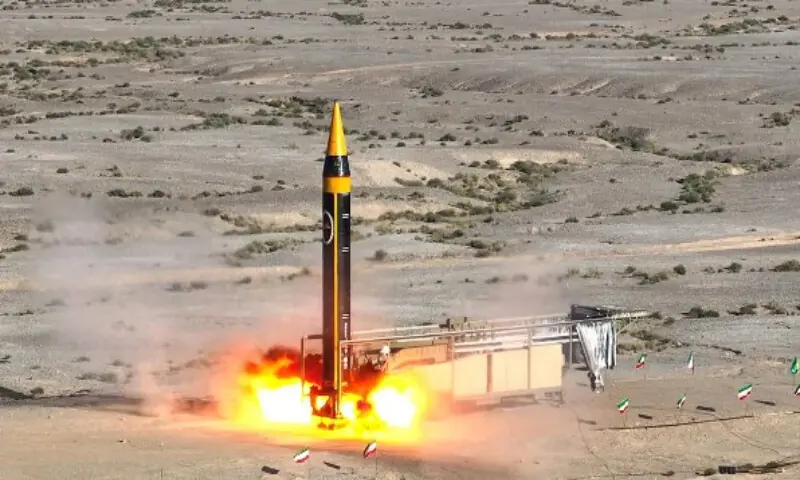
Israeli military officials are facing new security concerns over Iran’s reported use of cluster warhead missiles, which can disperse multiple explosive sub-munitions before reaching their target.
According to a report by Bloomberg, some Iranian ballistic missiles release dozens of smaller explosives mid-air, significantly widening the potential damage area and allowing a single strike to affect multiple locations simultaneously.
Israeli military officials say the missiles climb to a high altitude before their warheads split, scattering numerous bomblets in different directions. These smaller explosives fall to the ground and detonate, creating several blasts across a wide area.
The report noted that the bomblets appear in the night sky like glowing orange particles before landing at separate points, often triggering multiple explosions at once.
Israeli military sources estimate that nearly half of the ballistic missiles fired by Iran during the current escalation may be equipped with cluster munitions. Officials warn that the dispersal of dozens of smaller explosives from a single missile raises the risk of casualties.
Defence systems may also find it harder to intercept them, as the sub-munitions are smaller and travel at high speeds.
Security experts say the tactic could be aimed at overwhelming Israel’s missile defence network while forcing it to use large numbers of costly interceptors. Such a strategy could increase both financial and psychological pressure on Israel.
Reports suggest some Iranian ballistic missiles can carry around 24 sub-munitions, while the more powerful Khorramshahr missile is capable of carrying significantly more. Each bomblet reportedly contains several pounds of explosive material capable of causing severe damage upon impact.
Human rights organisations have also expressed concerns over the use of such weapons. Amnesty International has previously warned that cluster munitions are considered indiscriminate due to their wide dispersal pattern and are banned under international humanitarian law when used in populated areas.
Amid the threat, the Israeli military has advised civilians to immediately seek shelter when missile sirens sound and remain inside for several minutes even after the alarms stop, as some sub-munitions may fall with a delay.
The use of different missile tactics during the escalating confrontation between Iran and Israel has further heightened security concerns across the Middle East, with the international community closely monitoring the situation.
For the latest news, follow us on Twitter @Aaj_Urdu. We are also on Facebook, Instagram and YouTube.















Comments are closed on this story.