


Sindh cabinet approves Rs33.7bn to modernise firefighting infrastructure
6 min read

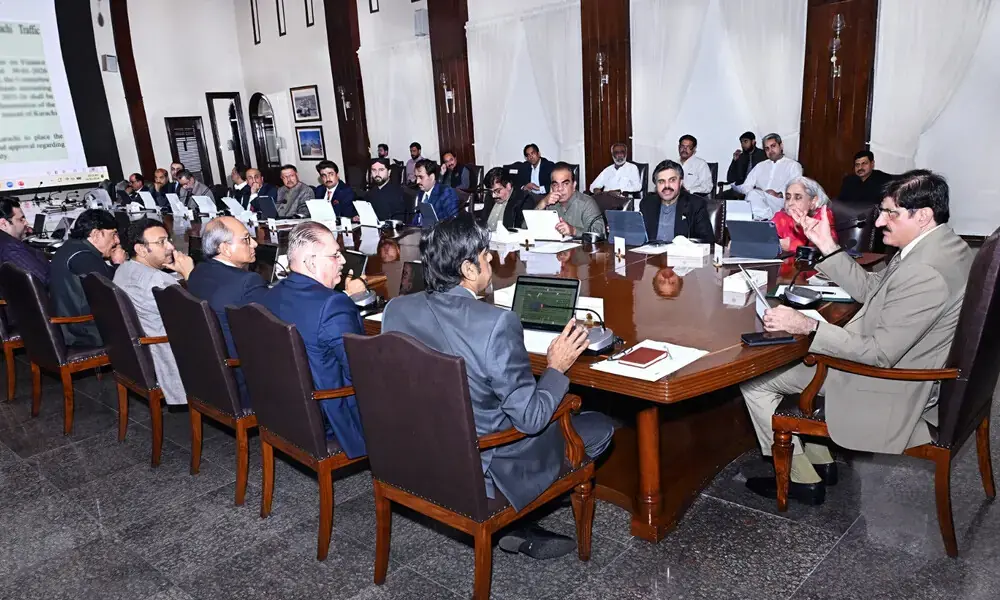
Sindh Chief Minister Syed Murad Ali Shah, chairing a provincial cabinet meeting, approved a Rs33.7 billion package on Tuesday to modernise the province’s firefighting and emergency response system and introduce a new Early Warning Public Alert System.
The meeting, held at the CM House, was attended by provincial ministers, advisors, special assistants, the chief secretary, chairman of Planning & Development (P&D), the principal secretary to the CM (PSCM), and other relevant officials.
The chief minister approved a landmark proposal to overhaul the province’s emergency response infrastructure, green-lighting a multi-billion-rupee plan to modernise the Provincial Disaster Management Authority (PDMA) and Sindh Emergency Rescue Service (SERS) 1122.
The Cabinet approved engaging the Chinese Consulate to source specialised equipment and vehicles under a government-to-government (G2G) arrangement.
The procurement includes 100 fire trucks, 35 water bowsers, specialised snorkels, and 50 all-terrain fire vehicles. In a shift toward modern firefighting, the province will acquire 8 firefighting drones, 12 multi-purpose drones, and a new Early Warning Public Alert System.
Total project cost is estimated at Rs33.7 billion, spread across three fiscal years, covering equipment, infrastructure development, and human resources.
The chief minister constituted a high-level committee, including the Ministers for Home and Local Government, to oversee the reorganisation of Sindh’s Rescue Services to ensure a more cohesive and rapid response to emergencies.
The cabinet also took a landmark step for labour rights by deciding to grant women agricultural workers equal wages, regulated working hours, maternity benefits, access to healthcare and child nutrition, protection from workplace harassment, written contracts, and the right to association.
The Cabinet discussed the Sindh Women Agricultural Workers Rules, 2026, to implement the Sindh Women Agricultural Workers Act, 2019, aimed at recognising and protecting women working in agriculture, livestock and fisheries. The draft rules, prepared with technical support from the International Labour Organisation, focus on equal wages, regulated working hours, maternity benefits, access to health and child nutrition, protection from harassment, written contracts, and the right to association.
The rules also provide for the issuance of the Benazir Women Agricultural Worker Card and the establishment of the Benazir Women Support Programme. Violations will be tried in labour courts, with fines and imprisonment prescribed. The cabinet has formed a committee comprising the ministers for agriculture and labour to review the rules and submit recommendations before final approval.
The Sindh Labour Department proposed major legislative amendments to modernise industrial regulations and make it easier to do business across the province. These reforms fall under the Sindh Business One Stop Shop (S-BOSS) initiative, led by the Investment Department with support from the World Bank.
At the core of the changes is the formal legal recognition of digital processes for registering factories and commercial establishments. A key amendment made to Section 10 of the Sindh Factories Act 2015 requires factory occupiers to submit commencement notices online. The reforms also support the implementation of an e-Licensing portal, approved by the Cabinet on May 30, 2024, to serve 16 departments.
For shops and commercial establishments, the new system automatically issues a provisional certificate for 10 days immediately after an online application is submitted. To ensure continuity, the law allows manual submissions if online portals remain unavailable for ten consecutive days.
The amendments introduce strict timelines to reduce bureaucratic delays and provide clear legal remedies. Authorised inspectors must issue factory registration certificates within seven working days of receiving a complete application or communicate any objections in writing within the same period. Establishments may appeal rejected or delayed applications to the chief inspector, who must decide within 14 days for factories and 10 days for shops.
Beyond digitalisation, the proposal updates labour standards and legal procedures. An amendment to Section 57 of the Sindh Factories Act clarifies that no adult worker may work more than nine hours a day, subject to weekly limits in Section 54. Additionally, prosecutions under the Sindh Shops and Commercial Establishment Act will now require prior sanction from the Deputy Chief Inspector of Shops to ensure consistent enforcement.
The Cabinet approved these amendments and referred them to the assembly.
The cabinet reviewed and confirmed several major financial decisions amounting to Rs23,766.941 million, previously cleared by the Cabinet Committee on Finance, led by Local Government Minister Nasir Shah.
These approvals include a grant of Rs8,530 million for the rehabilitation of Karachi’s road infrastructure under the Karachi Metropolitan Corporation (KMC). An amount of Rs 7,000 million was approved to compensate traders and shopkeepers affected by the Gul Plaza fire incident.
Furthermore, Rs1,570.000 million was approved for the purchase of the protected heritage property known as the Habib Insurance/Exchange Building on I.I. Chundrigar Road, Karachi. A grant-in-aid of Rs 5,206.941 million was also sanctioned for vital restoration and rehabilitation works within the jurisdiction of the Hyderabad Municipal Corporation (HMC).
To bolster law enforcement, an allocation of Rs560 million was approved to fund the Sindh Police’s ongoing operations against hardened criminals in the Katcha areas. In addition, Rs 900 million was allocated for capacity-building initiatives under the “People’s Information Technology Programme (PITP-II).”
Ramadan Price Control: At the onset of the meeting, CM Murad emphasised the sanctity of Ramadan, issuing strict directives to ensure rigorous price control and maintain the high quality of food items across the province.
Briefing the cabinet on immediate actions taken, Chief Secretary Asif Hyder Shah reported that 870 shops were inspected for price checking on February 23. At 119 locations, assistant commissioners auctioned commodities on the spot at the notified prices, and fines totalling Rs2.4 million were imposed.
Newly-formed Sindh Electric Power Regulator (SEPRA)
The cabinet approved the appointment of the chairman and members of the Sindh Electric Power Regulatory Authority (SEPRA), a new statutory body established under the Sindh Regulation of Electric Power Services Act, 2023.
On the recommendation of the Selection Committee, Rafique Ahmed Shaikh has been appointed as the chairman of SEPRA. For Member Technical & Development, the committee recommended Nand Lal P. Sharma. For Member Legal & Corporate, it recommended Irtafa-ur-Rehman. For Member Finance & Policy, Muhammad Hanif Idrees was proposed as the principal candidate.
The cabinet also approved the appointment of Ghulamullah Shaikh as Member (law), NEPRA.
Sindh, Balochistan MoU for Autism Rehabilitation Services: The Sindh cabinet approved the signing of a Memorandum of Understanding (MoU) between the Balochistan Health Department and the Sindh Centre for Autism Rehabilitation and Training Sindh (C-ARTS), DEPD, to support the establishment of autism rehabilitation services in Balochistan. Under the MoU, a C-ARTS facility will be set up at the Balochistan Institute of Child Health Services, Quetta, with Sindh providing l technical assistance, capacity building, staff training, and operational guidance based on its established C-ARTS model.
Karachi and Almaty Sister Cities: The Sindh Cabinet has formally approved a landmark “Twinning Agreement” to establish sister-city relations between Karachi and Almaty, Kazakhstan. The move aims to strengthen bilateral ties and foster economic cooperation between the two major commercial hubs. The partnership includes economic & Tech Boost. It focused cooperation on trade, investment, Artificial Intelligence (AI), and IT.
Exchange of experts in urban planning, transportation, public health, and environmental protection. Joint initiatives to promote tourism and build connections between the youth and educational institutions of both cities. Regular visits of municipal and business leaders to facilitate entrepreneurial links.
UC-16 Chairman removed: The Sindh Cabinet has approved the removal of Shafqatullah Bhutto, Chairman of Union Council-16 Baiji Sharif (Sukkur), following an inquiry that found him guilty of significant misconduct and corrupt practices.
The action follows a complaint by Vice Chairman Ali Asghar Kalhoro, accusing Bhutto of corruption, failing to approve the UC budget, and withholding salaries and pensions. After being suspended in September 2025, an inquiry by the Provincial Local Government Commission (PLGC) found Bhutto guilty. Notably, the Chairman failed to appear for multiple personal hearings to defend himself.
For the latest news, follow us on Twitter @Aaj_Urdu. We are also on Facebook, Instagram and YouTube.











Comments are closed on this story.