


Foreign cars flow to Russia through China, skirting Ukraine war sanctions
6 min read


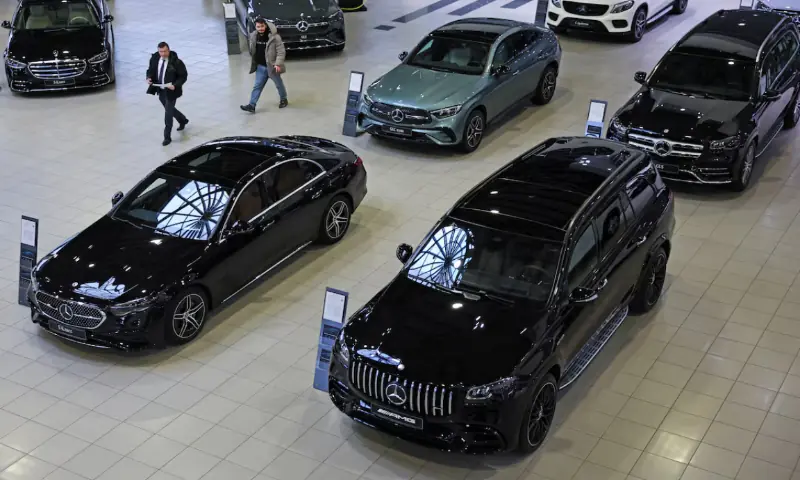
Tens of thousands of cars are being exported from China to Russia under grey-market schemes that often circumvent Western and Asian government sanctions and automakers’ commitments to exit the Russian market, according to registration data reviewed by Reuters and interviews with five people involved in the trade.
The sanctions and company pledges came in reaction to Russia’s 2022 invasion of Ukraine. But a thriving trade in these vehicles – from Toyotas (7203.T), and Mazdas (7261.T), to German luxury models – continues partly through informal networks enabling Russian dealers to order them through Chinese intermediaries, the interviews and data from Russian research firm Autostat show.
Most are made in China, where many international brands build vehicles with local partners, or are shipped through there after being manufactured elsewhere, according to the data and sources.
A growing number are zero-mileage “used” vehicles – new cars registered as sold in China by dealers or traders, who then reclassify them as used and export them.
The practice, highlighted by Reuters last year, is a symptom of China’s highly subsidised and hypercompetitive car market, allowing automakers and dealers to inflate sales figures, collect subsidies and export surplus vehicles.
Traders moving European, Japanese and South Korean brand cars from China to Russia classify new cars as used to eliminate the need to get automaker approval for Russia sales, said Zhang Ai Jun, a former exporter at a Sichuan-based car trader.
“This way is to export more easily,” she said.
Zero-mileage used cars are often heavily discounted in China.
But in Russia, they fetch prices similar to never-registered new cars, according to a Russian dealer and vehicle-shipping documents reviewed by Reuters.
Reuters is the first to report the Autostat data, China’s emergence as the primary conduit for foreign vehicles to reach Russia and the practice of avoiding automakers’ Russia-sales restrictions by classifying new cars as used.
Dmitry Zazulin, sales director at Moscow dealership Panavto-Zapad, said many customers want to buy and drive cars exclusively from Western brands, such as Mercedes.
“However, at present, we can only bring them in through parallel channels,” he said.
Mercedes-Benz (MBGn.DE), BMW (BMWG.DE),, Volkswagen (VOWG.DE), and other automakers from regions imposing sanctions said they prohibit sales to Russia and are doing their best to prevent unauthorised exports, including through training and contractual clauses with dealers.
But they highlighted the difficulty in investigating potential breaches: Such probes are “time-consuming and complex” and require third parties’ assistance, Mercedes said in a statement.
BMW said it has told its China retail operation to “strictly oppose any potential vehicle exports to Russia,” adding that if cars nevertheless enter Russia as grey-market imports, “this happens outside our sphere of influence — and also expressly against our will.”
A Russian dealer, who spoke on condition of only being identified by his first name, Vladimir, told Reuters his dealership in Vladivostok doesn’t stock restricted foreign cars but buys them one-by-one from Chinese traders to fill customer orders.
“There are lots of middlemen: This one knows that one; that one knows another, and that one can reach the dealer,” he said.
DATA REVEALS SCALE OF TRADE
The sales show up by the thousands in data collected by Autostat.
The figures show imports from China represent an increasingly large share of all Western or Japanese brand vehicles registered in Russia, and sustained volumes of brands from South Korea.
The number of such vehicles manufactured in China has more than doubled since 2023, the data shows.
They now account for nearly half of the nearly 130,000 total vehicles sold in Russia in 2025 that are made by automakers from countries imposing sanctions, according to Autostat.
Since Russia invaded Ukraine in early 2022, more than 700,000 vehicles from all such foreign brands have been sold in Russia.
The Autostat data showed Russians bought more Toyotas last year than any foreign brand except Chinese ones.
But the automaker said in a statement that it stopped sending cars there in 2022: “Toyota does not export new vehicles to Russia,” the company said, without addressing the Autostat figures.
Mazda, which also had significant sales, said the same and added that any new Mazdas sold in Russia “have been resold through third parties that are outside of Mazda’s control.”
Sebastiaan Bennink, a sanctions expert at European law firm Bennink Dunin-Wasowicz, said restricted products still often trickle into Russia even when industry players do their best to block them.
There are so many ways to skirt sanctions, it’s “almost impossible to prevent certain cars from ending up in Russia,” Bennink said.
While the Autostat statistics show China is the main avenue, Reuters couldn’t determine all the pathways by which vehicles reach Russia.
Germany’s economy ministry said customs authorities regularly investigate sanctions violations and work with counterparts in other EU countries to implement the measures.
Japan’s Ministry of Economy, Trade and Industry said automakers, exporters and dealers are bound by its sanction rules but declined to comment on the trade of Japanese cars between China and Russia.
South Korea’s trade ministry said it has been working to prevent circumvention of export controls and that the country has been cracking down on indirect exports of used cars to Russia.
China’s commerce ministry and Russia’s industry and trade ministry didn’t respond to requests for comment. Both countries have said they oppose unilateral sanctions and consider them illegal.
RUSSIA SALES OF CHINA-MADE, FOREIGN-BRAND CARS SURGE
The European Union, the United States, South Korea and Japan have all imposed similar automotive sanctions.
They generally ban the sales of vehicles above a certain price or those with larger engines, along with all EVs and hybrids.
Automakers from these regions also pledged to end or greatly restrict their Russian businesses.
Overall, these efforts have slashed Russian sales of vehicles from regions imposing sanctions from more than one million in 2021 to about one-eighth of that, the Autostat data shows.
But sales of Chinese-made German and Japanese cars are rising, the data shows, a trend some industry analysts attribute to growing exports of zero-mileage used cars.
These vehicles don’t show up in some industry data sets; research firm GlobalData, for instance, reported no official new-car sales of German brands in Russia this year.
The Autostat data, however, captures these sales because it’s based on new-car registrations in Russia, where imported vehicles with zero mileage are considered new regardless of whether they were previously registered in China.
Nearly 30,000 Toyotas were purchased in Russia last year, the Autostat data showed. Almost 24,000 of them were made in China.
Nearly 7,000 Mazdas were sold during the same period, almost all China-made.
Hybrids from brands including Toyota are among the most popular Japanese models in Russia, according to two Chinese auto-retail sources.
GERMAN LUXURY SUVs SLIP THROUGH GRAY-MARKET CHANNELS
German cars are also prized.
Autostat figures showed nearly 47,000 new BMW, Mercedes and Volkswagen Group vehicles, including brands Audi, Porsche and Skoda, were registered in Russia last year.
More than 20,000 of those vehicles were manufactured in China, the data show.
The rest were made in Europe, but many likely passed through China on their way to Russia, according to industry analysts and one of the people involved in importing vehicles to Russia.
Vladimir, the Russian car dealer, said most foreign cars are imported through China regardless of where they are built.
One popular model among the Russian elite: The Mercedes G-class, a boxy off-road vehicle that can sell for about 120,000 euros, or about $142,700, and is only produced in Austria, said Felipe Munoz, an analyst who runs the Car Industry Analysis platform.
Dozens of shipping documents reviewed by Reuters showed other examples of German luxury SUVs being imported to Russia from China, including the Mercedes GLC 300 and the BMW X1 xDrive25i.
“Given the trade between Russia and China, which has grown significantly in recent years in terms of cars, it is obvious to conclude that many of those cars imported into China from Germany end up in Russia,” Munoz said.
For the latest news, follow us on Twitter @Aaj_Urdu. We are also on Facebook, Instagram and YouTube.








Comments are closed on this story.