


PIDE seminar questions the ‘invisible hand’ as Adam Smith’s ideas revisited after 250 years
3 min read


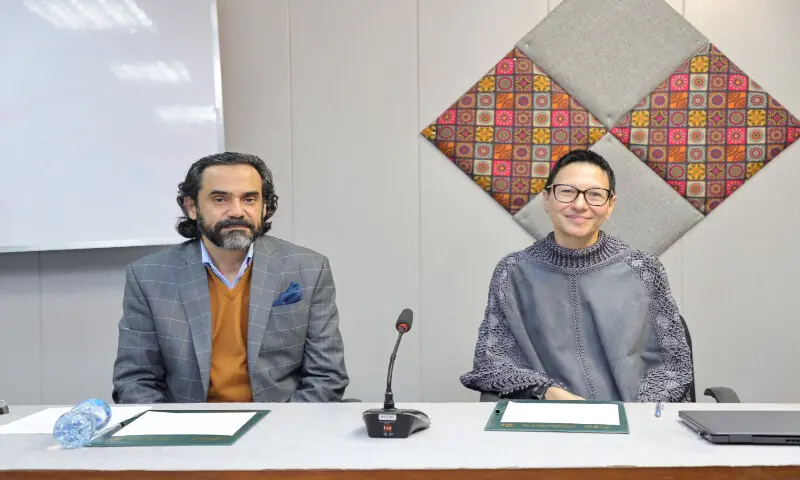
The Pakistan Institute of Development Economics (PIDE), in collaboration with PRIME, an Islamabad-based economics think tank, hosted a seminar titled “Whose Interest? Conflicts with the Invisible Hand” to mark the 250th anniversary of The Wealth of Nations by Adam Smith.
The seminar revisited Adam Smith’s ideas in light of contemporary economic challenges, questioning the widespread belief that markets automatically align private incentives with social welfare.
The talk was given by Maria Pia Paganelli, Professor of Economics at Trinity University, whose presentation, which was based on an upcoming paper co-authored with Professor Jimena Hurtado, challenged the modern conflation of Smith’s concept of “own interest” with narrow self-interest.
She explained that Smith’s invisible hand operates only when individuals pursue their goals while considering others’ interests. When interest turns into self-interest, pursued at the expense of others, the invisible hand fails to deliver socially beneficial outcomes.
Prof Paganelli identified four conditions under which self-interest comes into direct conflict with the interests of society. These include sharp differences in bargaining power, particularly in labour markets where employers can act collectively, outlast workers in negotiations, and influence public policy, while workers remain dispersed and vulnerable.
She noted that Smith saw such imbalances as a core reason why market outcomes could become unjust even in the absence of overt government interference.
A second source of conflict arises from unequal understanding of interests across social groups.
While landlords and workers may, in principle, have interests aligned with society, Smith argued that landlords were often distracted by luxury and status, and workers — constrained by repetitive labour and limited education — were denied the opportunity to develop critical judgment.
By contrast, merchants and manufacturers, fully aware of their interests, consistently sought higher prices and monopoly power, placing them in direct opposition to the public good.
The presentation further highlighted asymmetries in access to institutional and state power. Smith observed that merchants and manufacturers, concentrated in towns, were able to collude and extract favourable legislation, securing monopolies and privileges that oppressed consumers and workers alike.
Prof Paganelli emphasised Smith’s unusually strong language on this point, noting his description of such groups as deceiving, oppressing, and extorting the public through the legislature.
Finally, the seminar examined the role of weak or unstable institutions. Dr Paganelli discussed Smith’s critique of sovereign behaviour, including currency debasement, governance based on flattery rather than merit, and the dangers posed by what Smith termed the “man of system,” a ruler who attempts to impose an idealised social order without regard for real human constraints.
She also highlighted Smith’s condemnation of the East India Company as an extractive institution whose pursuit of profit destroyed long-term economic and social foundations.
The session was moderated by Omer Siddique, Senior Research Economist at PIDE, who steered the discussion towards present-day policy implications.
Participants actively engaged in whether the invisible hand can be treated as a universal principle, particularly in developing and South Asian economies marked by institutional fragility, power concentration, and unequal access to the state.
The seminar concluded with the reflection that Adam Smith was neither a simplistic champion of laissez-faire nor an apologist for unchecked markets.
Rather, he offered a conditional vision in which markets function effectively only when institutional arrangements limit power, prevent collusion, and ensure that individual pursuits remain mindful of social consequences.
Through such critical engagement with foundational economic ideas, PIDE reaffirmed its commitment to evidence-based, context-aware policy discourse aimed at addressing Pakistan’s contemporary economic challenges.
For the latest news, follow us on Twitter @Aaj_Urdu. We are also on Facebook, Instagram and YouTube.















Comments are closed on this story.