


Dr Lumbard calls for ethics and spirituality in modern education
3 min read

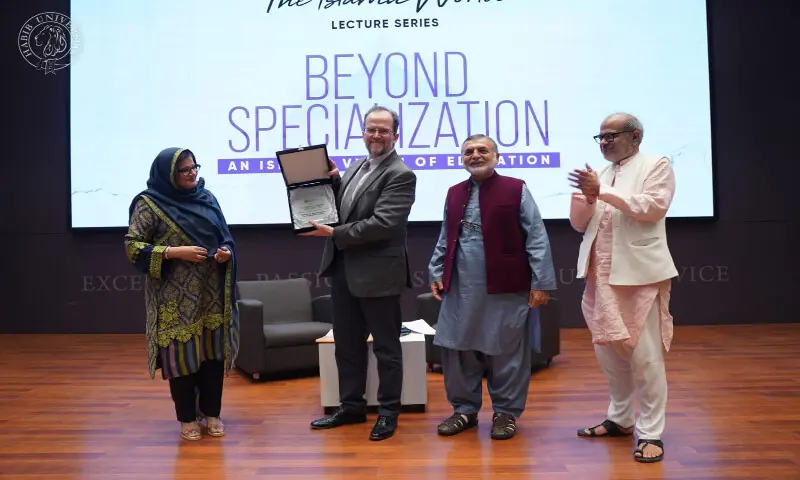
“Nowhere in the Islamic tradition is knowledge seen as something humans produce. Instead, knowledge shapes us as individuals and societies. We do not create knowledge; we transmit it, cultivate it through tarbiyah, discover it through kashf, verify it through tahqeeq, and recognise it through ma’rifah,” said Dr Joseph E. B. Lumbard during his lecture at Habib University.
Dr Lumbard delivered “Beyond Specialisation: An Islamic Vision of Education,” the third lecture in Habib University’s Reshaping Philanthropy in the Islamic World Lecture Series, on Friday, January 16, 2026. The event drew Karachi’s intellectuals, civil society members, students, and faculty for a discussion on how Islamic knowledge traditions can help address key challenges in modern higher education.
An American Muslim scholar and Associate Professor of Qur’anic Studies at Hamad Bin Khalifa University in Qatar, Dr Lumbard’s work spans Qur’anic studies, Sufism, and Islamic philosophy. He has held academic positions in Cairo, Boston, and Sharjah and served as Advisor for Interfaith Affairs to the Jordanian Royal Court under King Abdullah II.
In his lecture, Dr Lumbard highlighted what he described as an intellectual crisis in contemporary higher education. He argued that modern academia often fragments knowledge into isolated disciplines, detached from ethical and spiritual purpose. Drawing on Islamic intellectual history, he presented a vision of education that cultivates intellectually and morally integrated human beings, not just technical specialists.
He also addressed the impact of technology on human cognition, noting, “Increasing reliance on technology has reduced knowledge and wisdom to mere information. Tools once seen as aids to enlightenment, computers, the internet, cell phones, and now artificial intelligence, can instead undermine human faculties when overused.”
The lecture connected knowledge with philanthropic institution-building, encouraging participants to rethink higher education as a holistic service to society.
Dr Nauman Naqvi, Associate Professor in the Comparative Humanities Program at Habib University, introduced the session. He emphasized the importance of long-term investment in knowledge and institutions over short-term charitable relief: “While generosity remains strong in Muslim societies, it has often shifted away from building lasting institutions. Habib University is reviving a tradition of philanthropy rooted in education, intellectual growth, and public good, placing higher education at the center of Pakistan’s future.”
The session concluded with a lively Q&A, where Dr Lumbard addressed questions on ethics, Islamic intellectual traditions, and the challenges facing higher education in Muslim societies. The event reflected Habib University’s commitment to fostering thoughtful dialogue on Islam, education, ethics, and social responsibility.
Habib University’s Reshaping Philanthropy in the Islamic World Lecture Series explores how Islamic traditions of giving can focus on building enduring institutions of knowledge. The series aims to move philanthropy beyond short-term relief toward long-term social transformation, positioning education as a moral and societal investment for the modern era.
For the latest news, follow us on Twitter @Aaj_Urdu. We are also on Facebook, Instagram and YouTube.













Comments are closed on this story.