


Trump reignites trade war with China, announces 100% tariffs and new export curbs
4 min read


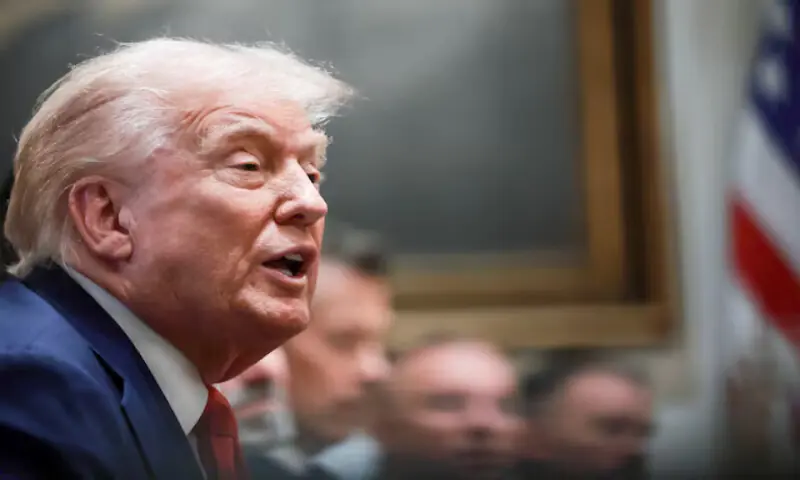
US President Donald Trump revived the trade war against Beijing on Friday, ending an uneasy truce between the two largest economies with promises to sharply hike tariffs in a reprisal against China, curbing its critical mineral exports.
The president unveiled additional levies of 100% on China’s US-bound exports, along with new export controls on “any and all critical software” by November 1, nine days before existing tariff relief is set to expire.
Trump also called into question the prospects for a previously announced meeting set for three weeks from now with Chinese President Xi Jinping in South Korea, saying on Truth Social that “now there seems to be no reason to do so”.
“I haven’t cancelled,” Trump later told reporters at the White House. “I would assume we might have it.” Beijing has never confirmed the meeting.
The new trade steps were Trump’s reaction to China’s dramatically expanding its rare earth element export controls. China dominates the market for such elements, which are essential to tech manufacturing.
“It was shocking,” Trump said of China’s steps, which did not specifically target Washington. “I thought it was very, very bad.”
The actions signalled the biggest rupture in relations in six months between Beijing and Washington – the world’s biggest factory and its biggest consumer.
Many questioned whether the uneasy economic detente reached over the summer can survive.
It was a swift and dramatic response by Trump, a Republican who has wielded tariffs paid by US importers against friends and foes.
It could escalate a trade war that Washington and Beijing paused earlier this year after painstaking diplomacy.
Experts said restrictions on US software shipments to China could be a massive blow to the country’s tech industry, including cloud computing and artificial intelligence.
Trump also threatened new export controls on aeroplanes and aeroplane parts, and a person familiar with the matter said the administration was sketching out other possible targets.
Beijing has long called for Washington to abandon unilateral trade restrictions it says undermine global commerce.
Markets dive on new threats
Trump’s trade threats – delivered in a series of social media posts and a public back-and-forth with reporters – sent markets and relations between the world’s largest economies into a spiral.
China produces over 90% of the world’s processed rare earths and rare earth magnets.
Many are vital materials in products ranging from electric vehicles to aircraft engines and military radars.
Trump’s unexpected broadside shook global financial markets, sending the benchmark S&P 500 Index sliding by more than 2%, its biggest one-day drop since April, when a steady barrage of tariff announcements by Trump stoked market volatility.
Investors fled into the safe haven of gold and US Treasury securities, and the US dollar weakened against a basket of foreign currencies.

Tech stocks piled on losses in after-market trading after Trump detailed the tariff and export control measures.
“Trump’s post could mark the beginning of the end of the tariff truce,” said Craig Singleton, a China expert at the Foundation for Defence of Democracies. Singleton said Washington viewed China’s export control steps as a betrayal.
“Beijing appears to have overplayed its hand.”
In his first social media post on Friday, Trump said China has been sending letters to countries worldwide saying it planned to impose export controls on every element of production related to rare earths. The reference to letters was an apparent reference to Beijing’s policy papers.
Trump said he had been contacted by unnamed countries incensed over Beijing’s steps and said he was surprised because of the “very good” recent relationship with China.
Trump condemns Beijing’s hostile order
Terming China’s actions a “hostile order,” Trump said he had been forced “to financially counter their move”.
“For every Element that they have been able to monopolise, we have two,” Trump said.
The White House and the Chinese embassy in Washington did not respond to a request for comment.
A spokesperson for the US Trade Representative declined to comment on what countermeasures Trump was contemplating, while a spokesperson for the US Treasury did not respond to a request for comment.
The two offices have led talks with Beijing on trade.
Economic tensions had been rising in recent days. On Thursday, the Trump administration proposed banning Chinese airlines from flying over Russia on routes to and from the US.
On Friday, the US Federal Communications Commission said that major US online retail websites have removed millions of listings for prohibited Chinese electronics.
China’s move on Thursday included adding five new elements as well as dozens of pieces of refining technology to its export-restricting control list.
It also required foreign rare earth producers that use Chinese materials to comply with its rules.
Analysts said the stakes had risen for a positive outcome from a Trump-Xi summit, if it still happens, on the sidelines of the Asia-Pacific Economic Cooperation forum starting October 31 in South Korea.
“Things are going to get interesting,” said Scott Kennedy, a China business and economics expert at Washington’s Centre for Strategic and International Studies think tank.
“They both are hoping that amping up pressure will lead the other to make concessions in advance of APEC, or they are now re-escalating, assuming a deal at APEC is impossible and are gaining leverage for the next round of the fight.”
For the latest news, follow us on Twitter @Aaj_Urdu. We are also on Facebook, Instagram and YouTube.











Comments are closed on this story.