



SC wants relevancy of questions over Bhutto's murder case
4 min read


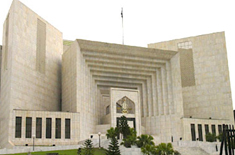
 The Supreme Court on Monday suggested to Dr Babar Awan, appearing as counsel in a Presidential reference, to further consider relevancy of questions of law raised by the worthy President upon which the apex Court might express its opinion.
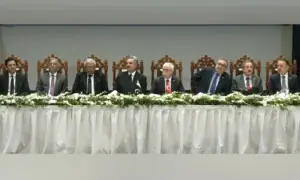
A three-Judge bench comprising Chief Justice Iftikhar Muhammad Chaudhry, Justice Muhammad Sair Ali and Justice Ghulam Rabbani adjourned further hearing till April 21 by asking the counsel to look into questions posed by them regarding relevancy of presidential question of law over which probably a larger bench of the apex Court might give its opinion under Article 186.
The Chief Justice told Dr Babar Awan that they wanted clarity about certain aspects of the Reference especially rising of a specific question, so that they could proceed ahead for giving their opinion.
He said the President and the Prime Minister both did not know the technicalities but they had wisdom with them.
He said that a lager bench might be constituted along with a number of amicus curiae to assist it over the issue, and suggested that if the worthy President could re-frame the reference and transmit them on Tuesday over specific question of law.
"You are not alien, nor we are, the whole nation knew the case, the case of a leader of Muslim world," he added.
He said that all judges were really interested in the issue but he should assist them on the question of law involved in it.
He hinted that they would adjourn all other cases to hear such an important issue. "By doing so, we are fulfilling the command of the Constitution and our opinion in this case would be looked upon by the whole world. That is why we are giving you an option as we are very much interested," he added.
There were international cases in which courts opinions were sought. In the reference the President desired to seek Supreme Court opinion on question of law but you had to formulate that question of law for their consideration, he said in the same tone.
He said "Unfortunately, formulations framed grounds without question of law!" "The cabinet is for revisiting of the murder trial and I do not know whether my brothers agree or not but I agreed that it could be a case of miscarriage of justice. It is a phenomenon not only known in this part of the world but across the globe. The worthy President of Pakistan is before the Supreme Court for rectifying it and acquittal," he added.
He said that it was the most important case before the Supreme Court but they did not know what would be its result.
Justice Muhammad Sair Ali suggested that if there were technical impediments, the issue could be re-referred.
Dr Babar Awan replied that he would not hide behind technicalities or ego as everybody knew that a letter about murder was sent to the apex Court.
He said that he would approach the President and by evening it could be done.
The counsel also touched preliminary points by referring to a book "Leopards and Fox" of Tariq Ali, and said that the author had stated that it was not a case of execution but of custodial killing of a Prime Minister of Pakistan.
He contended that there was no case in entire judiciary when a person was hanged on basis of Article 109. He said the reference was in accordance with procedural requirements under Rules of Business and the question raised by the President was before the cabinet and the Prime Minister.
Referring to an Indian verdict he said that such a practice was termed as procedural law and procedural judgement.
Raising another question he said that a testimony of an approver could not be a basis for death sentence.
He said a question arose out of Bhutto's trial case whether it met provisions of fundamental rights of Articles 4, 9, a and 14.
The case was a miscarriage of justice and a glaring example of bias against late Bhutto, he added. He said that law of repentance would also be applicable in this case as laid down in the Islamic injunctions.
He said this Court in its judgements of PLD 2001 and 2009 by a seven member’s bench and a five-member bench respectively dealt with the issue of bias.
Dr Babar said the judges' bias issue was mentioned by late Zulfikar Ali Bhutto in his book. The Chief Justice told him that they were bound by judgements and also by the Islamic injunctions.
He said the issue of bias was raised from the very beginning in his book. A former judge had expressed his mind by saying about ZAB that he was there for publicity, he added.
Justice Ghulam Rabbani also raised a question saying whether issue of bias could be reason for revisiting of the judgement under the scope of Article 186!.












Comments are closed on this story.