


Pakistan takes IWT dispute to world stage, calls water a question of global justice
3 min read


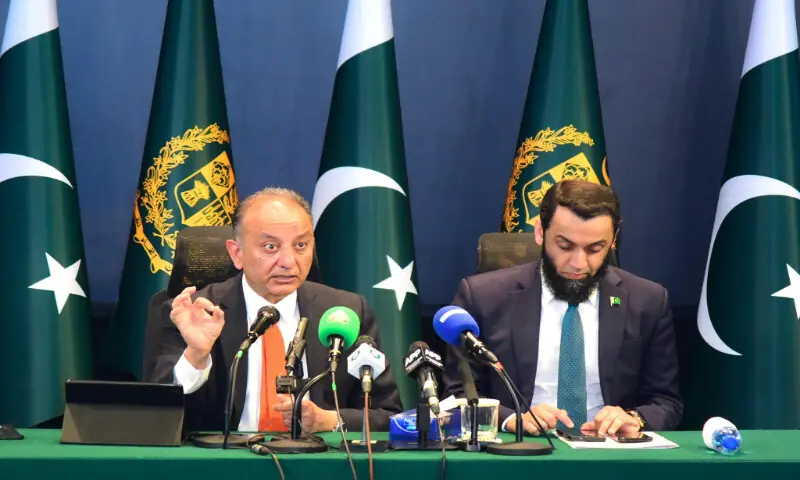
Pakistan is taking the Indus Waters Treaty dispute beyond a bilateral row with India, framing it as a global question of justice, fundamental rights and the protection of downstream nations’ access to water, Federal Minister for Climate Change Musadik Malik said on Monday.
Addressing a joint press conference in Islamabad alongside Information Minister Attaullah Tarar, Malik said Pakistan had raised the issue at the United Nations, its affiliated institutions and international arbitration forums, and that its position had been endorsed at each.
The ministers announced that an international seminar on the Indus Waters Treaty would be held in Islamabad on Tuesday, the first of its kind on the accord. Tarar said water and legal experts, as well as several foreign delegates who had already arrived in the country, would attend the seminar to deliberate on various aspects of the treaty.
“The international community acknowledges and endorses Pakistan’s position on the Indus Waters Treaty,” Tarar said, describing it as a significant success for Pakistan in the narrative domain.
He stressed that the treaty could not be unilaterally revoked or amended, and reaffirmed that Prime Minister Shehbaz Sharif and Field Marshal Syed Asim Munir had declared water to be Pakistan’s lifeline and its red line.
Malik argued that the stakes extended well beyond Pakistan. He said if upstream countries were permitted to stop or manipulate river flows to downstream states, the consequences would ripple across river systems worldwide.
“If this becomes acceptable here, what about all the other countries that depend on rivers flowing across borders?” he asked.
He said between 40 and 50 per cent of Pakistan’s population depended on agriculture for employment, the sector contributed between 20 and 25 per cent of the country’s GDP, and food security depended entirely on water availability.
“Our food security, our economy and the livelihoods of millions are linked to this water,” he said, adding that decisions affecting river flows should not rest in the hands of another country.
More recently, Indian Water Minister CR Patil said his country was working to ensure “not a single drop of water” would flow into Pakistan.
Malik said there was “a tap whose handle is in the hands of the prime minister of our neighbouring country.”
Malik said Pakistan had been making this case at international forums, including recent discussions in Brussels, where the issue was framed as one extending beyond Pakistan. He drew comparisons with European river-sharing arrangements, questioning whether Spain had ever stopped water flowing to Portugal.
“This conference is about justice,” he said. “This conference is about rights. It will decide whether children living downstream around the world have a right to water.”
On international rulings, Malik said arbitration had already accepted Pakistan’s position that water storage associated with run-of-the-river hydropower projects was subject to technical engineering limits and could not be carried out without restriction.
He also called for national consensus on water storage and regulation, urging all political parties to rise above political controversy on an issue that concerned farmers across the country.
Asked about the Diamer-Bhasha and Dasu dams, he said Pakistan was not relying exclusively on international financing and remained committed to completing the projects regardless.
“We are doing this for our own children,” he said.
Concluding the press conference, Malik said Pakistan would continue presenting its case internationally and welcoming scrutiny.
“We are not asking the world simply to listen to us,” he said. “We are asking the world to question us. And when there are no questions left, then ask yourselves whether this is justice.”
For the latest news, follow us on Twitter @Aaj_Urdu. We are also on Facebook, Instagram and YouTube.










Comments are closed on this story.