



Pakistan makes the World Cup ball — even if it can't qualify for the tournament
4 min read

There is a certain beautiful irony to all of this. Pakistan sits 198th in the FIFA world rankings and its national team has never come close to qualifying for a World Cup. And yet, every four years, the country that cannot get to the tournament makes the ball that defines it.
Every goal at the 2026 FIFA World Cup — every last-minute winner, every penalty that changes a game — will be scored with a ball made in Sialkot.
And behind that ball is a civil engineer who once worked for Pakistan Railways and never imagined he would end up in football at all.
Khawaja Masood Akhtar founded Forward Sports Private Limited in Sialkot in 1991 with 20 employees and a single room. Thirty-five years later, his company produces approximately 20.5 million footballs a year.
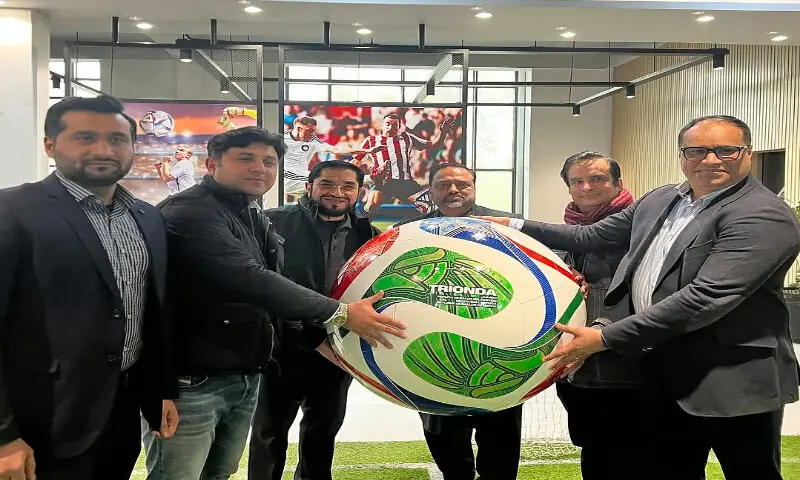
It has made the official match ball for four consecutive FIFA World Cups: the Brazuca for Brazil 2014, the Telstar 18 for Russia 2018, the Al Rihla for Qatar 2022, and now the Trionda for the 2026 tournament across the United States, Canada and Mexico.
The city the world’s footballs come from
Sialkot is often called the Football Factory of the World. It produces nearly 70 per cent of all footballs used globally — from training balls at local clubs to the match balls contested at the biggest tournaments on earth.
Pakistan exports around 40 million footballs annually, with roughly 300,000 leaving Sialkot’s factories every single day.
Official FIFA World Cup match balls have been produced there since 1982, a fact that has gone largely unnoticed outside the industry for four decades.
Swiss photographer Stefan Bohrer, who recently documented the city’s football industry, was struck by the scale.
“The sheer scale of football production in Sialkot is astonishing,” he told Talk to the Press.
“Knowing that around 300,000 balls leave these factories every day makes you pause and wonder where they all end up. These balls will be kicked, shared, and celebrated by millions of people around the world, carrying with them the passion of the game and the craftsmanship of the people who make them.”
An unlikely beginning
Akhtar’s path to football manufacturing was anything but straightforward. After graduating as a civil engineer, he joined Pakistan Railways. It was his uncle, a sports goods businessman in Sialkot, who convinced him to try the industry. He was not immediately sold.
“I never imagined I would end up manufacturing footballs,” he told Muslim Network TV.
“I had no experience in the industry, but I had a technical mindset and a close relationship with my uncle, so I accepted the challenge.”
He started as a production manager and eventually struck out on his own. The early years were hard — production stood at roughly 1,000 balls a month and the company struggled to compete with established players.
Everything changed in 1994 when Adidas came knocking.
“A major breakthrough came when Adidas partnered with us,” he said.
“From that point onward, I never looked back. There were setbacks, failures and difficult periods, but with hard work and perseverance, we continued moving forward.”
From hand-stitching to high technology
What has kept Forward Sports at the top for three decades is its willingness to reinvent itself. The company began with hand-stitched footballs, transitioned to thermo-bonded technology in 2007, then machine-stitching, laminated football technology and eventually the sensor-equipped Trionda for 2026.
Developing a World Cup ball is a specialised process that can take three to four years, involving rigorous testing for seam precision, roundness, durability and performance across weather conditions. Delivery times that once stretched to 90 days have been cut to as little as 15 through automation, laser-cutting and advanced machinery.
“Technology changes everything,” Akhtar said. “Football manufacturing was changing too. If we had not adapted, we would have been left behind.”
He visits his research and development department every morning. “One of the biggest reasons we reached this level is our investment in R&D,” he said.
The women behind the balls
A significant portion of Forward Sports’ workforce is women. The company introduced transport services, healthcare support and workplace improvements specifically to encourage female participation. Workers hand-stitch football panels, apply colours and logos, and inspect finished products before shipment worldwide.
“Women have played a major role in our success,” Akhtar said. “When given opportunities and respect, they deliver outstanding results.”
“There is no secret formula behind success,” Akhtar said. “Anything is possible when there is will. Where there is a will, there is a way.”
For the latest news, follow us on Twitter @Aaj_Urdu. We are also on Facebook, Instagram and YouTube.


Comments are closed on this story.