


SC acquits two death-row convicts in Baldia Town factory fire case
2 min read


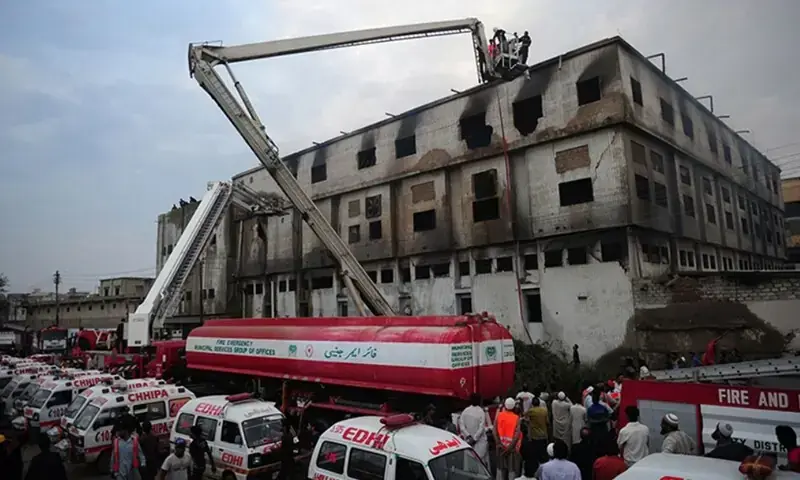
The Supreme Court of Pakistan on Wednesday acquitted the two main convicts sentenced to death over the 2012 Baldia Town factory fire, one of the deadliest industrial disasters in the country’s history.
A three-member bench headed by Justice Shahzad Malik accepted the appeals of Abdul Rehman alias Bhola and Zubair alias Chariya, setting aside death sentences handed down by both the trial court and the Sindh High Court.
The detailed written judgement will be issued later.
The court acquitted both men on the benefit of the doubt.
It also dismissed petitions seeking to make victims’ families a party to the proceedings, with Justice Malik noting that adding more parties would complicate the case and slow proceedings unnecessarily.
The bench also disposed of a separate MQM application seeking the expunction of certain remarks from the earlier judgement, ruling that since the verdict itself had been set aside, the remarks stood annulled automatically.
During the hearing, Justice Malik referenced the Sindh High Court’s earlier observation that MQM’s alleged control over Karachi had kept witnesses silent, but the bench raised questions on several aspects of that finding.
The court also noted that while a confessional statement by Zubair alias Chariya was on record, no such statement existed for Abdul Rehman alias Bhola.
It further questioned why acquittals of other accused linked to the alleged political party angle had not been challenged.
Background
The Baldia Town fire broke out on September 11, 2012, at a garments factory in Karachi’s Baldia Town neighbourhood, killing more than 250 workers and injuring hundreds more.
Exits were locked and windows barred with iron grilles, trapping workers inside and causing deaths from suffocation and burns.
While initial investigations considered an electrical short circuit as a possible cause, a subsequent Joint Investigation Team and Rangers report concluded the fire had been deliberately set amid an extortion dispute, and the incident was classified as a terrorist act.
The report alleged that factory owners had been subjected to a demand for hundreds of millions of rupees in extortion.
The case wound through the courts for years.
In 2020, an anti-terrorism court convicted some accused and acquitted others, with appeals following.
Wednesday’s Supreme Court ruling brings the long-running case to a close for its two principal convicts — though the acquittal is expected to reopen painful questions for the families of the victims.
The disaster remains a defining moment in Pakistan’s industrial history, having exposed critical failures in factory safety standards, labour protections, and workplace regulations.
For the latest news, follow us on Twitter @Aaj_Urdu. We are also on Facebook, Instagram and YouTube.













Comments are closed on this story.