


'Where is China' ask delegates at Asian defence forum
3 min read

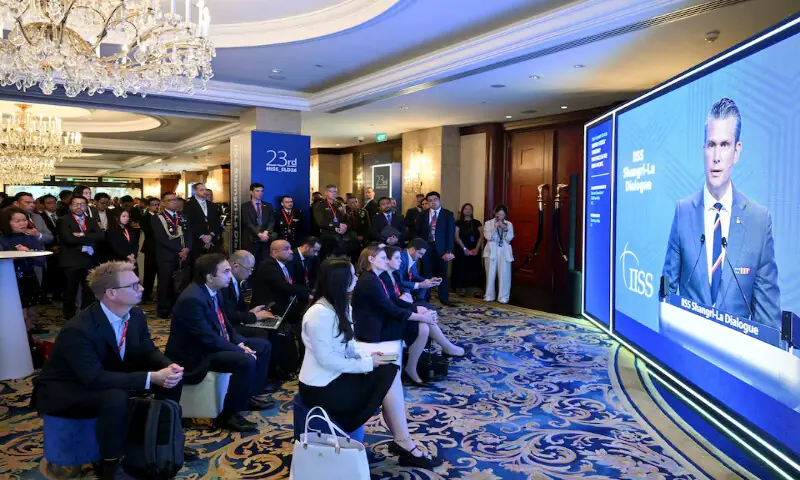
The big question hanging over this year’s Shangri-La Dialogue, Asia’s premier defence forum, is: “Where is China?”
For the second year running, Chinese Defence Minister Dong Jun has given the free-wheeling Singapore security meeting a miss, skipping opportunities to meet US Defence Secretary Pete Hegseth as well as counterparts from Australia, France, Britain, Japan and other nations.
In his place, Beijing sent a low-profile delegation of People’s Liberation Army “experts and scholars” — a step down from the usual high-powered presence.
A highlight of the dialogue’s annual programme has been a robust speech by China’s defence minister or senior official laying out Beijing’s defence doctrine and outlook on global tensions. But the speech helmed by China has been dropped from this year’s programme, like in 2025.
Even Hegseth took note.
“I wish my counterpart was here at this conference, but I look forward to other options when we can cross paths and communicate, talk about things where often actions at sea or actions in the air are perceived differently,” he said during his own keynote speech on Saturday.
Australia’s Richard Marles called it a lost opportunity for countries to have frank, face-to-face talks on flashpoints.
Dong Jun, however, did meet Hegseth during US President Donald Trump’s visit to China earlier this month.
Zhou Bo, a retired PLA senior colonel and a member of China’s delegation to the meeting, downplayed his absence.
“This is not the first time the defence minister is not attending,” he said. “And academic delegations have come before. But it is true that the level of the delegation is relatively low this time.”
Some analysts point to a more calculated choice: avoiding questions like Taiwan tensions and the effect of military corruption purges on China’s combat readiness.
“My feeling is that they are trying to avoid tough questions,” said Chong Ja Ian, a political scientist at the National University of Singapore.
“The question that comes up with the (Chinese) delegation, since it is so researcher-heavy, is their representativeness and authoritativeness.”
HEGSETH’S COMMENTS ON CHINA THIS YEAR RESTRAINED
Diplomats said Beijing may also have wanted to avoid a repeat of last year’s dialogue, when Hegseth described China as a threat in the Indo-Pacific and urged Asian allies to boost defence spending.
Beijing responded at the time by accusing the United States of vilifying China.
This year, Hegseth struck a more measured tone, although he cautioned that “no state, including China, can impose its hegemony and hold the security or prosperity of our nation and our allies in question”.
He added that US-China relations were better than they had been in many years.
China began sending a usually high-powered delegation to the 23-year-old event in 2007. It dispatched its defence minister in 2011 and again in 2019, and continued the practice from 2022 to 2024. The Shangri-La Dialogue was suspended in 2020 and 2021 due to the COVID-19 pandemic.
Bilahari Kausikan, a veteran Singapore diplomat, said the Shangri-La Dialogue was always primarily about anchoring the US in Southeast Asia and ensuring its defence chief comes to Singapore and Southeast Asia at least once a year.
“Whether China is represented by its defence minister is a secondary factor. It would be nice but not essential to have the Chinese defence minister here.”
For the latest news, follow us on Twitter @Aaj_Urdu. We are also on Facebook, Instagram and YouTube.







Comments are closed on this story.