


Xi warns Trump mishandling of Taiwan could lead to conflict
5 min read

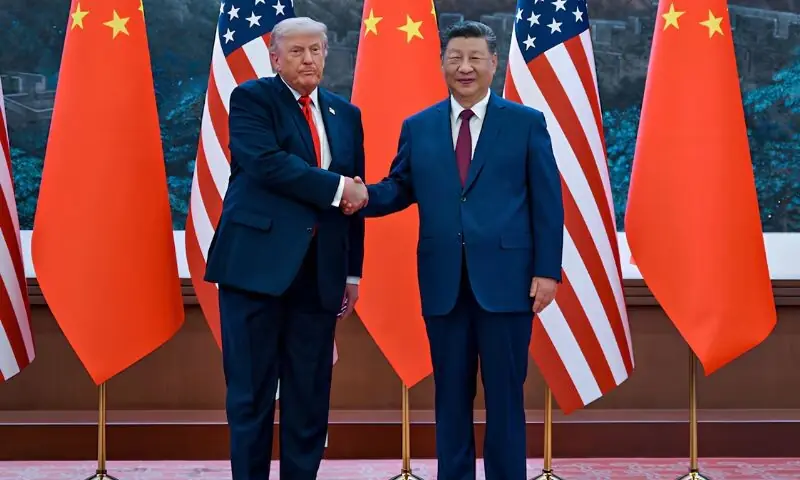
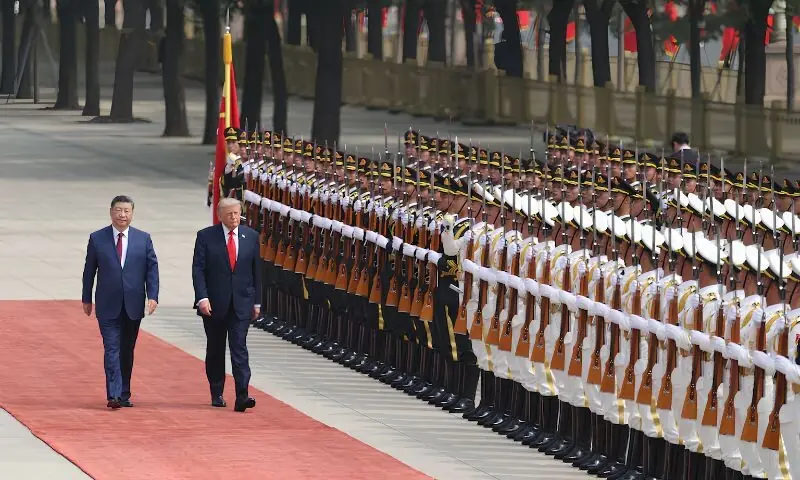
China’s President Xi Jinping told US President Donald Trump that trade talks were making progress at the start of a two-day summit on Thursday, but warned that disagreement over Taiwan could send relations down a dangerous path and even lead to conflict.
The Chinese leader’s remarks on Taiwan were a stark — but not unprecedented — warning in a pomp-filled meeting that otherwise appeared friendly and relaxed, and which Trump described as possibly the “biggest summit ever”.
With Trump’s approval ratings dented by his Iran war, the first visit by a US president to America’s main strategic and economic rival in nearly a decade has taken on added significance.
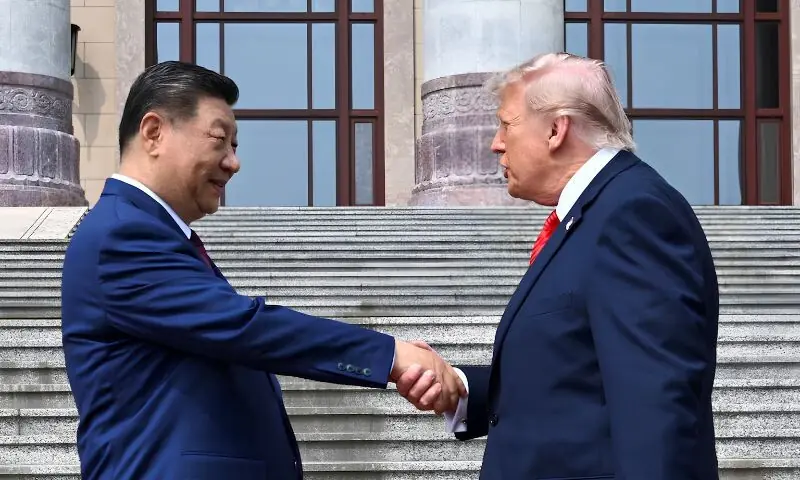
After a ceremony that featured an honour guard and throngs of children excitedly waving flowers and flags at Beijing’s imposing Great Hall of the People, Trump heaped praise on Xi as they began talks that lasted more than two hours.
“You’re a great leader, sometimes people don’t like me saying it, but I say it anyway,” Trump said in brief opening remarks.
“There are those who say this may be the biggest summit ever,” he added.
Later, Xi said negotiations between the US and Chinese economic and trade teams in South Korea on Wednesday had reached “overall balanced and positive outcomes”, according to a readout by China’s foreign ministry.
The negotiations had aimed to maintain a fragile trade truce struck between the world’s two biggest economies last October and establish mechanisms to support future trade and investment, officials with knowledge of the matter said.
Xi also broached the subject of Taiwan, the democratically governed island claimed by China and armed by the United States.
The Chinese leader told Trump that Taiwan was the most important issue they faced and if handled poorly could push the entire US-China relationship into an extremely dangerous situation and cause the countries to collide or even enter conflict, according to Beijing’s readout of the talks.
Joe Mazur, geopolitics analyst at consultancy Trivium China, said that while Beijing had used strong warnings on Taiwan in the past, Xi’s remarks were notable.
“He’s warning the US side in no uncertain terms not to screw around,” Mazur said.
Trump did not respond when a reporter later shouted a question about whether the leaders had discussed Taiwan as he posed for photos with Xi at the Temple of Heaven, a UNESCO World Heritage Site where emperors once prayed for good harvests.
Power dynamics have shifted
The leaders agreed to expand cooperation in trade and agriculture and exchanged views on the situations in the Middle East, Ukraine and the Korean peninsula, according to China’s readout.
Trump and Xi will later attend a state banquet before taking tea and lunch together on Friday.
Joining Trump on the trip are a group of CEOs looking to resolve issues with China, including Elon Musk and Nvidia CEO Jensen Huang, a late addition.
Trump has said his first request to Xi will be to “open up” China to US industry.
The power dynamics have changed since Trump’s last visit to Beijing, when China went out of its way to lavish the president and buy billions in US goods, said Ali Wyne, senior adviser for US-China relations at International Crisis Group.
Trump is now acknowledging China’s growing status, for example, by reviving the term ‘G2’, referring to a superpower duo, when he last met Xi on the sidelines of an APEC meeting in South Korea in October, Wyne said.
Trump enters the talks with a weakened hand.
US courts have hemmed in his ability to levy tariffs at will on exports from China and other countries.
The Iran war has also boosted inflation at home and escalated the risk that Trump’s Republican Party will lose control of one or both legislative branches in November’s midterm elections.
Though the Chinese economy has faltered, Xi does not face comparable economic or political pressure.
Nevertheless, both sides are eager to maintain a trade truce struck last October in which Trump suspended triple-digit tariffs on Chinese goods, and Xi backed away from choking global supplies of vital rare earths.
Washington looks to sell Boeing aircraft, farm goods and energy to China to cut a trade deficit that has long irked Trump, while Beijing wants the US to ease curbs on exports of chipmaking equipment and advanced semiconductors, officials involved in the planning said.
Iran, Taiwan in focus
Aside from trade matters, Trump is expected to encourage China to convince Iran to make a deal with Washington to end the conflict.
But analysts doubt that Xi will be willing to push Tehran hard or end support for its military, given Iran’s value to Beijing as a strategic counterweight to the US.
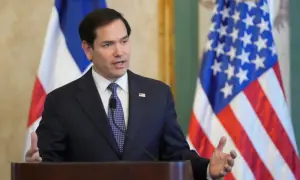
US Secretary of State Marco Rubio told Fox News aboard Air Force One that it was in China’s interest to help resolve the crisis, as many of its ships are stuck in the Gulf and a slowdown in the global economy would hurt Chinese exporters.
For Xi, US arms sales to Taiwan are a top priority.
China reiterated on Wednesday its strong opposition to the sales, with the status of a $14-billion package awaiting Trump’s approval still unclear.
The US is bound by law to provide Taiwan with the means to defend itself, despite a lack of formal diplomatic ties.
Taiwan cabinet spokesperson Michelle Lee told reporters in Taipei on Thursday that China’s military threat was creating insecurity in the region.
“Continuously strengthening national defence and effective collective deterrence is the single most critical factor in ensuring regional peace and stability,” she said.
Xi has a reciprocal visit tentatively planned for later this year, which would be his first visit to the United States since Trump began his second term in 2025.
For the latest news, follow us on Twitter @Aaj_Urdu. We are also on Facebook, Instagram and YouTube.






Comments are closed on this story.