


Dancing robots bring support, company to Barcelona elderly
2 min read



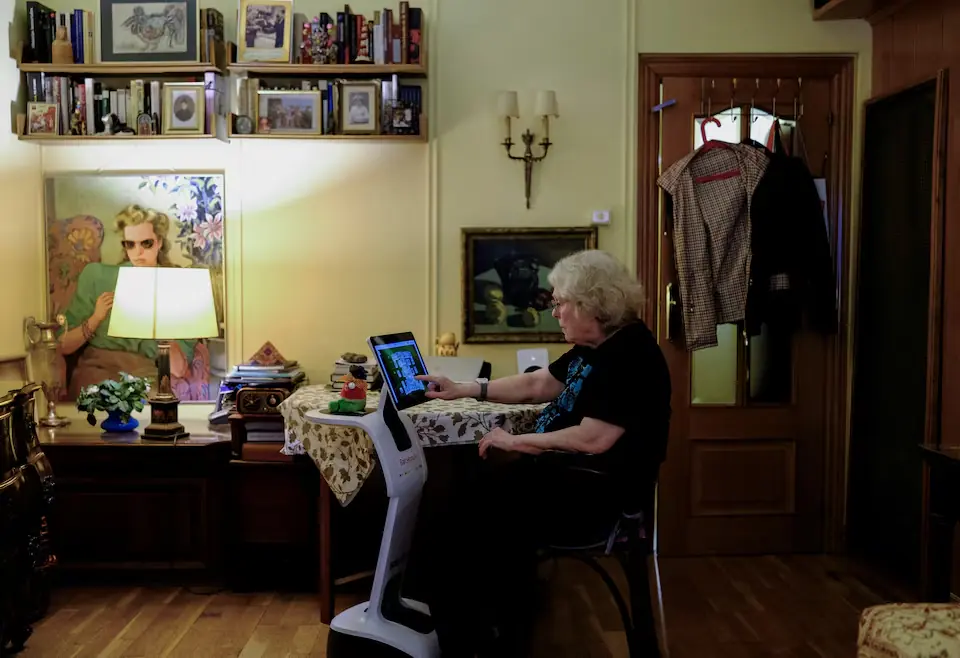
Barcelona resident Irene Veglison had not danced for more than two decades until a robot moved into her home three months ago.
The 67-year-old received the 1.35-metre-tall device in November as part of a government project to support people in the early stages of cognitive decline.
“We’re developing this pilot project to improve tele-assistance,” said Marta Villanueva Cendán, a councillor for Barcelona’s municipal council.
Like many countries, Spain faces rising life expectancy and falling birth rates, increasing pressure on its care sector to support an ageing population.
“In the future, we want the robots to detect risk and alert professionals, like if the person has fallen and cannot respond,” the councillor added.
Barcelona has deployed 600 such bots to private homes and care centres, under a programme backed by a 3.8 million euro ($4.47 million) grant from the European Union.
The devices are built by U.S.-based Misty Robotics and distributed in Europe by Catalan firm Grup Saltó.
Veglison, who lives with her two cats, has named her bot Sandi.
It reminds her to take her medication at 9 am, tells her when her doctor appointments are, wakes her up in the morning and bids her goodnight at the end of each day.
Nearly 2 million people over 65 live alone in Spain, three-quarters of them women, according to official data.
Studies estimate the country will need to double its long-term care workforce by 2030. Yet, paying about 10,000 euros below the national average has deterred younger workers, and more than half of current staff are over 45, according to think-tank Funcas.
In an emergency, Veglison can call a social worker through the device, which has a camera that can be activated remotely to assess the situation and offer help.
Scrolling through YouTube on its built-in screen, she selected a French chanson and swayed with Sandi as the screen tilted back and forth with her movements.
The devices are fitted with screens offering entertainment apps, a calendar, maps, and a selection of cartoon-like faces to set when it is on standby, with expressions like “surprised”, “loving” or “asleep”.
“It’s not just a trinket: there are lots of people behind it who are looking out for you, checking whether you’ve fallen, whether you’re okay,” Veglison said.
For the latest news, follow us on Twitter @Aaj_Urdu. We are also on Facebook, Instagram and YouTube.















Comments are closed on this story.