


Trump endorses Japan’s ‘Iron Lady’ Takaichi ahead of Sunday election
4 min read



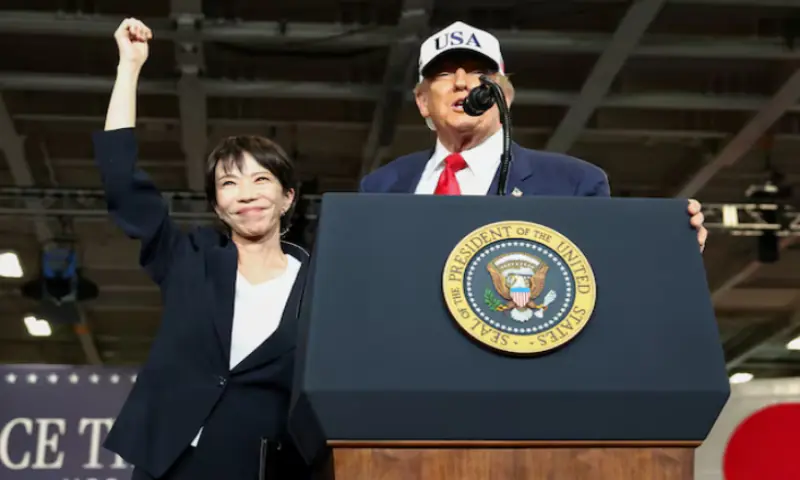
US President Donald Trump gave his “total endorsement” of Prime Minister Sanae Takaichi ahead of a national election in Japan on Sunday, adding he looked forward to hosting her at the White House next month.
Japan’s first female premier, a conservative who said she draws inspiration from Britain’s “Iron Lady” Margaret Thatcher, was already expected to deliver a solid win for her ruling coalition, according to opinion polls. She is seeking a public mandate for spending plans that have rattled investors, and a defence build-up that could further strain relations with China.
Takaichi’s Liberal Democratic Party and its partner, the Japan Innovation Party, known as Ishin, could capture around 300 seats in the 465-seat lower house of parliament, the polls show, well up from the razor-thin majority they now control.
TRUMP’S BACKING A TAILWIND FOR TAKAICHI
“Prime Minister Takaichi is someone who deserves powerful recognition for the job she and her Coalition are doing,” Trump posted on his Truth Social platform on Thursday.
“It is my Honor to give a Complete and Total Endorsement of her, and what her highly respected Coalition is representing.”
Unlike his predecessors, Trump has increasingly sought to shape foreign elections.
Analysts say his backing of Takaichi, 64, a nationalist and defence hawk, fits a growing pattern of aligning with right-wing leaders abroad.
On Thursday, he endorsed Hungarian Prime Minister Viktor Orban for a vote there in April and last year backed Argentine President Javier Milei, highlighting U.S. financial support as a factor in Milei’s 2025 legislative success.
Even though Takaichi already appears poised for a commanding victory, Trump’s endorsement will resonate in Japan, Asuka Tatebayashi, a geopolitical analyst at Mizuho Bank, said.
“From the perspective of the business community, improved relations and better recognition by Trump will be seen as a positive,” Tatebayashi said.
“And even amongst the general population, Trump is surprisingly popular in Japan compared to some Western countries.”
Japanese government spokesman Kei Sato declined to comment on Trump’s endorsement but confirmed that Trump had invited Takaichi to visit Washington on March 19.
“Amid a rapidly changing international situation, the visit is expected to provide an opportunity to reaffirm the unwavering bonds of the Japan–US alliance,” Sato told a regular press conference.
One of Takaichi’s first engagements after she was elevated to prime minister in October was to host Trump in Tokyo.
She gave him a putter used by his former golfing buddy, the late Japanese Prime Minister Shinzo Abe.
Lauded by Trump for breaking Japan’s glass ceiling, Takaichi pledged billions of dollars in investments in a meeting analysts said helped underline the strength of the Japan-US alliance.
CHALLENGES WITH CHINA, JITTERY MARKETS
Weeks later, however, she touched off the biggest diplomatic dispute with China in over a decade by publicly outlining how Tokyo might respond to a Chinese attack on Taiwan.
Trump, who is seeking to maintain a fragile trade truce with China, asked Takaichi in a private phone call in November not to further aggravate Beijing, sources told Reuters.
A resounding victory could hand Takaichi new clout in the dispute with China, current and former Japanese officials said, though Beijing has shown no signs of backing down.
Takaichi’s plans to strengthen Japan’s defences will likely also draw more anger from Beijing, which has cast her endeavours as an attempt to revive Japan’s past militarism.
While the row with China is starting to weigh on the world’s fourth-largest economy, it has hardly dented Takaichi’s high approval ratings.
She has even become an unlikely idol for some voters, who have been buying up the bag she carries and the pink pen she scribbles with in parliament.
Markets, however, have been less enamoured with Takaichi lately.
Her election promise to help households cope with rising prices by suspending the sales tax on food has shaken investor confidence in an economy with the heaviest debt burden in the world.
In recent weeks, investors have fled Japanese government bonds and sent the yen into crisis mode on concerns about how Tokyo would pay for the estimated 5 trillion yen ($30 billion) hit to annual revenue.
However, with other parties touting deeper tax cuts and broader spending, a comprehensive victory for the LDP, which has ruled Japan for most of the postwar era, could end up being the least-worst option for financial markets, analysts have said.
The outcome on Sunday may be affected by turnout among young supporters, who have supported Takaichi in large numbers but who tend to vote less than older cohorts.
Record snowfall in some parts of Japan could also crimp turnout.
If the polls have it all wrong, and Takaichi loses her majority, she has said she will resign.
For the latest news, follow us on Twitter @Aaj_Urdu. We are also on Facebook, Instagram and YouTube.

















Comments are closed on this story.