


Gul Plaza: A night of fire, fear, and forgotten safety
7 min read



Late on the night of January 17, 2026, a devastating fire broke out in one of Karachi’s busiest commercial centres, Gul Plaza.
The blaze quickly grew into an inferno, engulfing the multistorey shopping mall and trapping hundreds of shopkeepers, workers and visitors inside.
What should have been an ordinary night turned into a catastrophe that has shaken the city and raised serious questions about building safety, fire precautions and urban governance in Pakistan’s largest metropolis.
This is one of the most heartbreaking incidents the city has witnessed in recent years.
What began as an ordinary night in a busy commercial area quickly turned into a nightmare of flames, smoke and fear.
The fire destroyed a major shopping centre, claimed precious lives, injured many others and left hundreds of families facing grief and financial ruin.
Beyond the immediate tragedy, the Gul Plaza inferno exposed deep and long-standing problems related to building safety, structural weakness, poor planning and the lack of enforcement of fire regulations.
Gul Plaza was a well-known commercial complex located on M A Jinnah Road, one of the busiest and most crowded parts of Karachi.
It housed hundreds of shops selling clothing, carpets, plastic goods, furniture and household items.
These materials are highly flammable and can fuel a fire very quickly.
On the night of the incident, the fire reportedly started inside one of the shops and spread rapidly through the building.
Within minutes, thick smoke filled the corridors, and flames climbed from one floor to another, trapping people inside.
According to witnesses, firefighters reached the scene after over half an hour.
They faced enormous challenges from the very beginning, as the fire was intense, the heat was extreme, and the smoke was so thick that visibility inside the building was almost zero.
As hours passed, parts of the structure weakened and collapsed, making rescue efforts even more dangerous.
Despite continuous attempts to control the fire, it burned for more than a day, showing how severe the situation had become.
One disturbing aspect of the tragedy was the behaviour of the people who gathered at the site.
Instead of helping or making way for emergency services, many people were seen recording videos on their mobile phones.
These videos were quickly shared on social media, turning human suffering into online content.
While people were trapped inside and firefighters were risking their lives, some spectators appeared more interested in gaining views and attention than in showing empathy or responsibility.
This insensitive behaviour also caused serious problems for the rescue efforts.
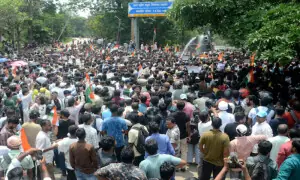
Crowds blocked roads, making it harder for the fire tenders and ambulances to reach the building.
Rescue workers repeatedly asked people to move back, but many refused to cooperate.
The noise, chaos and crowd pressure slowed down emergency operations and increased the danger for both victims and rescuers.
In moments like these, public cooperation is needed, yet it was sadly missing in many cases.
Another major issue was the lack of visible seriousness on the part of the authorities.
Despite the scale of the disaster, no senior official from the government was seen at the site during the early hours.
Their absence sent a negative message at a time when leadership, coordination and reassurance were badly needed.
The presence of senior officials could have helped improve coordination, control crowds and show that the state was taking the tragedy seriously.
Instead, their absence added to public anger and the feeling that the disaster was being handled without urgency or accountability.
One of the most alarming aspects of the Gul Plaza tragedy was the condition of the building itself.
Gul Plaza was not originally designed to support the heavy load it eventually carried.
Over time, additional floors were added without proper planning or approval.
These unplanned extensions put extra stress on the building’s structure.
When the fire broke out, the heat weakened the concrete and steel supports, leading to cracks and collapses.
Structural experts later said that the building was not strong enough to withstand such intense fire for such a long time.
Another major problem was the lack of proper fire exits.
In a large commercial building, clearly marked and easily accessible emergency exits are necessary.
In Gul Plaza, these exits were either missing, blocked or poorly designed.
Many corridors were narrow and overcrowded with goods placed outside shops.
When the smoke spread quickly, people inside struggled to find a safe way out. Panic set in, and confusion made escape even harder.
This lack of clear evacuation routes played a major role in the loss of life.
Fire safety equipment was also either absent or not in working condition.
There were no effective fire alarm systems to warn people early.
Sprinkler systems, which can slow down a fire before it spreads, were not installed.
Fire extinguishers, if present at all, were not enough to handle a blaze of this scale.
Without these basic safety measures, the fire was free to grow and spread unchecked.
By the time firefighters arrived, the situation was already out of control.
Electrical wiring inside the building was another serious concern.
Over the years, many shopkeepers have installed additional wiring to meet their needs, often without professional supervision.
Loose connections, overloaded circuits and poor-quality cables increased the risk of short circuits.
Such electrical faults are a common cause of fires in old commercial buildings.
While investigations are still ongoing, many experts believe that weak electrical systems may have contributed to the outbreak of the fire.
Ventilation inside Gul Plaza was extremely poor. The building was packed tightly with shops, and fresh air had little space to circulate.
When the fire started, smoke built up rapidly and spread throughout the structure.
Smoke inhalation is one of the leading causes of death in fires, and in this case, it made breathing almost impossible for those trapped inside.
The sealed nature of the building turned it into a deadly chamber once the fire took hold.
The human cost of the tragedy is devastating. Several people lost their lives, including a firefighter who was bravely trying to control the blaze.
Many others were injured, suffering burns, fractures and severe smoke inhalation.
Families waited in agony for news of loved ones who had gone missing inside the building.
For shopkeepers, the fire destroyed years of hard work in just a few hours.
Entire businesses were reduced to ashes, leaving owners with nothing but debt and despair.
Beyond individual losses, the incident exposed failures at an administrative level.
Building safety laws exist, but enforcement is often weak. Inspections are rare, and violations are frequently ignored.
In many cases, illegal constructions continue for years without action.
Gul Plaza was not an exception, but part of a larger pattern seen across Karachi, where commercial buildings operate without proper safety clearances.
The tragedy raised serious questions about who is responsible for ensuring public safety and why warnings are repeatedly ignored until disaster strikes.
Emergency response also came under criticism.
Although firefighters worked tirelessly, limited resources, traffic congestion and the lack of modern equipment slowed down rescue operations.
Narrow roads around the building made it difficult for fire tenders to reach the site quickly.
These issues highlight the need for better urban planning and improved emergency services in densely populated areas.
The Gul Plaza inferno is not an isolated incident. Karachi has witnessed several major fires over the years, many of them caused by similar problems such as poor construction, the lack of fire safety systems and weak oversight.
Each time, promises are made to improve regulations, yet little changes on the ground.
As a result, people continue to work and shop in buildings that are unsafe and poorly maintained.
This tragedy should serve as a wake-up call. Authorities must ensure that all commercial buildings meet strict safety standards.
Regular inspections should be made mandatory, and violations should lead to immediate action.
Fire safety systems such as alarms, sprinklers and emergency exits must be installed and maintained.
Building extensions should only be allowed after proper approval and structural assessment.
Shopkeepers and workers should be trained in basic fire safety, so they know how to respond in emergencies.
Public awareness is equally important. People must understand the risks of unsafe buildings and the importance of responsible behaviour during emergencies.
Filming suffering instead of helping only adds to the tragedy. Safety, empathy and cooperation should never be treated as optional.
Every life lost in such preventable incidents is a reminder of the cost of negligence.
The Gul Plaza fire is a story of loss, pain and failure. It is also a chance for change.
If lessons are learned and meaningful action is taken, this tragedy may at least lead to a safer future.
If ignored, it will simply become another name added to a long list of avoidable disasters.
The real responsibility now lies with those in power and with society as a whole to ensure that such an inferno never happens again.
The writer is a seasoned journalist and a communications professional.
He can be reached at [email protected]
For the latest news, follow us on Twitter @Aaj_Urdu. We are also on Facebook, Instagram and YouTube.
















Comments are closed on this story.