


Tributes pour in at Liaquat Bagh and Garhi Khuda Bakhsh for the ‘Daughter of the East’
3 min read

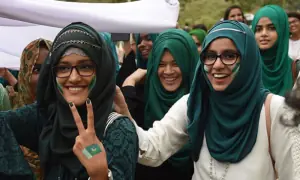



Commemorative events marking the 18th death anniversary of “Daughter of the East” former prime minister Benazir Bhutto are being held today (Saturday) at Liaquat Bagh, Rawalpindi, the site of her assassination.
The Pakistan Peoples Party (PPP) workers and supporters have begun arriving at Liaquat Bagh from various cities to pay their respects.
Quran Khawani was held at the site, while candles were lit in her memory last evening.
Benazir Bhutto was assassinated on December 27, 2007, after addressing a public rally at Liaquat Bagh.

Meanwhile, on the occasion of Benazir Bhutto’s death anniversary, a large number of PPP workers are reaching Garhi Khuda Bakhsh in Larkana to pay homage.
Reception camps have been set up at various locations to facilitate visitors.
First Lady and MNA Bibi Aseefa Bhutto Zardari visited the Bhutto family’s graveyard in Garhi Khuda Bakhsh and laid wreaths at the graves of her mother Benazir Bhutto, her maternal grandfather Zulfikar Ali Bhutto, Begum Nusrat Bhutto, Mir Murtaza Bhutto and Shahnawaz Bhutto and offered fateha for the departed souls on Saturday.
On this occasion, she paid tribute to Benazir Bhutto on her 18th death anniversary.

Benazir Bhutto’s political life was marked by extraordinary challenges. Her father, former prime minister Zulfikar Ali Bhutto, was executed; her two brothers were killed; she faced prolonged military dictatorships and endured years of exile, yet she never retreated from her struggle for democracy.
She holds the distinction of being the first woman prime minister of the Muslim world and served twice as Pakistan’s prime minister.
Political analysts describe Benazir Bhutto as one of Pakistan’s leaders who faced the toughest political challenges.
Benazir Bhutto received her early education in Karachi. She later studied at Harvard University and the University of Oxford, where she earned higher education in political science and international law.
According to observers, PPP founder Zulfikar Ali Bhutto named Benazir, rather than his sons, as his political successor — a decision that time proved correct.

During General Zia-ul-Haq’s martial law, Benazir Bhutto continued her struggle for democracy from abroad.
She received an unprecedented public welcome upon her return to Pakistan in April 1986.
Following her party’s victory in the 1988 general election, Benazir Bhutto was elected prime minister, becoming the first woman to lead a Muslim-majority country.
However, her government was dismissed after 18 months. She was re-elected prime minister in November 1993, but her second government was dissolved in 1996 by a president nominated by her own party.
After alleged political victimisation, Benazir Bhutto went into exile. In 2007, she announced her return to Pakistan despite serious security threats.
Upon her return to Karachi on October 18, 2007, Benazir Bhutto was welcomed by massive crowds.
However, her welcome procession was struck by devastating bomb attacks, causing hundreds of deaths and injuries.
Despite threats to her life, Benazir Bhutto continued to travel across the country, addressing public rallies.
On December 27, 2007, after addressing an election rally at Liaquat Bagh in Rawalpindi, Benazir Bhutto was assassinated in a gun and bomb attack.
She was laid to rest in her family’s ancestral graveyard in Garhi Khuda Bakhsh, Larkana, beside her father, former prime minister Zulfikar Ali Bhutto, and her brothers Mir Murtaza Bhutto and Shahnawaz Bhutto.
For the latest news, follow us on Twitter @Aaj_Urdu. We are also on Facebook, Instagram and YouTube.





Comments are closed on this story.