

Hormuz traffic near standstill as US vows blockade
4 min read

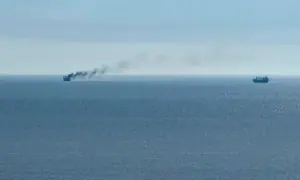
Transit through the Strait of Hormuz appeared to grind to a near standstill on Friday after two more ships were attacked there and the United States said it could maintain a naval blockade of Iran indefinitely.
A senior Iranian source said on Wednesday that there had been no progress in talks to build on a June agreement to end the war. Since the ceasefire renewed in the June deal broke down, Iran has resumed attacks on ships it accuses of trying to transit the strait without its permission.
The United Arab Emirates’ Abu Dhabi National Oil Company said two of its vessels were attacked transiting the strait on Thursday evening. The UAE government blamed Iran, which made no immediate comment.
Two vessels passed through the narrow waterway on Friday, according to analysis from ship tracking firm Kpler: a grain ship entering Iranian waters and an empty dry bulk ship going in the other direction.
A separate empty liquefied petroleum products tanker was sailing into the Gulf via the strait, the data showed. There were no crude oil shipments visible on Friday.
Nine vessels passed through the strait on Thursday, up from five on Wednesday but below the average of 12 for August.
Some ships may pass through undetected with their transponders off, but the figures are nowhere near the more than 130 ships that traversed the Strait of Hormuz daily before the war launched by the US and Israel on Iran in February.
“Alongside the threat to energy infrastructure in the region, Iran’s ability to restrict shipping through the strait is its main source of leverage in negotiations,” said Torbjorn Solvedt, principal Middle East analyst with risk intelligence company Verisk Maplecroft.
US PLEDGES NEW MEASURES AGAINST IRAN IN COMING WEEK
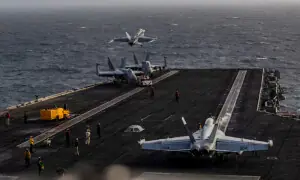
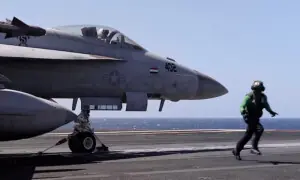
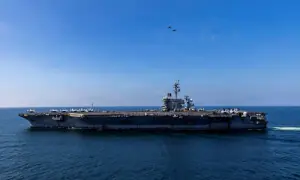
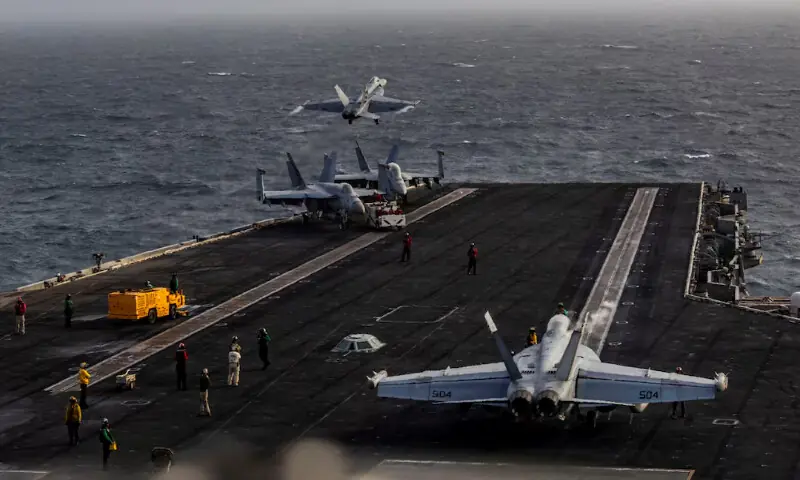
US Defence Secretary Pete Hegseth told reporters the US military has the capability to maintain a naval presence in the region to enforce its retaliatory blockade of Iran, which has inflicted severe economic damage on the country.
“Indefinitely the United States Navy can maintain a blockade like that because we’ll rotate ships in and out, as we have, and we’ll continue to,” Hegseth told reporters during a trip to Panama.
Treasury Secretary Scott Bessent said the United States planned to inflict more financial damage on Iran.
“Watch this space for more announcements coming next week because we are going to apply measures like have never been seen in the history of economic isolation on a country,” he said in an interview on Newsmax’s “Rob Schmitt Tonight” programme.
US President Donald Trump is under pressure at home to end an unpopular war, with high fuel prices dragging down his approval ratings and potentially eroding his party’s control of Congress in midterm elections in November.
Benchmark Brent futures and US West Texas Intermediate crude futures were both up slightly at about $87 and $81 a barrel, respectively.
India’s reliance on Russian crude surged to a record in July, while refineries in Asia, a major customer for fuel from the Gulf, bought US crude this week to ensure future supplies.
Trump has repeatedly asserted that the US has “total control” over the strait, through which a fifth of global oil and liquefied natural gas flowed before the start of the war.
Iran rejects that, and has said it will not allow the waterway to reopen until its conditions are met. These include removing economic sanctions and releasing frozen Iranian assets.
On Thursday, an Iranian parliamentary committee approved Iran’s plan for the strait. It includes a provision banning the transit of US, Israeli and other “hostile” countries’ assets and equipment, the semi-official Tasnim News Agency reported.
The US lifted its blockade of Iran’s shipping and ports for a month in mid-June but has since reimposed it, cutting off Tehran’s primary source of hard currency and compounding earlier losses from wartime strikes on its energy infrastructure.
Washington previously said it would lift the Iranian blockade once Iran and Oman, which sit on either side of the strait, reach an agreement to restore commercial shipping.
SHRINKING OIL SUPPLY
Trump has also repeatedly threatened to escalate military strikes and “hit Iran hard”, although he has thus far resisted deploying ground troops or seizing strategic islands and bombing desalination plants. Earlier this week, Trump suggested he would rely on economic means, rather than military action.
The US has tightened economic sanctions against Iran and other individuals and entities that it says are helping it procure weapons, but the pressure campaign has not brought Tehran back to the negotiating table.
Reports that Yemen’s Iran-backed Houthis had targeted a Saudi Aramco refinery with drones on Thursday renewed concerns about a widening regional war.
Global economists have forecast a sharp drop in global growth, and potentially a swing into recession in some areas, warning that the impact would grow if the war was not ended soon.
For the latest news, follow us on Twitter @Aaj_Urdu. We are also on Facebook, Instagram and YouTube.