As Iran war drags on, Americans are bracing for more chaos in Middle East, poll finds
4 min read


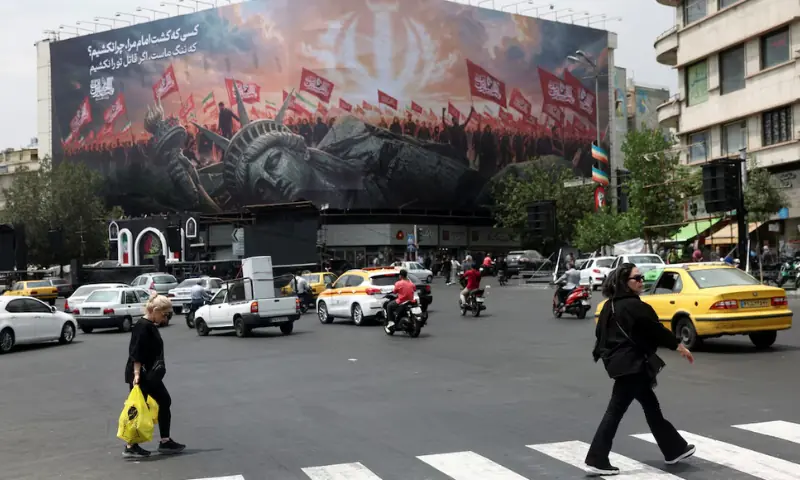
Five months into the US war with Iran, Americans who expect the Middle East to slide toward chaos outnumber those who see the war bringing more stability by three to one, according to a new Reuters/Ipsos poll.
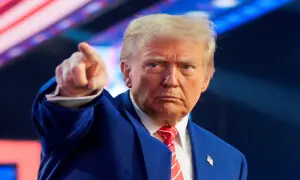
The six-day poll concluded on Monday, as Republican President Donald Trump again backed away from threatened “massive attacks” on Iran, underscoring uncertainty surrounding a conflict he initially predicted would bring a swift victory.
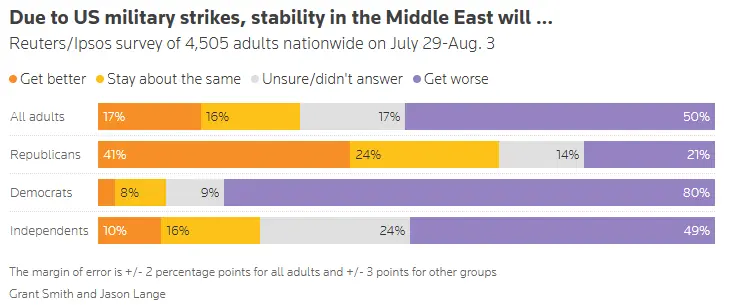
Fifty per cent of poll respondents said they thought US military action in Iran would destabilise the Middle East over the next year, about three times the 17% who said the war would lead to more stability in the region. Another 16% said stability would stay about the same and 17% said they were unsure or didn’t answer the question.
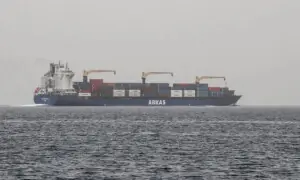
Americans were also pessimistic about gasoline prices, which have risen as Iran has choked off traffic through the Strait of Hormuz, a vital route for global oil supplies. Some 58% said they expected gas prices to worsen, while just 15% expected them to improve.
Respondents held similarly grim views about the Russian invasion of Ukraine, with a majority fearing it will get worse over the next few years, and also raising concerns about new conflicts arising elsewhere on the world stage.
Political risk
The findings underscore the political risks for Trump and his fellow Republicans as they seek to defend narrow congressional majorities in November’s midterm elections.
Trump returned to office in January 2025 vowing to avoid “stupid wars”, a message that resonated with voters weary of the two decades of war that followed the September 11, 2001, al Qaeda attacks.
Republicans, in contrast with their general support for Trump, were sharply divided on how they see his war with Iran playing out. While 80% of Republicans approve of Trump’s performance as president and 66% back his handling of Iran, fewer than half - 41% - think stability in the Middle East will get better over the next year as a result of the war.
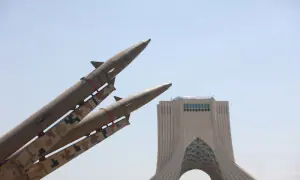
The war has led to Iranian missile and drone attacks against neighbouring countries and commercial shipping, and sparked new fighting in Lebanon, which has reduced in intensity since a US-brokered truce. The Iran-backed Houthis in Yemen have also threatened Saudi shipping transiting the Bab al-Mandeb chokepoint at the southern end of the Red Sea.
David Schenker, who served as the State Department’s top Middle East official during Trump’s first term, said the economic effects could persist even if the fighting ended quickly. But he said it was not certain the war would result in a more unstable Middle East, arguing that US and Israeli attacks had significantly weakened Iran’s military capabilities and the regional proxy network.
“I don’t think there’s an understanding of the nature of the degradation of Iran’s capabilities, which is significant,” said Schenker, now with the Washington Institute for Near East Policy.
The war, which Trump launched with Israel in late February, has cost US taxpayers at least $37.5 billion, killed 18 US service members and killed thousands of Iranians.
An unpopular war
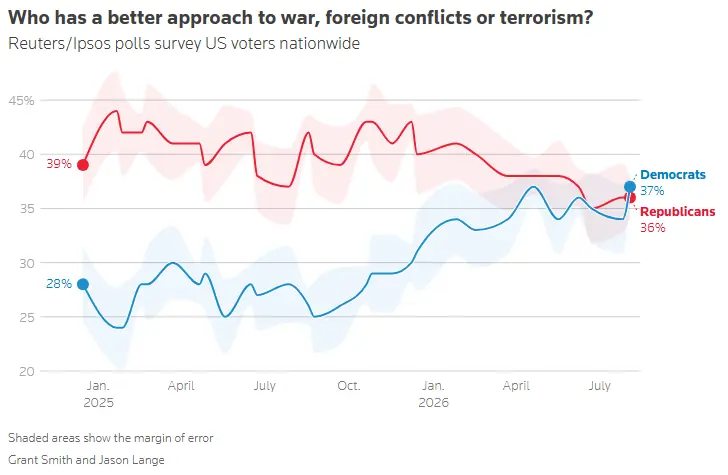
Just 35% of Americans approve of the war. Asked which political party has a better approach to handling war and terrorism, registered voters picked Democrats over Republicans - 37% to 36% - the first time Democrats led since Reuters/Ipsos polling began posing the question in December 2024, when Republicans led 39% to 28%. The poll also showed voters now see Democrats as better able to manage the economy for the first time in about a decade.
“This war was unpopular the day it started, and it’s gotten more unpopular since,” said Justin Logan, director of defence and foreign policy studies at the Cato Institute, a Washington think tank.
Logan said Trump faced a difficult tradeoff: He has set ambitious goals for the conflict - destroying Iran’s missile capabilities and preventing it from ever obtaining a nuclear weapon - while seeking to limit US casualties and the political costs that could come with them.
“That incoherence, or rudderlessness, in the conduct of the war is causing more problems for the president,” Logan said.
Worries about Ukraine, China
The poll found that Americans also have significant concerns that wars underway will get worse and that new wars will break out. Some 58% said they were concerned the Russia-Ukraine war, in which Washington and European allies have supported Kyiv with weapons and intelligence, could get worse.
Another 55% said they worried about China engaging in conflict with Taiwan, while 48% were concerned a war could break out between Russia and a European country other than Ukraine. Some 37% worried the US would go to war over Greenland.
The Reuters/Ipsos poll was conducted online, gathering responses from 4,505 US adults nationwide. It had a margin of error of 2 percentage points.
For the latest news, follow us on Twitter @Aaj_Urdu. We are also on Facebook, Instagram and YouTube.