


Space startups race to build infrastructure of trillion-dollar orbital economy
4 min read




A wave of space startups is attracting major investment as the global space economy is projected to reach $1.8 trillion by 2035, with companies increasingly focused not on reaching orbit, but on building the infrastructure to sustain long-term activity beyond Earth.
Once dominated by governments and large aerospace firms, the sector has opened up due to falling launch costs, improved satellite data processing, and growing demand from commercial and defence customers for space-based services, according to a report in Forbes.
From access to infrastructure
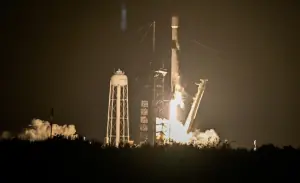
Industry executives say cheaper access to orbit, driven in part by reusable rockets such as Falcon 9 developed by SpaceX, has enabled smaller firms to raise tens of millions in funding and build hardware for space deployment.
Eric Truitt, CEO and cofounder of space infrastructure startup Mantis Space, said launch costs have fallen to about $7,000 per kilogram, allowing startups with relatively modest capital to deploy orbital systems.
“There is truly now a market in space, with demonstrated demand and demonstrated value,” he said.
Building a ‘space power grid’
One of the emerging players, Mantis Space, is developing what it describes as the first orbital power distribution network.
The system would use laser-based transmission to beam energy between satellites in medium Earth orbit, reducing reliance on onboard batteries and sunlight availability.
Originally, the company explored beaming solar energy to Earth, but cofounder Jeremy Scheerer said physics constraints made that model less viable.
Instead, the company shifted focus to “transmitting power from space to space,” targeting satellites that spend significant time in Earth’s shadow.
The Albuquerque-based firm operates a 20,000-square-foot laser optics lab in New Mexico and has raised a $15 million seed round alongside roughly $28 million in non-dilutive public funding.
Its 22-person team includes engineers with backgrounds in major optics and space science programmes.
National security and operational demand
New leadership additions include former US navy officer Hugh Wyman Howard III, who said orbital power is becoming a key limiting factor for mission capability.
He compared the company’s work to defence operations, noting that reliable power in orbit directly affects the performance of intelligence and surveillance systems used on Earth.
Funding surge, but structural risks remain
Investors say the sector is benefiting from a broader shift in confidence following the commercial success of companies such as ICEYE and others in the satellite data market, alongside growing geopolitical demand for space-based defence capabilities.
However, industry leaders warn that space startups face two persistent challenges: the gap between early funding and stable long-term contracts, and the difficulty of operating complex satellite systems reliably at scale.
Ann Stevens, US CEO of ICEYE US, said many firms fail not in building technology, but in transitioning to sustained, mission-critical service delivery.
“Operating one reliably, day after day, is a different discipline entirely,” she said.
Geopolitics and new markets
Investors also point to rising defence spending and emerging technologies such as direct-to-device connectivity and in-orbit computing as major growth drivers.
Some analysts expect orbital data centres to become a future market, despite technical hurdles.
Space investment firm Seraphim Space said these trends have made it easier for startups to attract venture capital by demonstrating credible commercial pathways within typical investment timelines.
Scaling challenges and launch bottlenecks
A key constraint remains launch capacity, with firms often needing to book rocket rides well in advance.
Startups without enough funding can get stuck waiting for a single rocket launch, slowing down their progress and stretching out months — or even years — before they can try again.
Environmental implications
Companies such as Mantis Space argue that building permanent orbital infrastructure could reduce waste from decommissioned satellites, which are often deorbited into the ocean.
Extending satellite lifespans from a few years to a decade or more is also seen as a potential environmental benefit.
Outlook
Mantis Space plans to begin in-orbit demonstrations of its laser-based power transmission system in 2028, with long-term ambitions to expand orbital energy infrastructure.
Truitt said the broader goal is to remove power constraints in space systems: “We are enabling humanity’s ability to go beyond Earth, and by solving the power constraint, we unlock the true potential of space.”
For the latest news, follow us on Twitter @Aaj_Urdu. We are also on Facebook, Instagram and YouTube.
















Comments are closed on this story.