


India's tougher grid rules unsettle investors, test clean energy ambitions
4 min read



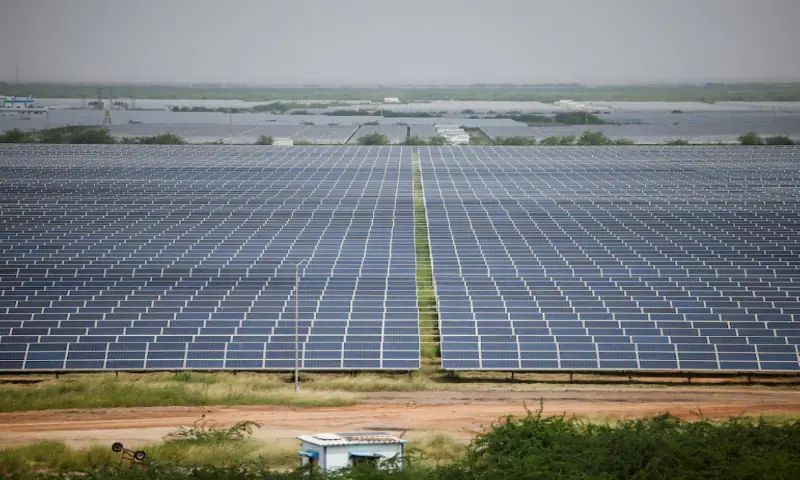
India’s push to tighten power grid discipline is colliding with its clean energy ambitions as tougher rules for solar and wind projects alarm investors, who warn the requirements could slash returns and impede investment needed for the energy transition.
The most-feared regulations, due to take effect in April 2027, sharply increase penalties when renewable power producers fail to deliver electricity matching their commitments to the grid, according to industry executives, investor presentations and documents reviewed by Reuters.
Industry groups estimate the tougher regime could cut revenue by about 11% for solar projects and as much as 48% for wind farms, fuelling concerns that India could make renewable investments less attractive just as it seeks billions of dollars to expand clean energy capacity.
India’s federal power regulator has said a tougher framework is needed to protect grid stability as renewable capacity expands rapidly.
The dispute over the new rules underscores the challenge of integrating growing volumes of renewable power into India’s grid while preserving investor confidence as the country seeks to meet its clean energy target of installing 500 gigawatts of non-fossil fuel capacity by 2030.
Under the revised rules, penalties rise according to the gap between scheduled and actual power supplied to the grid.
“Developers will face very high penalties even when deviations are small. This tightens margins, revenues will shrink and project viability will be affected,” said Debabrat Ghosh, India head at energy consultancy Aurora Energy Research.
Investors and developers generally eye at least a 10% internal rate of return (IRR) for solar projects, and at least 12% to 13% for hybrid projects combining solar and wind, analysts and industry executives said.
Aurora expects the new rules to reduce IRRs by 1.5 percentage points for wind projects and by 1.2 percentage points for hybrid projects.
Wanted: Real-time weather forecasts
The penalties expose companies to financial risks they cannot fully control because renewable energy generation depends on weather conditions that remain difficult to forecast accurately in India, developers said.
“Renewable energy operates within the limits of weather and forecasting uncertainty,” said Raghavendra Upadhya, chief executive of the Wind Independent Power Producers Association, which represents more than 50 clean energy producers.
“While grid discipline is essential, the current approach places additional risk on projects built under earlier frameworks,” he said.
Smaller developers whose projects are most at risk from the tougher rules referred Reuters to their industry associations for comments.
The National Solar Energy Federation of India, which represents more than 100 clean energy companies, has challenged the regulation in court.
Officials have told industry representatives there can be no compromise on grid discipline, according to people familiar with the discussions.
Stricter rules unsettle foreign investors
Industry executives said the policy shift has caught developers off guard because many existing projects were bid and financed under a more lenient regime, leaving them exposed to costs that were not factored into their original economics.
“The market has not yet developed for generators to be that accurate,” said Pratyush Thakur, India country head at Blueleaf Energy, a clean energy producer and investor, owned by Australia’s Macquarie Asset Management.
The concerns have also unsettled other major foreign investors that have poured billions of dollars into India’s clean energy sector.
Investors, including Canada Pension Plan Investment Board and Actis, raised concerns with Indian officials during a meeting in April, according to five industry sources familiar with the discussions.
The investors warned about the impact of lower returns, policy unpredictability and financial stress from tighter grid rules, while arguing that regulatory tightening was advancing faster than improvements in transmission infrastructure and battery storage capacity, the sources said.
Because of these challenges, investment in the sector would slow, Thakur said, although he added that Blueleaf remained committed to India because of its long-term renewable energy potential.
Blueleaf plans to deploy about $3 billion in India, including around $1 billion in equity over the next three years, but expects grid-related constraints to delay the equity deployment by a further two to three years.
Actis said India continued to be one of its preferred investment destinations.
KKR and Canada Pension Plan Investment Board did not respond to Reuters requests for comment.
Industry groups have also appealed to the prime minister’s office for relief, two sources said.
The clean energy ministry has held discussions with industry groups and appears open to easing implementation of the rules, according to the sources and documents reviewed by Reuters.
But the power ministry, its technical adviser, the Central Electricity Authority, and Grid India, the country’s grid operator, have maintained that stricter enforcement is necessary to prevent grid instability.
The prime minister’s office, power ministry, clean energy ministry, Central Electricity Authority and Grid India did not respond to Reuters’ requests for comment.
Costly upgrades to meet tougher regulations
Developers say India still lacks several tools needed to meet the tighter standards.
Industry executives say weather forecasts in India are typically updated only a few times daily, compared with near real-time forecasting in some European power markets.
To adapt, renewable energy companies are investing in upgraded forecasting systems, automated weather stations and data science teams to improve power scheduling accuracy.
The industry will need to take other steps, such as adding batteries, said Kartikeya Sharma, co-founder of Sunsure Energy.
Sunsure is installing advanced automated weather stations on site and subscribing to real-time, high-resolution satellite weather data from European providers, he said.
For the latest news, follow us on Twitter @Aaj_Urdu. We are also on Facebook, Instagram and YouTube.
















Comments are closed on this story.