Hegseth spars with Democrats over Iran war in Congress
4 min read


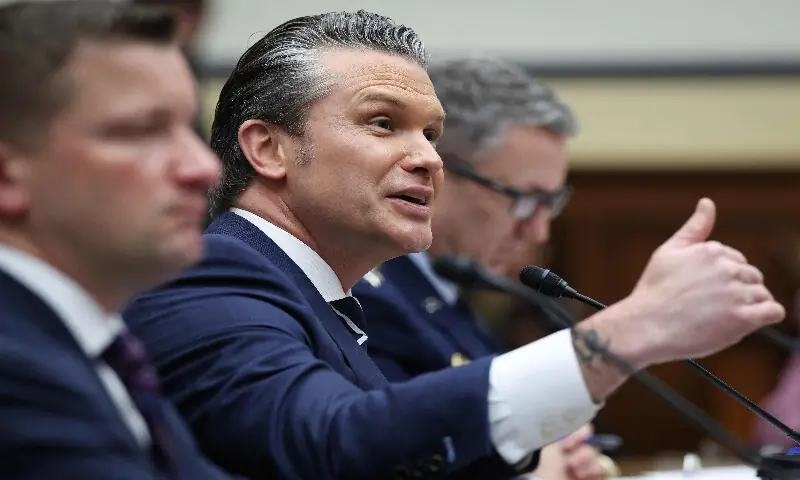
US Defence Secretary Pete Hegseth repeatedly clashed with Democratic lawmakers over the Iran war on Wednesday, in his first testimony to Congress since President Donald Trump launched the conflict two months ago.
Appearing before the House Armed Services Committee, Hegseth quickly struck a combative tone, saying in his opening remarks that the main challenge at this point is the “defeatist words of congressional Democrats and some Republicans.”
Representative Adam Smith — the committee’s top Democrat — took aim at the regional fallout from the war and its toll on both US troops as well as civilians, saying he wanted answers on where the conflict is going and “the plan to achieve our objectives.”
He later asked Hegseth how the “lethal, kinetic action” of the war could be translated into degrading Iran’s nuclear program, which Washington is seeking to eliminate.
Hegseth responded by taking aim at the “very bad” Iran nuclear agreement that Trump scrapped during his first term in office.
Representative John Garamendi, another Democrat, accused Hegseth of “lying to the American public about this war from day one,” describing events in the Middle East as a “geopolitical calamity, a strategic blunder, resulting in worldwide economic crisis.”
“During the 60 days of Trump’s Iran war, critical munitions have been expended at an alarming rate, depleting magazine levels below what is thought necessary to hold China at bay,” said Garamendi, also describing the conflict as a “quagmire.”
Hegseth pushed back, asking Garamendi “who are you cheering for here?” and saying that calling the war a quagmire was “handing propaganda to our enemies.”
$25 billion cost
Democratic Representative Seth Moulton asked Hegseth if he advised Trump to attack Iran — a question Hegseth declined to answer, though he later said he thought doing so was “a good idea.”
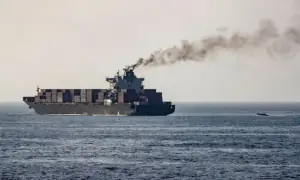
Asked by Moulton if he had considered the risk of Iran closing the vital Strait of Hormuz if it were attacked, Hegseth said the Pentagon “looked at all aspects of this risk.”
But the Defence Department failed to prevent the closure of the strait, which has sent oil prices spiking and caused economic fallout around the globe.
Washington has hit back with a blockade of Iran’s ports, and now has three aircraft carriers deployed in the Middle East for the first time in more than 20 years.
Hegseth was asked about the cost of the conflict, which he said was estimated at less than $25 billion so far.
The Pentagon chief then asked the committee: “What is it worth to ensure that Iran never gets a nuclear weapon?”
Trump has indefinitely extended what was initially a two-week ceasefire with Iran, but negotiations have yet to yield a breakthrough on either ending the conflict or Tehran’s nuclear programme.
Hegseth also faced questions about an Iranian attack in Kuwait that killed six US troops on March 1, the second day of the war.
There were “no counter-drone capabilities, no counter-rocket systems, no counter-mortar or counter-artillery” to protect those troops, Democratic Representative Patrick Ryan said.
Hegseth insisted that “before the commencement of the conflict, we put in (the) maximum defensive posture we could,” continuing to speak as Ryan directed him to “stop.”
“Just because you yell doesn’t make you right,” Hegseth told the lawmaker.
Ryan was one of more than a dozen Democrats who signed a letter to Hegseth last week demanding a “formal, immediate investigation” into the attack in Kuwait, saying the Pentagon chief failed to protect American forces and then “misled the public about the circumstances of the attack.”
A total of 13 American troops have been killed in the conflict while 400 have been wounded.
Earlier, a senior Pentagon official said the United States’ war in Iran has cost $25 billion so far, providing the first official estimate of the military’s price tag for the conflict.
With just six months before the midterm elections in which President Donald Trump’s Republicans may face an uphill battle to keep their House majority, Democrats are riding high in public opinion polls as they attempt to link the unpopular Iran war with affordability.
Jules Hurst, who is performing the duties of the comptroller, told lawmakers on the House Armed Services Committee that most of that money was for munitions.
Hurst did not detail what that cost estimate included and whether it took into account the projected costs of rebuilding and repairing base infrastructure in the Middle East damaged in the conflict.
Rep. Adam Smith, the top Democrat on the House Armed Services Committee, responded to Hurst: “I’m glad you answered that question. Because we’ve been asking for a hell of a long time, and no one’s given us the number.”
The $25 billion cost is equal to the entire budget of NASA for this year.
But it is unclear how the Pentagon arrived at the $25 billion amount given that a source had told Reuters last month that President Donald Trump’s administration estimated that the first six days of the war had cost the United States at least $11.3 billion.
For the latest news, follow us on Twitter @Aaj_Urdu. We are also on Facebook, Instagram and YouTube.