


Trump extends Iran ceasefire after Pakistan request
3 min read





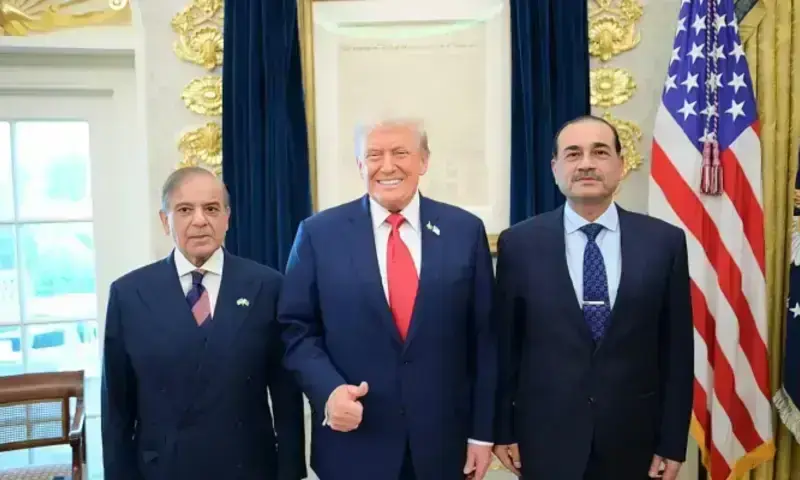
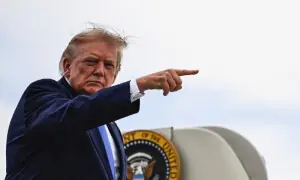
US President Donald Trump on Wednesday extended a ceasefire with Iran, delaying its expiry to allow more time for negotiations mediated by Pakistan.
Trump said the decision followed a request from Pakistan, which has been facilitating talks between Washington and Tehran. He added that US forces would maintain a naval blockade of Iranian ports while attacks remain paused.
The extension comes despite Trump’s earlier threats to strike Iranian infrastructure.
In a statement, Trump said attacks on Iran would remain on hold, but military readiness and the blockade would continue.
Trump said that he was extending a ceasefire between the US and Iran until Tehran submitted a “unified proposal” and “discussions are concluded, one way or the other”.
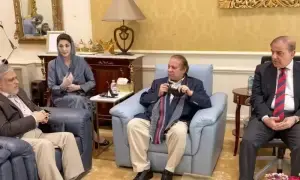
“Based on the fact that the Government of Iran is seriously fractured, not unexpectedly so and, upon the request of Field Marshal Asim Munir, and Prime Minister Shehbaz Sharif, of Pakistan, we have been asked to hold our Attack on the Country of Iran until such time as their leaders and representatives can come up with a unified proposal.
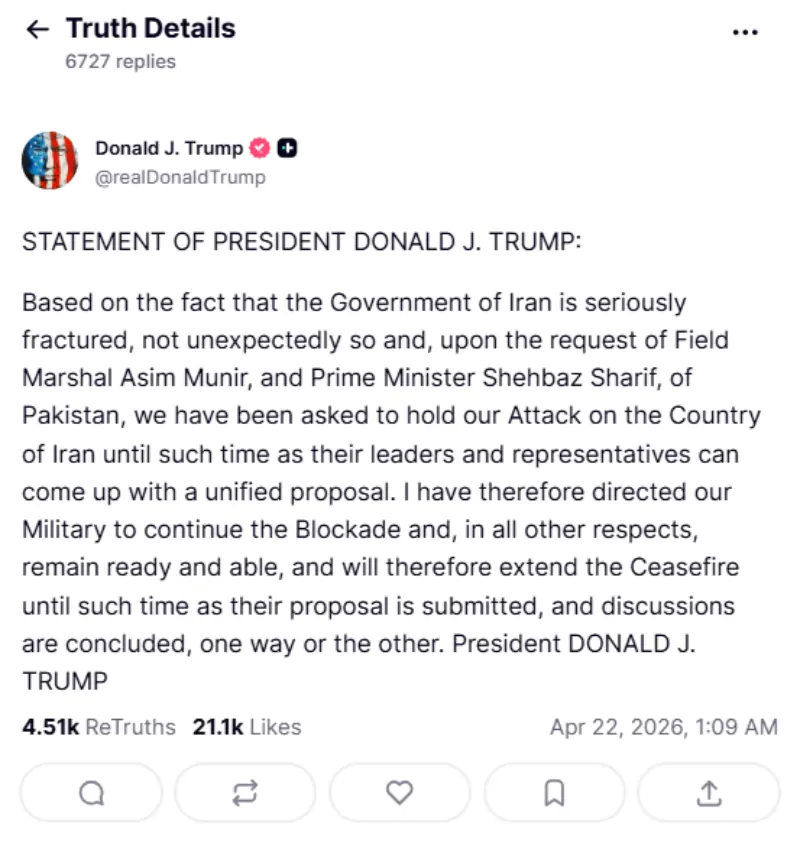
“I have therefore directed our Military to continue the Blockade and, in all other respects, remain ready and able, and will therefore extend the Ceasefire until such time as their proposal is submitted, and discussions are concluded, one way or the other,” he posted on his Truth Social platform.
Trump’s statement came as the Pakistan-brokered ceasefire agreed on April 8 neared its deadline. The original deadline for the ceasefire was set for April 21 at 8.00 p.m. ET, but Trump said on Monday that it was to continue till “Wednesday evening Washington time”.
He had said he would not extend it beyond Wednesday, but reversed course at the last moment.
Pakistan’s Information Minister Attaullah Tarar had earlier said the truce would end at 4:50 a.m. PST on April 22.
Blockade dispute clouds talks
Tensions remain high over the US naval blockade, which Tehran has described as a violation of the ceasefire.
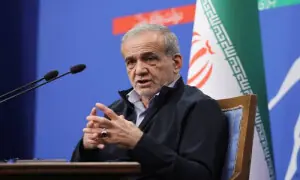
Iran’s Foreign Minister Abbas Araqchi called the blockade an “act of war” and accused Washington of breaching the truce.
“Iran knows how to neutralize restrictions, how to defend its interests, and how to resist bullying,” he posted on X.
Iran has also tightened control over the Strait of Hormuz in response, raising concerns over global oil flows.
Uncertainty over Islamabad talks
The ceasefire extension comes amid uncertainty over a planned second round of talks in Islamabad.
US Vice President JD Vance, expected to lead the American delegation, had not departed Washington as of Tuesday. A US official said he remained engaged in policy meetings at the White House.
At the same time, Iran signalled hesitation over participating.
“The reason for this is not indecision; the reason for this situation is that we are faced with contradictory messages, contradictory behaviours, and unacceptable actions from the American side,” said foreign ministry spokesman Esmaeil Baqaei.
Despite the uncertainty, Trump expressed confidence in Washington’s position.
“We’re going to end up with a great deal. I think they have no choice,” he told CNBC.
Both sides have accused each other of violating the ceasefire since the first round of talks in Islamabad. The US has enforced a maritime blockade, while Iran has restricted access through the Strait of Hormuz.
Pakistan has continued diplomatic efforts to keep negotiations on track.
Foreign Minister Ishaq Dar urged both sides “to consider extending the ceasefire and to give dialogue and diplomacy a chance,” according to a foreign ministry statement.
Information Minister Attaullah Tarar said Islamabad was still awaiting confirmation from Tehran on participation in the next round of talks, calling the decision “critical”.
Iranian parliament speaker Mohammad Bagher Ghalibaf warned that Tehran would not negotiate “under the shadow of threats” and would “show new cards on the battlefield” if fighting resumes.
Earlier, the US Defence Department said it had intercepted and boarded a “stateless sanctioned” vessel linked to Iranian activity as part of enforcement measures.
For the latest news, follow us on Twitter @Aaj_Urdu. We are also on Facebook, Instagram and YouTube.






Comments are closed on this story.