


EU divided on suspension of Israel pact as Spain pushes for action
3 min read

European countries, including Spain and Ireland, pushed on Tuesday for suspending a European Union pact governing its relationship with Israel, but the bloc remained divided on whether to take action.
Arriving at an EU foreign ministers meeting in Luxembourg, a number of ministers called for suspending or partially suspending the pact over concerns about settlements in the West Bank, the humanitarian situation in Gaza and a new death penalty law.
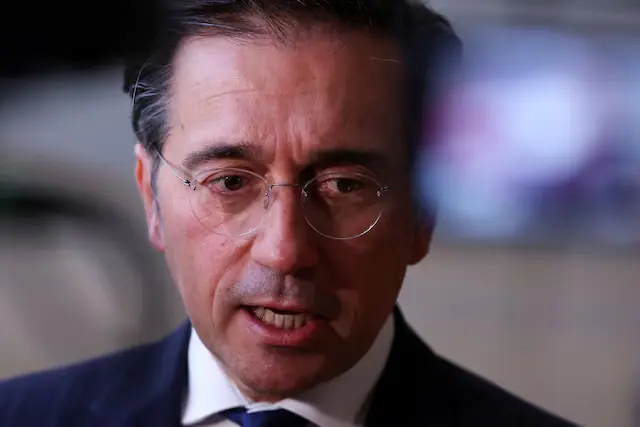
“Today, Europe’s credibility is at stake,” Spain’s Foreign Minister Jose Manuel Albares told reporters, calling for a discussion on suspending the association agreement, which came into force in 2000.
Diplomats nevertheless do not expect a decision at the meeting, as countries retain diverging positions as to whether - and how - to shift the bloc’s policies on Israel.
Germany calling for dialogue
The European Commission proposed in September suspending some trade-related provisions of the association agreement, an arrangement affecting about 5.8 billion euros of Israeli exports. Israel said at the time the proposals were “morally and politically distorted”.
Suspending the trade arrangement would require a qualified majority vote among EU governments - the support of 15 out of 27 EU members representing 65% of the EU population. A full suspension of the association agreement would require a unanimous decision from all member countries.
Thus far, the European Commission’s proposal has not garnered sufficient support to meet this threshold.
Officials are especially watching Berlin and Rome’s positions, but on Tuesday, Germany indicated that it was sticking to its existing position, stressing the need for dialogue rather than action against Israel.
“We have expressed our criticism regarding the introduction of the death penalty. We warned against taking this step beforehand. We also have a very clear position on settler violence,” German Foreign Minister Johann Wadephul told reporters.
Berlin remains committed to creating the conditions for a two-state solution with the Palestinians, “but this must be done through critical, constructive dialogue with Israel”, he added.
Trading partner
Danish Foreign Minister Lars Lokke Rasmussen said ahead of the meeting that “there is no sign of any majority in favour of doing anything with the association agreement”, also citing the current ceasefire between Israel and Lebanon.
Ministers from countries including Ireland and Belgium pushed for a shift in the EU’s policy.
Belgian Foreign Minister Maxime Prevost said his country was calling for at least a partial suspension of the association agreement, but added that Belgium is “aware that a full suspension is probably out of reach given the positions of the various European countries”.
The European Union is Israel’s biggest trading partner, with trade in goods between the two amounting to 42.6 billion euros in 2024, according to the EU.
The EU also has proposals on the table to impose sanctions on violent settlers and Israeli ministers it deems to be extremist.
These proposals require unanimous backing from member countries, with diplomats hoping that the measures targeting violent settlers could move ahead once a new Hungarian government comes to office in May. Israel has blamed settler attacks on a “fringe minority”.
Sweden and France, meanwhile, have circulated a paper ahead of Tuesday’s meeting calling for the EU to take stronger action to limit commercial engagement with illegal settlements.
Some ministers indicated that they are searching for ways to put pressure on Israel, even in the absence of sufficient votes to take action on the association agreement.
“It is important to increase the pressure on Israel,” Dutch Foreign Minister Tom Berendsen said, adding, “The goal is not to suspend the trade section. The goal is behavioural change in Israel, and that is what we are working on.”
Israeli settlements in the West Bank are deemed illegal by the United Nations and much of the international community. Israel disputes that interpretation. Palestinians hope the West Bank will be part of a future state.
For the latest news, follow us on Twitter @Aaj_Urdu. We are also on Facebook, Instagram and YouTube.








Comments are closed on this story.