



US-Iran truce: Iranian official says strait could open in time for talks
5 min read


The United States and Iran agreed to a two-week ceasefire brokered by Pakistan, suspending a six-week-old war that has killed thousands, spread across the Middle East and caused unprecedented disruption to the world’s energy supplies.
There was relief on many of the region’s streets and in world financial markets after President Donald Trump announced the agreement late on Tuesday, two hours before a deadline he had set for Iran to open the blockaded Strait of Hormuz or face the destruction of its “whole civilisation”.
Both sides declared victory. But their main disputes remained unresolved, with Washington and Tehran sticking to competing demands for a potential peace deal that could shape the Middle East for generations.
A senior Iranian official involved in the discussions told Reuters Tehran could open the Strait of Hormuz on Thursday or Friday ahead of planned peace talks in Pakistan, if a framework for the ceasefire is agreed.
By Wednesday afternoon, the United States and Israel appeared to be abiding by their promise to pause the devastating air campaign that had pounded hundreds of Iranian targets a day for six weeks.
But in Lebanon, where Israel has waged war in parallel with its strikes on Iran, Israel not only said the ceasefire did not apply, it chose to escalate, launching what its forces described as their biggest air strikes yet on Iran’s Hezbollah allies.
Explosions tore through Beirut, and huge columns of smoke rose into the sky. Residents in Beirut and the south said the attacks came without the usual warnings to evacuate targeted buildings.
Meanwhile, Iran’s Gulf neighbours, including Kuwait, the UAE and Bahrain, were still reporting incoming attacks by Iranian missiles and drones during the day.
Pakistani Prime Minister Shehbaz Sharif said he had invited Iranian and US delegations to meet in Islamabad on Friday for what would be the first official peace talks since the war began, and that Iran’s president had confirmed it would attend.
US Vice President JD Vance, seen as the potential head of an American delegation, said Trump had told negotiators to try to reach an agreement, but Vance stopped short of confirming talks at a specific time or place.
IRAN’S RULING ESTABLISHMENT SURVIVES
Trump said Iran had agreed to open the Strait of Hormuz, where a fifth of global oil and liquefied natural gas normally passes. But the senior Iranian official made clear this was still conditional on clinching a framework ceasefire agreement. The official said the initial opening would be “limited” and ships would still require Iranian permission to pass.
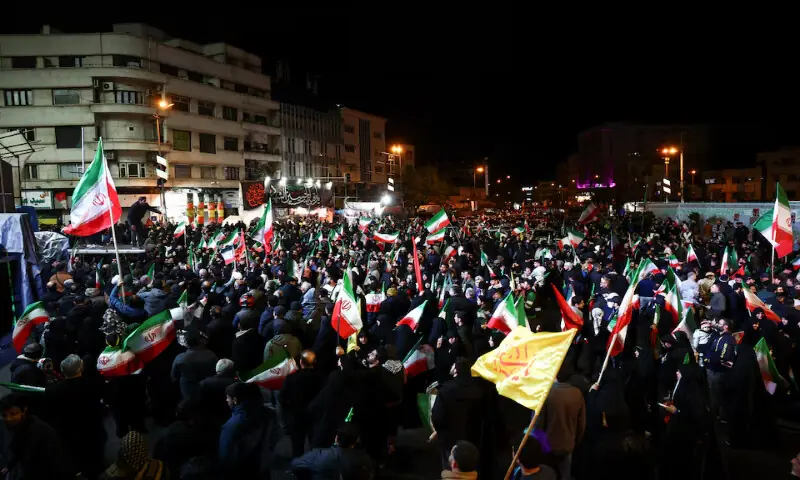
Crowds took to the streets of Iran overnight to celebrate, waving Iranian flags and burning flags of the United States and Israel. But there was also wariness that a deal would not hold.
“Israel will not allow diplomacy to work, and Trump might change his view tomorrow. But at least we can sleep tonight without strikes,” Alireza, 29, a government employee in Tehran, told Reuters by phone.
The ceasefire would suspend the war launched on February 28 by Trump and Israeli Prime Minister Benjamin Netanyahu, who had announced they aimed to prevent Iran from projecting force beyond its borders, end its nuclear programme and create conditions for Iranians to topple their rulers.
Trump told the French news agency AFP that the ceasefire represented a “total and complete victory” and said on Truth Social that the US had achieved its military objectives.
But so far, Iran retains both its stockpile of near-weapons-grade highly enriched uranium and its ability to hit its neighbours with missiles and drones. The clerical leadership, which faced a mass uprising months ago, has withstood the superpower onslaught with no sign of domestic opposition.
And Tehran’s newly proven ability to cut off Gulf energy supplies through its grip on the strait, despite the massive US military presence built across the region over decades, could reshape the power dynamics of the Gulf for years.
“The enemy, in its unjust, illegal and criminal war against the Iranian nation, has suffered an undeniable, historic and crushing defeat,” Iran’s Supreme National Security Council said in a statement.
Netanyahu’s office said Israel supported the decision to suspend strikes on Iran for two weeks. But the agreement is likely to be seen as a blow for the Israeli leader, who had repeatedly said he wanted Iran’s rulers to fall.
“There has never been such a diplomatic disaster in all our history,” said opposition politician Yair Lapid. Yair Golan, a former Israeli military deputy chief of staff, called the outcome a “complete failure that endangered Israel’s security”.
“The nuclear programme was not destroyed. The ballistic threat remains. The regime is still intact and is even emerging from this war stronger,” he wrote on X.
COMPETING PEACE PLANS
Shipping firms said they needed further assurances of safety before sailing.
“Any decision to transit the Strait of Hormuz will be based on continuous risk assessments, close monitoring of the security situation, and available guidance from relevant authorities and partners,” said container shipper Maersk.
If peace talks open on Friday in Islamabad as announced, they will begin with the main demands of the warring sides unresolved. Washington has presented its demands in a 15-point plan, while Iran has responded with a 10-point plan of its own.
In a post overnight, Trump acknowledged receiving the Iranian plan and called it “a workable basis to negotiate”, which Iran’s powerful security council said amounted to accepting its terms in principle. Those include lifting all sanctions, compensating Iran for damage and leaving it in control of the strait.
An Israeli official said senior Trump administration officials had assured Israel that they would insist on previous conditions, such as the removal of Iran’s nuclear material, a halt to enrichment and the elimination of ballistic missiles.
Hossein Shariatmadari, editor-in-chief of Kayhan, a newspaper closely associated with late supreme leader Ayatollah Ali Khamenei, derided the ceasefire in an editorial, saying “compromise and negotiation are a gift to the enemy”.
For the latest news, follow us on Twitter @Aaj_Urdu. We are also on Facebook, Instagram and YouTube.






Comments are closed on this story.