


NASA counts down for first crewed lunar mission in half a century
4 min read



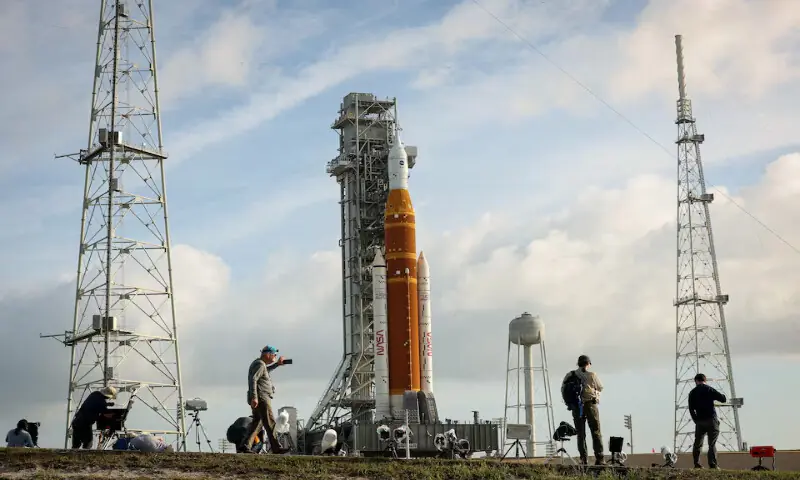
NASA is set to launch four astronauts as soon as Wednesday evening on a 10-day flight around the moon, marking the most ambitious U.S. space mission in decades and a major step toward returning humans to the lunar surface before China’s first crewed landing.
NASA mission managers on Monday polled “go” to launch the Artemis II mission’s towering, 322-foot (98 m) Space Launch System rocket topped with the astronauts’ Orion crew capsule as early as 6:24 p.m. EDT (2224 GMT) on Wednesday.
It will launch from NASA’s Kennedy Space Centre in Florida, just one pad away from where the last moon-bound astronauts of the U.S. Apollo program lifted off more than half a century ago.
The Artemis II crew includes NASA astronauts Christina Koch, Victor Glover and Reid Wiseman and Canadian astronaut Jeremy Hansen, who arrived in Florida from Houston on Friday. They awoke about nine hours before launch, for breakfast, a weather briefing and pre-mission preparations ahead of their 2 p.m. drive to the launchpad.
They have been in a two-week quarantine leading up to liftoff and spent time with their families over the weekend at the Kennedy Space Centre’s beach house, a spot where astronauts rest before blasting off into space.
NASA on Wednesday morning started filling the SLS core stage with 733,000 gallons of super-cooled propellant that powers the rocket’s four RS-25 engines. The pickup truck-sized engines, built by Aerojet Rocketdyne, had powered NASA’s Space Shuttle for decades.
“Everything is going very well right now,” assistant launch director Jeremy Graeber said of the SLS core stage fuelling process.
Weather conditions appeared favourable for an on-time lift off, with only a 20% chance of souring within the agency’s two-hour launch window on Wednesday. If the weather worsens and triggers a scrub, NASA could try again to launch as soon as Friday and until April 6, after which it would wait until April 30 for its next opportunity.
“Certainly all indications are right now, we are in excellent, excellent shape as we get into count,” launch director Charlie Blackwell-Thompson told reporters on Monday.
The launch had originally been planned for as early as February 6, and then March 6, until a pesky hydrogen leak prompted NASA to roll the rocket back to its vehicle assembly building for scrutiny.
FARTHEST TRIP IN HISTORY
The Artemis II mission will send the crew on a winding, nearly 10-day journey around the moon and back, sending them some 252,000 miles (406,000 km) into space - the farthest humans have ever traveled.
The current record for the farthest spaceflight at roughly 248,000 miles is held by the three-man crew of the Apollo 13 lunar mission in 1970, which was beset by technical problems after an oxygen tank exploded and was unable to land on the moon as planned.
Humans have not left Earth’s orbit since the final Apollo mission in 1972.
NASA launched its first Artemis mission without crew in 2022, sending the gumdrop-shaped Orion spacecraft on a similar path around the moon and back.
Artemis II will pose a greater test of Orion and the SLS rocket. The astronauts on board will test critical life-support systems, crew interfaces and communications. They will also take manual control of Orion in space roughly three hours after launch to test its steering and manoeuvrability, a key feature should its automated systems fail.
Lockheed Martin builds Orion, while Boeing and Northrop Grumman have led the development of SLS since 2010, a program partly known for its ballooning costs at an estimated $2 billion to $4 billion per launch.
Elon Musk’s SpaceX and Jeff Bezos’ Blue Origin are racing to develop the landers that NASA will use to put its astronauts on the lunar surface.
The Artemis II mission is a key early step in the agency’s multibillion-dollar Artemis program that envisions a long-term settlement on the lunar south pole. NASA is pressing hard to land its first crew of astronauts there on the Artemis IV mission by 2028, before China does around 2030.
Artemis III had been set to be the agency’s first astronaut moon landing, but new NASA Administrator Jared Isaacman in February added an extra test mission before the landing.
For the latest news, follow us on Twitter @Aaj_Urdu. We are also on Facebook, Instagram and YouTube.
















Comments are closed on this story.