


Israeli strike kills three journalists in south Lebanon
3 min read



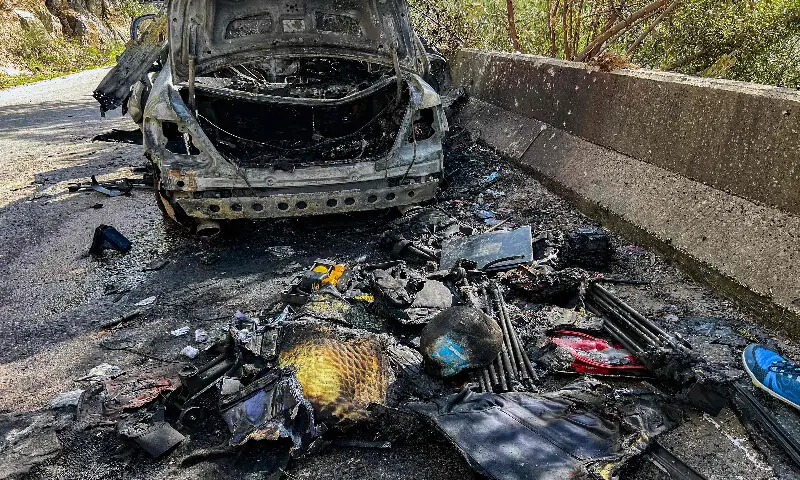
An Israeli strike killed three journalists on Saturday in south Lebanon, their channels and a Lebanese military source said, while Israel said one of them was a Hezbollah member.
This came as Israel continued its raids on southern Lebanon, and Hezbollah announced it had targeted Israeli forces that had entered border villages.
Lebanon was pulled into the Middle East war when Tehran-backed militant group Hezbollah fired rockets at Israel on March 2 to avenge the US-Israeli killing of Iran’s supreme leader, Ayatollah Ali Khamenei.
Israel has responded with large-scale airstrikes across Lebanon and a ground offensive in the south.
A Lebanese military source told AFP earlier on Saturday that Ali Shoeib of Hezbollah’s Al Manar channel and Fatima Ftouni of Al Mayadeen, seen as close to the Iran-backed movement, were killed in Jezzine, alongside Ftouni’s brother, a cameraman.
Al Mayadeen and Al Manar confirmed the deaths of their journalists.
Shoeib was one of Al Manar’s most prominent war correspondents, having covered Israeli attacks on Lebanon for decades.
In a statement, the Israeli military said it had targeted Shoeib, accusing him of being a “terrorist in the intelligence unit of Hezbollah’s Radwan Force”.
Shoeib, it said, “operated within the Hezbollah terrorist organisation under the guise of a journalist for the Al Manar network, while operating systematically to expose the locations of IDF soldiers operating in southern Lebanon and along the border”.
‘Blatant crime’
Lebanese President Joseph Aoun condemned the killings, calling them “a blatant crime that violates all the norms and treaties under which journalists enjoy international protection in wars”.
Prime Minister Nawaf Salam said the targeting of journalists was “a flagrant violation of international humanitarian law.”
Several journalists have been killed in southern Lebanon since the start of the previous round of hostilities between Israel and Hezbollah in 2023.
A strike on central Beirut earlier this month killed Mohammad Sherri, Al Manar’s political programmes director.
In October 2024, during the previous war, three journalists — including a cameraman for Al Manar and a cameraman and broadcast engineer for Al Mayadeen — were killed in an Israeli airstrike that targeted the place where they were sleeping in southern Lebanon.
Al Mayadeen correspondent Farah Omar, cameraman Rabih Maamari and fixer Hussein Aqil were killed while on assignment in the south in November 2023.
In October 2023, Reuters journalist Issam Abdallah was killed and six others were wounded, including AFP journalists Dylan Collins and Christina Assi, while covering the conflict near the Israeli border.
An independent AFP investigation concluded that two Israeli 120mm tank shells were fired from the Jordeikh area inside Israel.
The findings were corroborated by other international probes, including those by Reuters, the Committee to Protect Journalists, Human Rights Watch, Amnesty International and Reporters Without Borders.
Strikes on south
Israel launched a new series of raids on southern Lebanon on Saturday.
Lebanon’s state-run National News Agency reported “a series of strikes” at dawn on southern towns and villages.
It said several Israeli strikes also targeted the city of Nabatiyeh, hitting “residential and commercial buildings and a fuel station”.
At the same time, the agency reported strikes on border towns, particularly Taybeh, along with “an attempt by enemy forces to advance toward the Litani area”.
The Israeli military said Saturday morning that “at this time, the IDF continues to strike Hezbollah terrorist infrastructure across Lebanon”.
Hezbollah, for its part, said in separate statements that it had targeted gatherings of Israeli forces in Debel, a predominantly Christian border town where some residents remain despite the fighting.
Israeli forces have been pushing into areas near the border in southern Lebanon, where Israeli officials have announced plans to establish a buffer zone up to the Litani River, around 30 kilometres (20 miles) north of the border.
For the latest news, follow us on Twitter @Aaj_Urdu. We are also on Facebook, Instagram and YouTube.





Comments are closed on this story.