



US drivers face long-term pain at pump, analysts say
4 min read



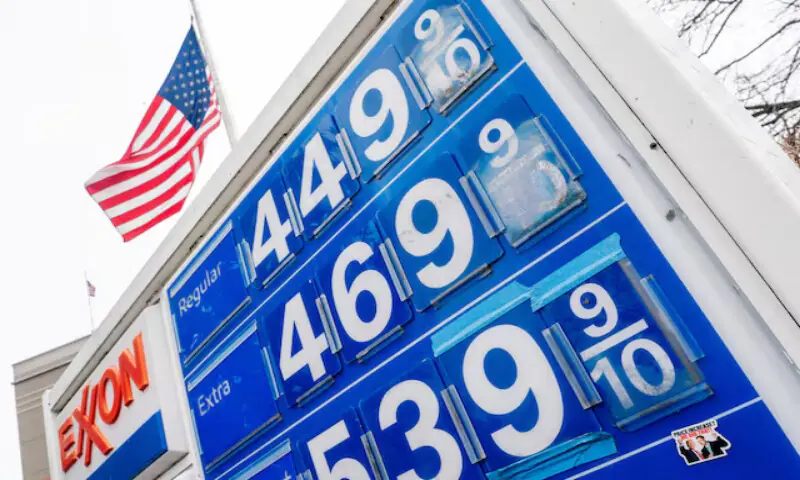
President Donald Trump and congressional Republicans are betting the oil-price shock sparked by the Iran crisis will be too short-lived to hurt them politically in November, but traders and industry analysts see signs that US pump prices will stay painfully high long after any diplomatic breakthrough.
Oil prices have surged as the conflict disrupted global supply.
US crude topped $100 a barrel for the first time since the 2022 Russia-Ukraine shock.
US diesel climbed above $5 a gallon, its highest since late 2022.
The disruptions stem in large part from Iran’s effective blockade of the Strait of Hormuz, the choke point through which roughly one-fifth of global oil normally flows.
Trump has repeatedly said the higher energy costs are a small price to pay for neutralising Iran.
On Tuesday, he again predicted energy prices would “drop like a rock” after the conflict ends.
But oil futures, government forecasts and seasonal summer demand point to elevated crude and gasoline prices persisting even if tensions ease, analysts warned, noting that energy costs tend to fall slower than they rise.
“It’s going to take time for those prices to come back down,” said Matt Smith, an analyst at energy consultant group Kpler.
If fuel costs stay high through the summer, voters could blame Trump’s Republican Party for straining household budgets and punish its candidates in November’s midterm elections.
Polls show voters are worried about the cost of living.
Affordability is the key issue for Democrats, who are within reach of getting a majority in the House of Representatives and narrowing Republicans’ margin of control in the Senate.
Trump has long used social media and the White House megaphone to shape the political narrative, but gasoline prices are hard to spin, said Chris Borick, a pollster and political science professor at Muhlenberg College in Pennsylvania.
“It’s the most in-your-face reminder of affordability concerns, and it’s almost impossible to convince voters of some kind of contextual case that outweighs their emotional reaction,” Borick said.
White House spokeswoman Taylor Rogers said Trump has been “right about everything,” and oil prices are no different.
“Once the military objectives of Operation Epic Fury are completed and the Iranian terrorist regime is neutralised, oil and gas prices will drop rapidly — potentially even lower this before the strikes began,“ Rogers said.
Signs point to higher for longer
The US Energy Information Administration this month sharply raised its outlook for crude and fuel prices.
It now projects Brent crude will average about $79 a barrel in 2026, up 37% from a prior forecast of $58, while US retail gasoline is expected to average $3.34 a gallon, up nearly 15% from its prior estimate.
For 2027, the revised government forecasts put global crude prices about 22% higher and US gasoline prices roughly 8.4% higher than previous projections, underscoring expectations that tighter supplies and geopolitical risks could keep energy costs elevated for years.
Oil futures markets tell a similar story, with contracts for delivery well into next year trading above levels seen earlier this year.
US crude futures have averaged $68.10 a barrel so far this year but are expected to average $85.25 for the remainder of 2026 and $71.35 in 2027, according to LSEG.
That compares with an average of about $64.70 a barrel in 2025.
Florence Schmit, an energy strategist at Rabobank, said any normalisation would be gradual.
“Even if they signed a peace deal tomorrow, it would take months before we see a full resumption of traffic and energy flows,” she said, adding prices could ease to the mid-to-high $70s by year‑end.
US drivers are feeling the impact. The national average for regular fuel climbed on Tuesday to $3.79 per gallon from $3.54 a week ago and $2.92 a month ago, according to industry data.
Prices are up sharply from $3.08 a year ago, reflecting broader inflationary pressures in energy markets and tighter crude supplies.
Since the conflict began on February 28, Trump has reviewed a range of options to ease price pressure, with Chief of Staff Susie Wiles taking a lead role in the effort, Reuters has reported.
The administration has already taken several steps to blunt the supply shock and stabilise global markets, including easing certain sanctions on Russian energy exports to bring additional crude to the market and joining allied nations in a historic, coordinated release of strategic petroleum reserves.
The US release of roughly 200 million barrels from its Strategic Petroleum Reserve is expected to occur over several months, limiting its immediate impact on prices.
For the latest news, follow us on Twitter @Aaj_Urdu. We are also on Facebook, Instagram and YouTube.













Comments are closed on this story.