


Israel pounds Beirut suburbs after Hezbollah fires volley of rockets
3 min read
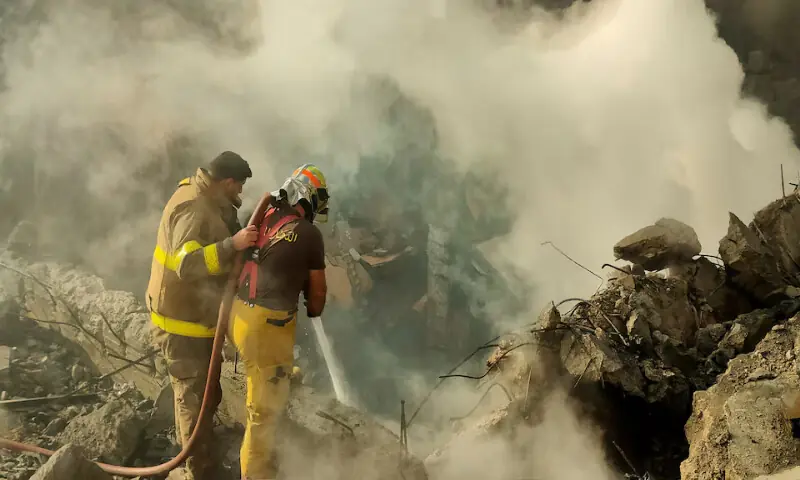
Israeli strikes battered Beirut’s southern suburbs late on Wednesday, lighting up the skyline with flashes of red and setting buildings on fire, after the Lebanese-armed group Hezbollah launched a volley of rockets into northern Israel.
Israel launched an offensive against Iran-backed Hezbollah after it opened fire on March 2 to avenge the killing of Iran’s supreme leader at the start of the US-Israeli war on Iran.
Israeli strikes have killed more than 600 people in Lebanon, and uprooted 800,000 more, Lebanese authorities say.
On Wednesday night, Hezbollah said it had launched dozens of rockets into northern Israel as part of a “series of operations,” indicating there could be more to come.
Lebanese security sources told Reuters more than 100 rockets were launched.
A senior Israeli defence official said Iran and Hezbollah had launched a joint missile attack, describing it as the first coordinated action against Israel since the war began.
In the early hours of Thursday, Lebanon’s health ministry said at least eight people were killed in an Israeli strike on Beirut’s Ramlet al-Baida seafront.
Rough conditions for displaced people
Dozens of explosions also lit up the sky north of the Israeli city of Nazareth as missile defence systems intercepted rockets from Lebanon. Some could be seen crashing to the ground.
Israel’s ambulance service said two people had been lightly wounded by the rockets.
The Israeli strikes on Beirut’s southern suburbs began almost immediately after Hezbollah’s attack, sending half a dozen consecutive booms reverberating across the city.
The Israeli military said it struck 10 Hezbollah structures within 30 minutes, including a headquarters of its elite Radwan unit.
Beirut’s skyline was covered in thick smoke, Reuters footage showed.
In one of the bombed locations, flickering orange flames were visible late into the night.
Israel’s military has repeatedly ordered residents of the southern suburbs to leave over the last week, prompting a displacement crisis as government shelters struggle to cope.
Less than a quarter of the 800,000 displaced had found space in government shelters, but even there they live in “super rough conditions,” said Maureen Philippon, the Norwegian Refugee Council’s Lebanon director.
Shelters lack showers and sufficient toilets, several families occupy the same rooms and there are fears of infectious diseases spreading, she told Reuters.
Some residents of the southern suburbs told Reuters they had nowhere to go and no choice but to return home between bombing raids despite Israeli evacuation orders.
On Wednesday night, after strikes began, the Israeli military said it would “soon act with overwhelming force” against Hezbollah and that residents should leave immediately.
Israeli strikes kill priest, medic
Israel’s strikes on Lebanon have killed 634 people since March 2, including 91 children, Lebanon’s health ministry said.
Catholic priest Pierre Al Rahi and Red Cross medic Youssef Assaf, who died after sustaining injuries in separate Israeli strikes on southern Lebanon earlier this week, were buried on Wednesday.
Pope Leo offered his condolences for Rahi, saying he was a “true shepherd”.
The International Committee of the Red Cross mourned Assaf in a statement on social media, saying he “lost his life while carrying out his humanitarian duty”.
Earlier on Wednesday, an Israeli strike hit an apartment block in central Beirut, the second time in days that Israel targeted the heart of the capital.
Lebanon’s health ministry said four people were wounded. Israel’s military did not comment on the strike.
“The sound was indescribable, the fear is indescribable. Enough is enough, enough. This is a nightmare, when will it end?” said Bassima Ramadan, a woman living across the street.
The Israeli military says it has struck hundreds of Hezbollah targets since March 2, launching daily air strikes in the south, Beirut’s southern suburbs, and the eastern Bekaa Valley.
Israel’s military ordered reinforcements to the area bordering Lebanon, including its elite Golani Brigade and has also sent soldiers into southern Lebanon, establishing new positions there.
For the latest news, follow us on Twitter @Aaj_Urdu. We are also on Facebook, Instagram and YouTube.






Comments are closed on this story.