


Heaviest day of strikes yet on Iran despite market bets that war will end soon
5 min read

The United States and Israel pounded Iran on Tuesday with what the Pentagon and Iranians on the ground said were the most intense airstrikes of the war, despite global markets betting that President Donald Trump will seek to end the conflict soon.
Raising the stakes for the global economy, Iran’s Revolutionary Guards said they would block oil shipments from the Gulf unless U.S. and Israeli attacks cease.
“Today will be yet again, our most intense day of strikes inside Iran: the most fighters, the most bombers, the most strikes, intelligence more refined and better than ever,” U.S. Defence Secretary Pete Hegseth told a Pentagon briefing.
‘LIKE HELL’
Tehran residents reached by Reuters also described the war’s most intense night of bombardment.
“It was like hell. They were bombing everywhere, every part of Tehran,” a resident said by phone, speaking on condition of anonymity for security reasons. “My children are afraid to sleep now. We have nowhere to go.”
Images verified by Reuters showed two houses had been struck overnight in an upscale residential district of Karaj, just west of Tehran.
In Tehran’s eastern District Four, two five-storey residential buildings had been hit on Monday, blasting out floors and walls and leaving a rickety concrete frame. Footage from Iran’s Red Crescent showed rescuers there carrying a victim in a body bag. Workers were still recovering bodies at the site on Tuesday when a missile struck a road intersection nearby.
Yet with Trump having described the war on Monday as “very complete, pretty much”, investors appeared convinced he would end it soon — before the disruption to global energy supplies caused a worldwide economic meltdown.
A historic surge in crude oil prices on Monday was mostly reversed within a day. Asian and European share prices staged a partial recovery from earlier precipitous falls, and Wall Street bounced to around its levels of late February, before the war.
A source familiar with Israel’s war plans told Reuters the Israeli military wanted to inflict as much damage as possible before the window for further strikes closes, under the assumption that Trump could end the war at any time.
Israel’s foreign minister, Gideon Saar, said his country was not planning for an endless war and was consulting with Washington about when to stop it.
TRUMP PRESS CONFERENCE APPEARS TO REASSURE MARKETS
Iran has refused to bow to Trump’s demand that it let the United States choose its new leadership, naming hardliner Mojtaba Khamenei as supreme leader to replace his father, who was killed on the war’s first day.
But occasionally contradictory remarks from Trump at a press conference on Monday appeared to reassure markets he would stop his war before provoking an economic crisis like those that followed the Middle East oil shocks of the 1970s. He said the U.S. had already inflicted serious damage and predicted the conflict would end before the four weeks he initially set out.
Trump has not defined what victory would look like, but on Monday did not repeat declarations that Iran must let him choose its leader.
IRANIAN DEFIANCE
Several senior Iranian officials voiced defiance on Tuesday.
“Certainly, we are not seeking a ceasefire; we believe the aggressor must be struck in the mouth so that they learn a lesson and never again think of attacking dear Iran,” Iran’s parliament speaker, Mohammad Baqer Qalibaf, posted on X.
Foreign Minister Abbas Araqchi told PBS that Tehran was unlikely to resume negotiations with the U.S.
The war has effectively halted shipments through the Strait of Hormuz, where a fifth of global oil and liquefied natural gas normally passes along Iran’s coast. Some of the world’s biggest producers have run out of storage and cut back output.
In the latest incident, the UK Maritime Trade Operations Centre reported that crew aboard a bulk carrier in the Gulf had witnessed a splash and a loud bang.
After Iran chose its hardline new leader, oil prices briefly surged to nearly $120 a barrel on Monday. But by 1500 GMT on Tuesday, Brent crude had settled back down below $90.
Trump said on Monday that U.S. military might was sufficient to keep oil flowing. If Iran blocks oil through the strait, “We will hit them so hard that it will not be possible for them or anybody else helping them to ever recover that section of the world,” he said.
But a spokesperson for the Revolutionary Guards said Tehran would not allow “one litre” of Middle Eastern oil to reach the U.S. or its allies while U.S. and Israeli attacks continue.
“We are the ones who will determine the end of the war,” the spokesperson said.
QUICK END TO WAR COULD LEAVE IRAN’S LEADERS IN PLACE
Ending the war quickly to let oil flows resume would appear to preclude toppling Iran’s leadership, which held large-scale rallies on Monday in support of the new supreme leader.
Many Iranians want change, and some openly celebrated the death of the elder Khamenei, weeks after his security forces killed thousands of people to put down anti-government protests. But there has been little sign of protest during the war, with opponents saying it would be unsafe while Iran is under attack.
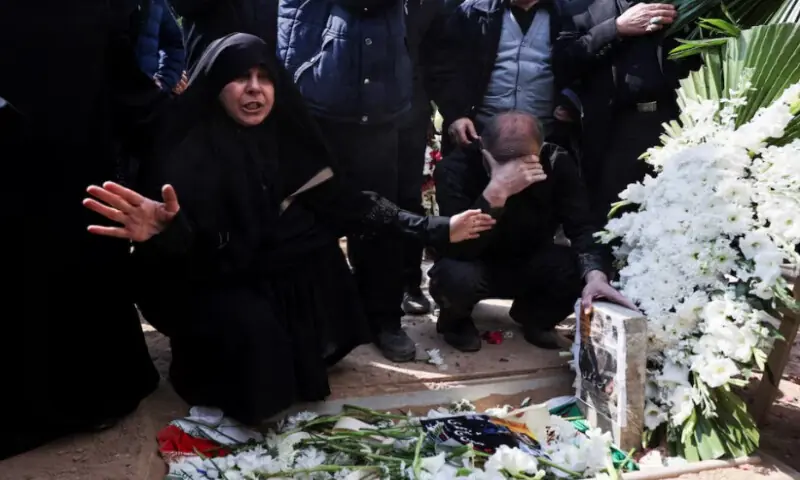
At least 1,270 people have been killed since the U.S. and Israeli airstrikes began on February 28, according to Iranian state media reports.
Scores have also been killed in Israeli attacks on Lebanon to root out the Iran-backed group Hezbollah, which has fired into Israel in solidarity with Iran.
Iranian strikes on Israel have killed 12 people. Iran has struck U.S. military bases, and diplomatic missions in Arab Gulf states, but also hit hotels, closed airports and damaged oil infrastructure.
For the latest news, follow us on Twitter @Aaj_Urdu. We are also on Facebook, Instagram and YouTube.











Comments are closed on this story.