


China overtakes US in nuclear submarine launches, raising strategic concerns
3 min read



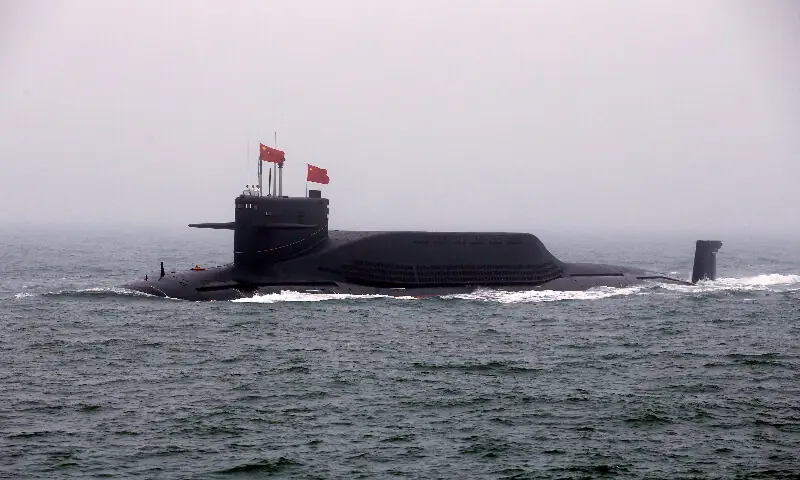
China has accelerated production of nuclear-powered submarines over the past five years, launching subs at a faster pace than the United States and challenging Washington’s long-standing naval advantage, according to a new report by the International Institute for Strategic Studies (IISS).
The buildup includes both ballistic-missile (SSBN) and attack (SSN) submarines.
Between 2021 and 2025, China launched 10 nuclear-powered subs compared with seven by the US, and the total tonnage launched also exceeded that of the US (79,000 tons versus 55,500).
The report is based on satellite imagery of Chinese shipyards, as Beijing does not publicly release fleet numbers.
This marks a sharp change from 2016–2020, when China added only three nuclear-powered subs compared with seven for the US.
While these numbers reflect launches rather than completed, operational vessels, they indicate a clear expansion of China’s undersea capabilities.
As of early 2025, China had 12 active nuclear-powered subs—six ballistic-missile and six guided-missile/attack boats—alongside 46 conventionally powered submarines.
By contrast, the US maintained 65 nuclear subs, including 14 ballistic-missile boats, but has no conventional subs, which require regular refuelling.
To support its nuclear submarine expansion, China has significantly enlarged the Huludao shipyard of Bohai Shipbuilding Heavy Industry Co. in northern China.
The report highlights recent launches of two Type-094 SSBNs, which strengthen Beijing’s nuclear triad alongside land-based missiles and bombers.
China is also developing the Type-096 SSBN, expected to enter service in the late 2020s or early 2030s.
The PLA Navy has also launched at least six guided-missile submarines equipped with vertical launch systems, capable of firing advanced anti-ship missiles displayed during last year’s Victory Day parade.
While China is increasing numbers, the IISS notes that its subs generally lag behind US and European designs in quality and stealth, leaving Washington with a technological edge.
Still, experts warn that larger fleets tend to dominate in naval conflicts, and China already fields the world’s largest fleet of destroyers, frigates, and surface combatants.
Meanwhile, the US faces construction delays.
The Congressional Research Service report notes that Virginia-class attack sub deliveries have averaged just 1.1–1.2 vessels per year since 2022, below the two-per-year goal.
Columbia-class ballistic-missile subs are also behind schedule, with the first, USS District of Columbia, expected in 2028.
Navy Secretary John Phelan described US naval construction as “in dire straits,” citing cost overruns and delays.
The CRS report warns that the US attack submarine fleet will shrink to 47 vessels by 2030 as older Los Angeles-class subs retire, reaching 50 only by 2032 if construction targets are met.
Plans to sell some Virginia-class subs to Australia under AUKUS could further limit numbers in the short term.
Analysts say this “valley” in operational capacity could weaken conventional deterrence against China.
President Donald Trump has proposed a new class of heavily armed “Trump-class” surface warships to modernise the Navy, unveiling the initiative in December 2025 at Mar-a-Lago alongside Pentagon chief Pete Hegseth, Secretary of State Marco Rubio, and Navy Secretary John Phelan.
For the latest news, follow us on Twitter @Aaj_Urdu. We are also on Facebook, Instagram and YouTube.











Comments are closed on this story.