


UK’s Starmer arrives in China, encourages firms to seize opportunities
3 min read


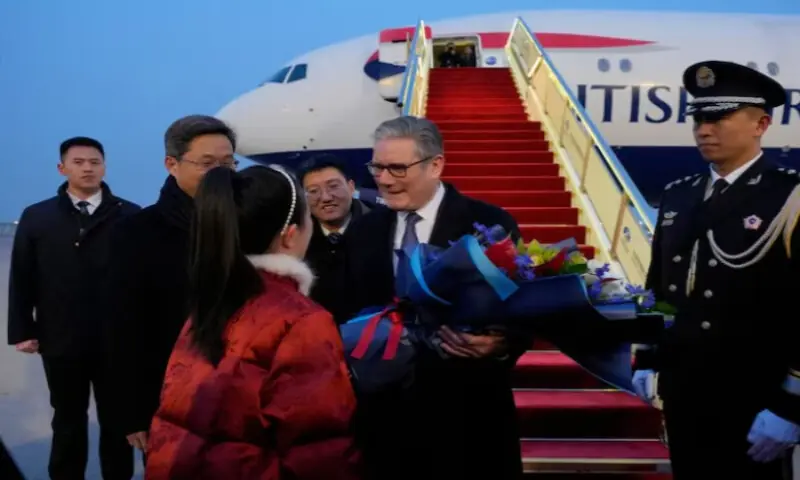
Keir Starmer began the first visit to China by a British prime minister since 2018 on Wednesday, encouraging businesses to seize opportunities on a trip aimed at strengthening ties with Beijing as relations with the U.S. become more volatile.
Starmer, whose approach to China has been criticised by some British and U.S. politicians, said that while courting the world’s second-largest economy, Britain must also remain vigilant about potential security threats.
“They say that eight days is a long time in politics. Try eight years, because it’s eight years since a British prime minister stepped on Chinese soil. So on this delegation you’re making history,” Starmer told more than 50 business leaders visiting with him.
“You’re part of the change that we’re bringing about … Because everything you’re doing here, everything I’m doing here is focused on how do we benefit people at home,” he said before meeting President Xi Jinping and Premier Li Qiang on Thursday.
The visit could mark a shift in ties between Britain and China after years of deep acrimony over Beijing’s crackdown on political freedoms in Hong Kong, China’s support for Russia in the Ukraine war and allegations by British security services that China regularly spies on politicians and officials.
For China, the visit offers the country a chance to portray itself as a stable and reliable partner at a time of global disorder.
TENSIONS WITH TRUMP SHADOW STARMER’S TRIP
“It doesn’t make sense to stick our head in the ground and bury it in the sand when it comes to China, it’s in our interests to engage,” Starmer told reporters earlier.
European and other Western countries have engaged in a flurry of diplomacy with China as they hedge against unpredictability from the United States under President Donald Trump.
Starmer’s trip follows tensions with Trump over his threats to seize Greenland, his criticism of Britain’s deal to cede sovereignty of the Chagos Archipelago - including an island with a U.S.-UK air base - to Mauritius, and his comments that NATO allies avoided front-line combat during the war in Afghanistan.
On Saturday, Trump threatened to impose a 100% tariff on Canadian goods if that country’s prime minister, Mark Carney, signed a trade deal with China.
The UK leader insisted Britain could continue to strengthen economic ties with China - without angering Trump - because of his country’s long history of working closely with the United States.
“The relationship we have with the U.S. is one of the closest relationships we hold, on defence, security, intelligence and also on trade and lots of areas,” he said.
Starmer was reluctant to be drawn on what he would discuss with Chinese leaders, or if he would bring up the fate of Jimmy Lai, the former Hong Kong media tycoon who was convicted in December of national security crimes.
He also declined to say whether he would ask China to pressure Russia to end its war against Ukraine.
Asked if Britain and China could strike a deal that would allow more visa-free travel, Starmer said he hoped to make some “progress” in that area.
He also distanced himself from comments made by Carney last week about middle countries working together to avoid being victimised by American hegemony.
“I’m a pragmatist, a British pragmatist applying common sense,” Starmer said, rejecting the idea that his government must choose between the U.S. and Europe.
For the latest news, follow us on Twitter @Aaj_Urdu. We are also on Facebook, Instagram and YouTube.








Comments are closed on this story.