


NA holds debate on Gul Plaza tragedy after MQM protest
3 min read

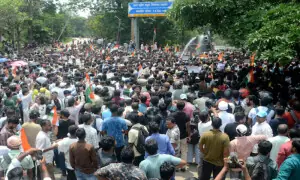

The deadly fire at Karachi’s Gul Plaza shopping centre echoed in the National Assembly on Tuesday, as lawmakers from the Muttahida Qaumi Movement (MQM-P) staged a strong protest demanding an immediate debate on the incident, which they termed a national tragedy.
As the session began, MQM members, including senior leader Dr Farooq Sattar, stood up from their seats and called for the suspension of the day’s agenda to discuss the Gul Plaza fire.
When Acting Speaker Syed Ghulam Mustafa Shah said time would be allotted after completion of the agenda, MQM lawmakers gathered around the speaker’s dais in protest.
Pakistan Tehreek-e-Insaf (PTI) members also stood at their seats, raising a separate issue related to the former FATA region.
MQM lawmakers also tore copies of the agenda and continued chanting slogans in front of the speaker’s dais to press their demands.
Following loud protests from both MQM and PTI, Law Minister Azam Nazir Tarar moved a motion to suspend the agenda and allow discussion on both matters.
The House approved the motion by a majority vote, after which debate on the Gul Plaza tragedy formally began.
Speaking on the floor, Dr Farooq Sattar urged the House to declare the incident a national tragedy, stating that more than 40 people had lost their lives.
Talking to reporters outside parliament, MQM convener Khalid Maqbool Siddiqui lamented that no official mourning had been announced over the Gul Plaza fire tragedy.
He said no representative of the federal government visited Karachi following the incident, warning that the death toll could surpass 100.
Participating in the debate, Pakistan Peoples Party (PPP) leader Shehla Raza said the Gul Plaza incident should not be used for political point-scoring.
She said it was not always necessary for chief ministers or ministers to reach the site of every incident, adding that the most important thing during such incidents was the timely arrival of rescue teams and the clearing of access routes.
Shehla Raza highlighted serious structural and logistical issues at the plaza, noting that out of 26 entry and exit points, 24 were blocked, causing severe difficulties for firefighters and rescue personnel.
She added that traffic congestion and large crowds further hampered rescue efforts.
Providing background, she said Gul Plaza was constructed in the 1980s with 180 shops in its basement, later expanded to include 405 shops on the ground floor and 175 on the first floor.
In 1998, more shops were constructed, including in parking areas and corridors, significantly increasing the load on the structure.
She noted that deadly fires had occurred internationally and within Pakistan, including repeated fires at Lahore’s Hafeez Centre, without such incidents being politicised.
She cautioned against using the Gul Plaza tragedy to raise unrelated constitutional and political issues.
For the latest news, follow us on Twitter @Aaj_Urdu. We are also on Facebook, Instagram and YouTube.













Comments are closed on this story.