


Why Pakistan saves too little — and how to fix it
4 min read


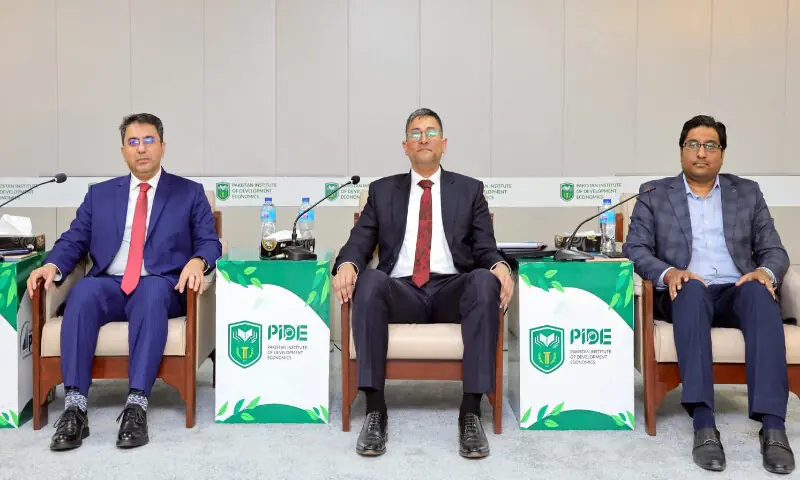
Chaired by PIDE Vice Chancellor Dr Nadeem Javaid (SI), Pakistan Institute of Development Economics (PIDE) hosted a seminar on “The Challenges of Low Savings in Pakistan,” featuring Sohaib Jamali, Additional Director/Division Head at the State Bank of Pakistan, as the keynote speaker.
Dr Haider Ali, Director of PIDE’s Macro Policy Lab, served as discussant, while the session was moderated by Amna Riaz, Research Economist at PIDE.
Mr Jamali opened the discussion by presenting fresh analysis from the State Bank’s thematic work, noting that Pakistan’s domestic savings rate has remained stuck around 12 to 15 per cent for nearly two decades — below the 20 per cent threshold commonly associated with sustained economic growth and investment takeoff.
Since most economies finance the bulk of investment through domestic savings, he argued that Pakistan’s shortfall is structural rather than cyclical, shaped by a rare combination of low and volatile growth, high inflation, heavy youth dependency, widespread informality, and shallow financial sector development.
Even when compared with countries sharing similar characteristics, Pakistan’s savings rate continues to lag behind.
Jamali asserted that while households do save, persistent public sector dissaving and weak intermediation diminish the impact of those savings.
Over the past decade, a large share of household financial savings — through National Savings Schemes, mutual funds, insurance pools, and bank deposits — has ultimately flowed into government securities, where spending efficiency and productivity gains remain limited.
Jamali added that real returns on most formal instruments have been low or negative after adjusting for inflation, prompting savers to seek refuge in gold and real estate, the only assets that consistently preserved value over the last ten years.
Household survey evidence further showed that most working-age Pakistanis prefer to consume first and save what remains, which, combined with rising out-of-pocket expenses and low educational attainment, depresses their capacity to build savings.
Financial literacy gaps and taxes on banking transactions have weakened trust in formal channels, while participation in capital markets remains thin, and insurance and pension penetration are still modest.
The discontinuation of postal savings in 2021, he added, removed an important last-mile savings channel for low-income households.
Speaking as discussant, Haider Ali praised the diagnostic for its depth and breadth, noting that Pakistan’s savings challenge spans economic, demographic, institutional, and behavioral dimensions.
He emphasised that even with higher savings, growth outcomes would remain muted without addressing declining productivity, which reduces the effectiveness of investment.
“A low domestic savings rate is a symptom of deeper structural issues,” stated Dr. Haider.
“We see that about 45 per cent of Pakistanis are poor, and the middle class has been eroding over time — this erosion directly weakens our national savings pool.”
In his closing remarks, Dr Nadeem Javaid highlighted the social, cultural, and incentive structures that shape saving behavior in Pakistan.
With a sizeable housing shortage, real estate continues to generate outsized returns, attracting both formal and informal savings.
“Strong family ties and a culture of philanthropy create a de facto safety net,” Dr Nadeem observed.
“This inadvertently diminishes the incentive for precautionary savings among households.”
Drawing from international experiences, Dr Nadeem noted that mandatory, long-term pension savings supported by employer contributions and professional fund management can mobilise large pools of stable capital for national development, but only if accompanied by transparent governance and productive deployment.
Looking ahead, Dr Nadeem stressed that the URAAN Pakistan framework’s trillion-dollar goals cannot be met without foundational reforms.
“We must lift our domestic savings rate to at least 20 per cent of GDP, while simultaneously driving productivity growth and strengthening our financial architecture,” he concluded.
The seminar concluded with a consensus that Pakistan’s savings challenge demands coherent, long-horizon economic and social reforms.
These include rebalancing incentives by rationalising taxes on deposits and transactions, reducing distortions that fuel speculative real estate investment, strengthening capital markets, broadening retail participation through asset management channels, expanding takaful and pension systems, restoring last-mile savings access through digitised postal and branchless platforms, and building trust through stronger consumer protection and transparent regulation.
Participants emphasised that higher savings must be paired with higher incentives to translate investment into sustainable economic growth.
For the latest news, follow us on Twitter @Aaj_Urdu. We are also on Facebook, Instagram and YouTube.


















Comments are closed on this story.