Aaj English TV

Friday, December 05, 2025  
13 Jumada Al-Akhirah 1447  
Live
Bangladesh

British MP Tulip Siddiq jailed two years in Bangladesh graft case

Ex-PM Hasina, niece Tulip Siddiq and relatives convicted in land project scandal
MP Tulip Siddiq attends a news conference in London, Britain, October 11, 2019. – Reuters

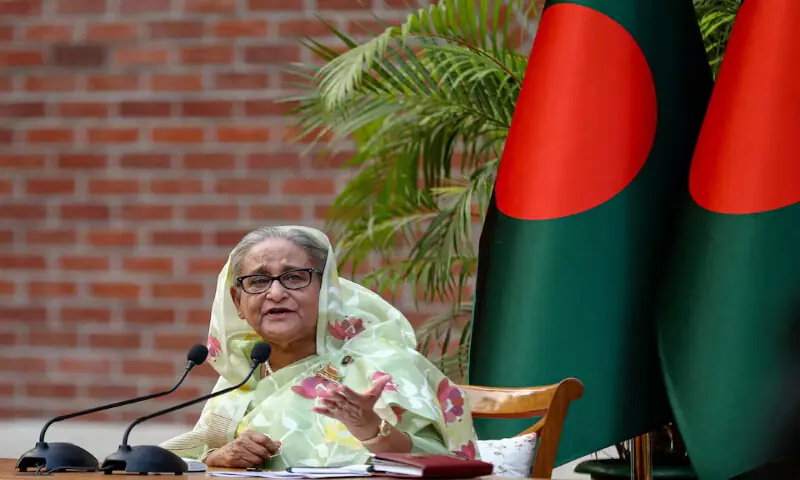
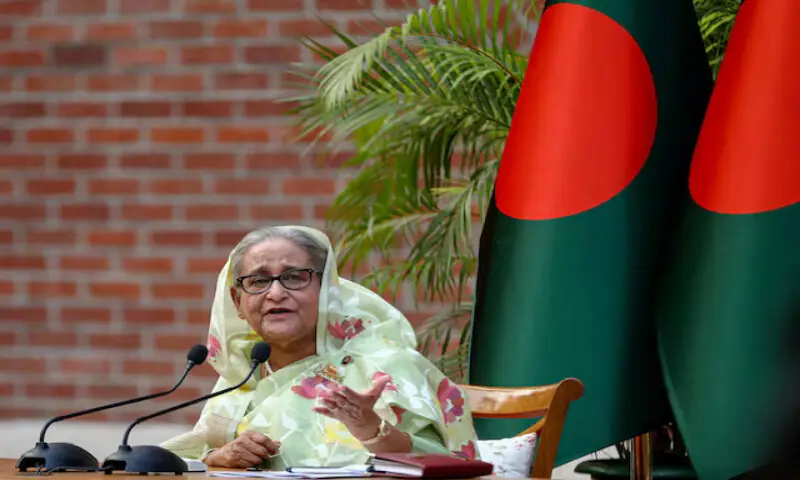
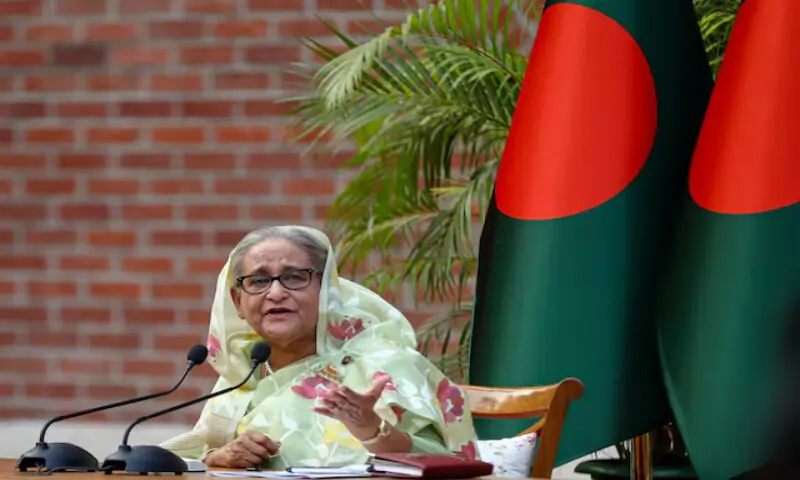
A Bangladesh court sentenced British parliamentarian and former minister Tulip Siddiq to two years in jail in a corruption case involving the alleged illegal allocation of a plot of land, local media reported.

The verdict was delivered in absentia as Siddiq, her aunt and former Bangladesh Prime Minister Sheikh Hasina, and Hasina’s sister Sheikh Rehana, all co-accused in the case, were not present in court.

Hasina was sentenced to five years in jail and Rehana to seven, the local media reports said.

Hasina, who fled to neighbouring India in August 2024 at the height of an uprising against her government, was sentenced to death last month over her government’s violent crackdown on demonstrators during the protests.

Last week, she was handed a combined 21-year prison sentence in other corruption cases.

Prosecutors said that the land was unlawfully allocated through political influence and collusion with senior officials, accusing the three powerful defendants of abusing their authority to secure the plot, measuring roughly 13,610 square feet, during Hasina’s tenure as prime minister.

Most of the 17 accused were absent when the judgment was pronounced.

Siddiq, who resigned in January as the UK’s minister responsible for financial services and anti-corruption efforts following scrutiny over her financial ties to Hasina, has previously dismissed the allegations as a “politically motivated smear”.

Britain does not currently have an extradition treaty with Bangladesh.

For the latest news, follow us on Twitter @Aaj_Urdu. We are also on Facebook, Instagram and YouTube.

Pakistan and Bangladesh agree to boost maritime cooperation

Countries aim to strengthen trade, port collaboration, and regional stability

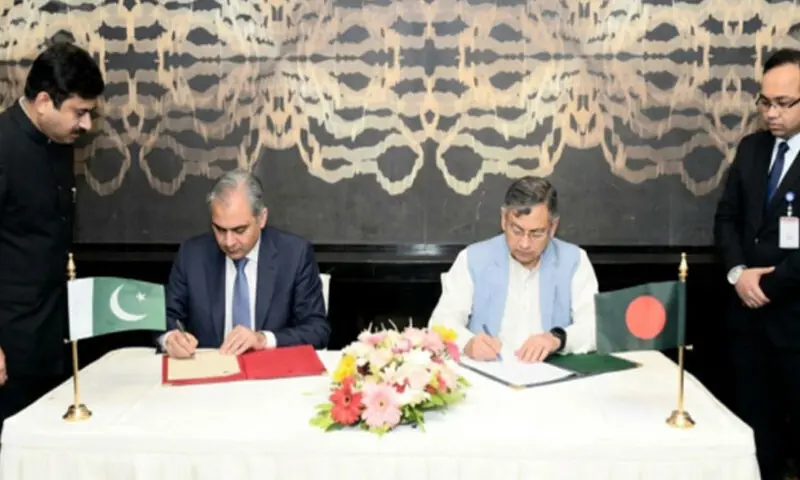
Pakistan and Bangladesh have agreed to enhance maritime cooperation to support regional stability, economic growth, and shared prosperity, officials said.

The understanding was reached during a meeting between Pakistan’s Minister for Maritime Affairs Muhammad Junaid Anwar Chaudhry and Brigadier General (retired) Dr M. Sakhawat Hussain, Adviser for Shipping of Bangladesh, in London.

Chaudhry proposed establishing a formal cooperation framework between the Pakistan National Shipping Corporation and the Bangladesh Shipping Corporation to deepen collaboration.

He also sought Bangladesh’s support for Pakistan in the upcoming International Maritime Organisation Category C elections, pledging reciprocal backing.

The minister reiterated Pakistan’s earlier offer to make Karachi Port Trust facilities available for Bangladeshi cargo.

He said closer port-to-port cooperation can ease logistics challenges, reduce regional bottlenecks, and open new opportunities for commercial integration across South Asia.

For the latest news, follow us on Twitter @Aaj_Urdu. We are also on Facebook, Instagram and YouTube.

Pakistan’s TCP issues tender for 100,000 tons of rice for Bangladesh

Bangladesh launches another import tender as it races to cool local rice prices

The Trading Corporation of Pakistan (TCP), Pakistan’s state agency, has issued a tender to purchase 100,000 metric tons of rice for supply to Bangladesh, European traders said on Monday.

The deadline for submission of price offers is November 28. Bangladesh also announced another rice tender on Monday, continuing a series of import tenders in the last few weeks to cool local prices.

The tender seeks long grain white rice.

Price offers have to be valid for 21 working days after submission.

The rice must be available for shipment within 45 days calendar days after the contract award.

Traders regarded the tender as a possible move to bring Pakistani rice into Bangladesh’s import supplies, with market expectations that Indian-origin rice will be used to supply some recent purchases by Bangladesh.

For the latest news, follow us on Twitter @Aaj_Urdu. We are also on Facebook, Instagram and YouTube.

Earthquake jolts Bangladesh, killing five and injuring around 100

Residents rushed out of their homes in Dhaka as buildings shook
Men mourn the death of their relatives outside a hospital morgue following an earthquake in Dhaka, Bangladesh, November 21, 2025//REUTERS

At least five people, including a child, were killed and around 100 were injured when a magnitude 5.7 earthquake struck Bangladesh on Friday, the government said, with buildings damaged in many areas, including the densely populated capital Dhaka.

Tremors were felt in eastern states in neighbouring India that border Bangladesh, but there were no immediate reports of major damage there, authorities said.

Dhaka residents rushed out of their homes as buildings shook and some makeshift structures collapsed, Reuters witnesses said.

“We felt a strong jolt and buildings were shaking like trees,” said resident Suman Rahman. “Staircases were jammed as people rushed down. Everyone was terrified, and children were crying.”

The fire department said some people had been injured when bricks and loose cement fell from buildings that were under construction.

“I have never felt such a tremor in my life. We were at the office when the furniture started shaking.

We rushed down the stairs on the street and saw other people on the road already,“ said Sadman Sakib, who works in Dhaka.

The government was closely monitoring the situation and had directed departments to intensify rescue operations in affected areas, Yunus’ office said in the statement.

For the latest news, follow us on Twitter @Aaj_Urdu. We are also on Facebook, Instagram and YouTube.

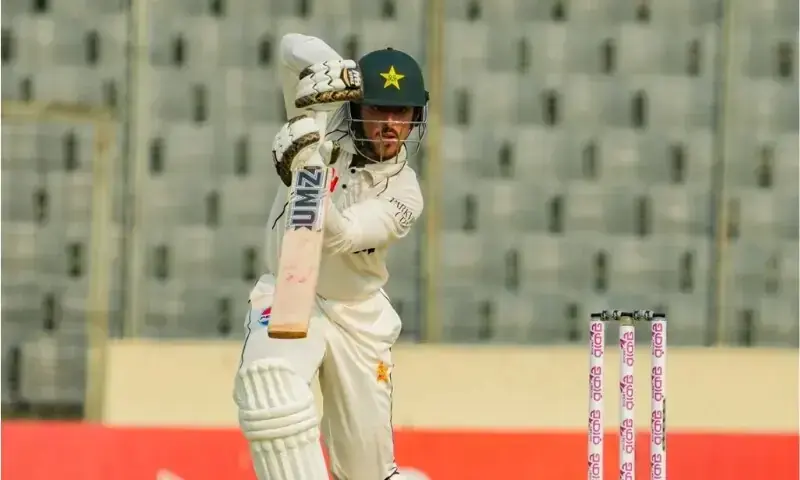
Bangladesh A defeat India A in Super Over thriller at Asia Cup Rising Stars

Semi-final sees tie after 20 overs before Bangladesh clinches win in dramatic Super Over

Bangladesh A edged out India A in a thrilling semi-final of the Asia Cup Rising Stars in Doha, winning in a tense Super Over after the match ended in a tie.

Batting first, Bangladesh posted 194 for 6 in their allotted 20 overs.

India matched the total, also finishing at 194 for 6, needing four runs off the final ball to win.

However, three runs were taken on the last delivery due to a misfield, resulting in a tie and sending the match to a Super Over.

In the Super Over, India failed to score, leaving Bangladesh a target of just one run to claim victory.

Although an Indian bowler took a wicket, a wide delivery handed Bangladesh the winning run, sealing a dramatic win for the team.

In the other semi-final, Pakistan Shaheens will take on Sri Lanka later today.

For the latest news, follow us on Twitter @Aaj_Urdu. We are also on Facebook, Instagram and YouTube.

Bangladesh asks India to extradite convicted ex-PM Sheikh Hasina

Dhaka says former prime minister and ex-home minister convicted of crimes against humanity; cites bilateral agreement for extradition

Bangladesh has formally asked India to hand over former prime minister Sheikh Hasina and former home minister Asaduzzaman Khan Kamal after a court in Dhaka convicted them of crimes against humanity.

In a statement, Bangladesh’s Ministry of Foreign Affairs said the International Crimes Tribunal (ICT) had found the two guilty and sentenced them accordingly, making it India’s responsibility to immediately return them to face further legal proceedings.

According to The Daily Star, the ministry warned that giving refuge to individuals convicted of such offences would be seen as an “extremely unfriendly act” and akin to obstructing justice.

It added that India is legally bound under agreements between the two countries to ensure their extradition.

The ministry urged New Delhi to promptly hand over Sheikh Hasina and Kamal to the relevant Bangladeshi courts or authorities.

The ICT’s three-member bench announced its verdict in a 453-page judgment, convicting Sheikh Hasina on five charges of crimes against humanity. The court ordered that she remain imprisoned for life.

The special tribunal handed her the death penalty on two charges related to violent suppression of protests and life terms on three others.

The allegations included incitement, ordering the use of lethal force against demonstrators, the killing of a student at Begum Rokeya University in Rangpur, the shooting deaths of six protesters in Dhaka, and the burning alive of six people in Ashulia.

The tribunal also ordered the confiscation of assets owned by Sheikhh Hasina and Kamal.

AAJ News Whatsapp

A UN report earlier found that between 15 July and 5 August last year, nearly 1,400 people were killed and thousands injured during anti-government protests, marking the deadliest period of political violence in Bangladesh since the 1971 Liberation War.

The International Crimes Tribunal is a domestic war-crimes court established under Bangladeshi law.

For the latest news, follow us on Twitter @Aaj_Urdu. We are also on Facebook, Instagram and YouTube.

Bangladesh’s ousted PM Hasina sentenced to death for students crackdown

Sheikh Hasina found guilty over deadly crackdown on student-led protests last year
Big News Dhaka Bangladesh - Aaj News Breaking

A Bangladesh court sentenced ousted Prime Minister Sheikh Hasina to death on Monday, concluding a months-long trial that found her guilty of ordering a deadly crackdown on a student-led uprising last year.

The ruling comes months ahead of parliamentary elections expected to be held in early February.

Hasina’s Awami League party has been barred from contesting, and it is feared that Monday’s verdict could stoke fresh unrest ahead of the vote.

The International Crimes Tribunal, Bangladesh’s domestic war crimes court located in the capital Dhaka, delivered the guilty verdict amid tight security and in Hasina’s absence after she fled to India in August 2024.

The verdict can be appealed in the Supreme Court.

For the latest news, follow us on Twitter @Aaj_Urdu. We are also on Facebook, Instagram and YouTube.

Death sentence for Sheikh Hasina? Son warns to boycott upcoming elections

Bangladesh court to announce televised verdict today

The son and adviser of ousted Bangladesh Prime Minister Sheikh Hasina said on Sunday that supporters of her Awami League would block February’s national election if a ban on the party was not lifted, warning that protests could escalate into violence.

Sajeeb Wazed’s remarks to Reuters came a day before a Dhaka court was due to deliver a televised verdict that is expected to convict Hasina, 78, in absentia on charges of crimes against humanity for a deadly crackdown on student-led protests in 2024. She denies wrongdoing and says the case is politically motivated.

A United Nations report estimated that up to 1,400 people were killed and thousands wounded — most by gunfire from security forces — during anti-government demonstrations between July 15 and August 5 last year, the worst political violence in Bangladesh since its 1971 independence war.

Home to more than 170 million people, Bangladesh is one of the world’s largest garment exporters, supplying major global brands. The industry was hit hard by last year’s protests.

‘WILL PROBABLY SENTENCE HER TO DEATH’

Hasina has lived in exile in New Delhi since fleeing Bangladesh in August 2024. Wazed said India was providing her full security and treating her “like a head of state”.

“We know exactly what the verdict is going to be. They’re televising it. They’re going to convict her, and they’ll probably sentence her to death,” said Wazed, who lives in Washington, D.C. “What can they do to my mother? My mother is safe in India. India is giving her full security.”

A spokesperson for the interim government led by Nobel laureate Muhammad Yunus, which took over after Hasina’s 15 straight years in power ended, denied the trial was politically motivated, saying the court “functioned transparently, allowing observers and publishing regular documentation”.

Hasina told Reuters in October that she could move freely in Delhi, though she remained cautious because of security. Her parents and three brothers were killed in a 1975 military coup while she and her sister were abroad.

She said a guilty verdict from the International Crimes Tribunal, Bangladesh’s domestic war crimes court, was a “foregone conclusion” because the “proceedings were a politically motivated charade”.

Wazed, widely known in Bangladesh by his nickname Joy, said they would not appeal unless a democratically elected government took office with the Awami League’s participation.

The party’s registration was suspended in May after the interim government banned its political activities, citing national security threats and war crime investigations into senior party leaders.

“We will not allow elections without the Awami League to go ahead,” he said. “Our protests are going to get stronger and stronger, and we will do whatever it takes. Unless the international community does something, eventually there’s probably going to be violence in Bangladesh before these elections … there’s going to be confrontations.”

The government spokesperson said there were no plans to lift the ban on the Awami League. “The interim government regards any incitement to violence —especially by exiled political figures — as deeply irresponsible and reprehensible,” said the spokesperson.

“At present, there is no dialogue space for Awami League as it continues to refuse to express any remorse for crimes against humanity committed under its rule and to accept the accountability process, including under the International Crimes Tribunal.”

For the latest news, follow us on Twitter @Aaj_Urdu. We are also on Facebook, Instagram and YouTube.

Bomb blasts rock Dhaka ahead of Hasina verdict

Security tightened as authorities deploy forces to prevent violence and sabotage
People wave flags during celebrations marking the one-year anniversary of student-led protests that led to the ousting of Bangladeshi then-prime minister Sheikh Hasina, at Manik Mia Avenue, outside the parliament building, in Dhaka, Bangladesh. – Reuters file

Several crude bombs exploded in the Bangladesh capital Dhaka on Sunday, police said, heightening tensions ahead of a verdict on Monday in a case against ousted former prime minister Sheikh Hasina over violence during street protests last year.

No casualties were reported, but the blasts further unsettled a city already on edge after days of political unrest.

Hasina, 78, is being tried in absentia on charges of crimes against humanity for allegedly ordering a deadly crackdown on student protests in mid-2024.

She denies any wrongdoing and has remained in India since fleeing there after her ouster in August last year.

The Dhaka Metropolitan Police Commissioner has instructed officers to open fire on anyone involved in arson or attempts to cause death by hurling crude bombs, local media reported.

AAJ News Whatsapp

Security has been tightened across Dhaka, in Gopalganj — Hasina’s ancestral home and a stronghold for her party — and in two neighbouring districts, with Border Guard Bangladesh personnel deployed to reinforce local authorities.

Police and Rapid Action Battalion teams have been positioned around key government buildings and major intersections, leaving parts of the capital unusually quiet.

“It’s very tense — hardly anyone is coming out,” said Ramjan Ali, an autorickshaw driver in Dhaka.

“I’ve been on the road since morning, but I’ve barely earned anything today.”

In the days leading up to the verdict, authorities recorded more than 30 crude bomb explosions and reported dozens of buses torched in Dhaka and several other districts.

Dozens of Awami League activists have also been arrested in recent days over alleged involvement in explosions and acts of sabotage.

For the latest news, follow us on Twitter @Aaj_Urdu. We are also on Facebook, Instagram and YouTube.

Navy chief’s Bangladesh visit strengthens defence ties

Admiral Naveed Ashraf meets Bangladeshi military leadership, visits naval institutions, and underscores regional maritime cooperation
Chief of the Naval Staff Admiral Naveed Ashraf (right) and Bangladesh’s Chief of Army Staff General Waker-Uz-Zaman during a meeting.

Chief of the Naval Staff Admiral Naveed Ashraf concluded his official visit to Bangladesh, coinciding with the port visit of PNS SAIF at Chattogram.

The visit featured high-level meetings and engagements aimed at strengthening bilateral defence and maritime cooperation.

During his trip, Admiral Ashraf met with senior military leadership, including Chief of Army Staff General Waker-Uz-Zaman, Bangladesh Navy Chief Admiral M Nazmul Hassan, Chief of Air Staff Air Chief Marshal Hasan Mahmood Khan, and Principal Staff Officer Armed Forces Division Lieutenant General S M Kamrul Hassan.

Discussions focused on mutual professional interests, regional maritime security, and avenues to enhance defence collaboration. The meetings highlighted both countries’ commitment to peace and stability in the region.

The Naval Chief also visited the National Defence College (NDC) in Dhaka, where he interacted with the President and faculty members and received a detailed briefing on the college’s mandate and programs.

While in Chattogram, Commander Chattogram (COMCHIT), Commander Bangladesh Navy Fleet (COMBAN), and Area Superintendent Dockyard (ASD) called on Admiral Ashraf.

AAJ News Whatsapp

Admiral Ashraf visited the Bangladesh Naval Academy (BNA), engaging with the Commandant and faculty. He praised the academy’s professional standards and emphasised academic excellence, collaborative naval training, and the need for advanced training in the evolving maritime domain.

A reception was held onboard PNS SAIF in Chattogram, attended by CNS Bangladesh Navy, Pakistan’s High Commissioner Imran Haider, diplomats, military officials, scholars, journalists, and business leaders. The gathering reinforced both nations’ commitment to peaceful cooperation in the Bay of Bengal and Indian Ocean Region.

For the latest news, follow us on Twitter @Aaj_Urdu. We are also on Facebook, Instagram and YouTube.

Fazlur Rehman departs for Bangladesh visit

JUI-F chief to attend religious events in Dhaka, Sylhet and other cities

Jamiat Ulema-e-Islam-Fazl (JUI-F) chief Maulana Fazlur Rehman has departed for a visit to Bangladesh.

According to JUI-F spokesperson Aslam Ghauri, Maulana Fazlur Rehman will address various religious gatherings and serve as the chief guest at the International Khatm-e-Nabuwwat (PBUH) Conference in Bangladesh.

He added that the JUI-F leader will also attend annual congregations of religious seminaries, while events in his honour will be held in Dhaka, Sylhet, and other cities.

The spokesperson further said that Maulana Abdul Ghafoor Haidari, Maulana Asad Mahmood, Maulana Saeed Yousaf, Mufti Abrar Ahmed, and other party members are accompanying him on the trip.

For the latest news, follow us on Twitter @Aaj_Urdu. We are also on Facebook, Instagram and YouTube.

Land that disappears overnight: Bangladesh’s endless battle with erosion

'I’ve lost count of how many times the river took my home'

On an overcast morning, Nurun Nabi loads bamboo poles and tin sheets onto a wooden boat. His home, built just a year ago on a fragile island in the Brahmaputra River, is on the verge of being swallowed by water.

It is the second time the farmer and father of four has had to move in a year.

“The river is coming closer every day,” Nabi said, his voice tight with exhaustion. “We are born to suffer. Our struggle is never-ending. I’ve lost count of how many times the river took my home.”

Nabi, 50, has no choice but to move to another char - a temporary island formed by river sediment. His rice and lentil fields are already gone, claimed by the advancing current of the Brahmaputra, which originates in the Himalayas and flows through China and India before reaching Bangladesh.

“I don’t know what awaits us there in the new home,” he said, looking towards the wide brown river. “If I’m lucky, maybe a few years. If not, maybe a month. This is our life.”

LAND THAT DISAPPEARS OVERNIGHT

Every year, hundreds of families in northern Bangladesh’s Kurigram district face the same fate. As riverbanks collapse, people lose not only their homes but also their land, crops, and livestock. The Brahmaputra, Teesta, and Dharla rivers — once lifelines for millions — have become unpredictable, eroding land faster than ever before.

The chars — sandy, shifting islands scattered across the country’s northern plains — are among the most fragile places in Bangladesh. Families rebuild again and again, only for the river to take everything they have.

“The water comes without warning,” said Habibur Rahman, a 70-year-old farmer who has lived on several chars. “You go to sleep at night, and by dawn, the riverbank has moved. You wake up homeless. There is no peace in our lives.”

As the world’s eyes turn to Brazil, the host of the UN climate summit from November 10 to 21, Bangladesh’s struggle offers a sobering message for global leaders. The country is often praised as a model of resilience — building embankments, improving flood forecasting, and pioneering community-based adaptation. But without stronger international support and climate finance, those efforts will fall short.

“People here are paying the price for emissions they never made,” said Ainun Nishat, a water resource and climate change specialist. “If COP30 means anything, it must deliver real funding for loss and damage and help vulnerable nations like ours protect lives and land before it’s too late.”

CLIMATE CHANGE MADE VISIBLE

Scientists say what is happening in Kurigram is climate change made visible, as the melting of the Himalayan glaciers that feed the Brahmaputra and Teesta rivers accelerates.

“We are seeing rapid glacial melt, almost double the rate of the 1990s. Extra water is flowing downstream, adding to already swollen rivers,” said Nishat, the climate change specialist.

At the same time, the monsoon has grown more erratic — arriving earlier, lasting longer, and falling in intense, sudden bursts. “The rhythm of the seasons has changed,” Nishat said. “When it rains, it rains too much, and when it stops, there are often droughts. This instability is making erosion and floods far worse.”

He added that Bangladesh contributes less than half a percent of global carbon emissions, yet suffers some of the most serious consequences of climate change.

The World Bank estimates one in every seven Bangladeshis could be displaced by climate-related disasters by 2050.

For Kosim Uddin, 50, a father of seven, moving has become routine. “In my life, the river has taken my home 30 or 35 times—maybe more,” he said.

“Every time we rebuild, the river comes again,” Uddin said, his eyes fixed on the water. “But where can we go? The whole world is water now.”

Women carry much of the burden of the constant displacement. Shahina Begum, 30, a mother of two, recalled standing in waist-deep water as she cooked for her family during floods last year. “We moved six times in 10 years,” she said. “Every time we start again, the river takes it back.”

For Shahina, each move brings new hardships. “It is even more difficult for women and adolescent girls,” she said. “We have to find dry ground, cook, take care of children — and there is no privacy or safety.”

BUILDING FOR SURVIVAL

On Kheyar Alga Char, about 300 families have managed to stay put for three years after local groups installed geobags — large sand-filled sacks that strengthen riverbanks against erosion.

“Geobags have made a huge difference,” said Johurul Islam, 39, who lost his home more than 10 times before settling here. “For the last three years, the river didn’t take our land. For the first time, I feel a little confident about the future.”

Local NGOs are also helping to build raised villages - clusters of homes elevated above the ground to withstand seasonal floods.

Standing by the riverbank that has held firm for three years, Islam struck a note of cautious optimism.

“Maybe the river will come again one day,” he said, smiling faintly. Around him, children played on solid ground, their laughter carried by the evening wind. “This time, we’ll be ready. For now, the land is holding — and so are we.”

For the latest news, follow us on Twitter @Aaj_Urdu. We are also on Facebook, Instagram and YouTube.

Bangladesh’s Sheikh Hasina warns of mass voter boycott as her party barred from election

'I would of course love to go home, so long as the government there was legitimate,' says former PM

Millions of supporters of Bangladesh’s Awami League will boycott next year’s national election, after the party was barred from contesting the polls, ousted Prime Minister Sheikh Hasina told Reuters on Wednesday from her exile in New Delhi.

Hasina, 78, said she would not return to Bangladesh under any government formed after elections that exclude her party, and plans to remain in India, where she fled in August 2024 following a deadly student-led uprising.

An interim government headed by Nobel peace laureate Muhammad Yunus has governed Bangladesh since Hasina’s ouster and has pledged to hold elections next February.

“The ban on the Awami League is not only unjust, it is self-defeating,” Hasina said in emailed responses to Reuters — her first media engagement since her dramatic fall from power after 15 straight years at the helm of Bangladeshi politics.

“The next government must have electoral legitimacy. Millions of people support the Awami League, so as things stand, they will not vote. You cannot disenfranchise millions of people if you want a political system that works.”

EX-LEADER HOPES AWAMI LEAGUE WILL BE ALLOWED TO CONTEST

Bangladesh has over 126 million registered voters. The Awami League and the Bangladesh Nationalist Party have long dominated the country’s politics, and the BNP is widely expected to win the upcoming vote.

The Election Commission suspended the Awami League’s registration in May. Earlier, the Yunus-led government banned all party activities, citing national security threats and war crimes investigations into senior Awami League leaders.

“We are not asking Awami League voters to support other parties,” Hasina said. “We still hope common sense will prevail and we will be allowed to contest the election ourselves.”

She did not say if she or anyone else on her behalf was holding any back-channel talks with Bangladeshi authorities to let the Awami League participate in the polls.

Spokespeople for Yunus did not immediately respond to requests for comment.

Hasina, credited with transforming Bangladesh’s economy but accused of human rights abuses and suppressing dissent, won a fourth consecutive term in 2024. That election was boycotted by the main opposition, whose top leaders were either jailed or in exile.

The International Crimes Tribunal, Bangladesh’s domestic war crimes court, has concluded proceedings against Hasina, who faces charges of crimes against humanity over the violent crackdown on student protests in mid-2024.

According to a United Nations report, up to 1,400 people may have been killed during the protests between July 15 and August 5, 2024, with thousands more injured — most from gunfire by security forces — in what was the worst violence in Bangladesh since its 1971 war of independence.

Prosecutors also allege she oversaw enforced disappearances and torture of opposition activists through clandestine detention centres run by security agencies.

A verdict is expected on November 13.

Hasina denied the charges, saying she was not personally involved in the use of lethal force or other alleged crimes. “These proceedings are a politically motivated charade,” she said. “They’ve been brought by kangaroo courts, with guilty verdicts a foregone conclusion. I was mostly denied prior notice or any meaningful opportunity to defend myself.”

NO PLANS TO RETURN HOME YET

Despite the political turmoil, Hasina said the Awami League would eventually return to play a role in Bangladesh’s future — whether in government or opposition — and that her family need not lead it.

Her son and adviser, Sajeeb Wazed, who lives in Washington, told Reuters last year he might consider leading the party if asked.

“It’s really not about me or my family,” Hasina said. “For Bangladesh to achieve the future we all want, there must be a return to constitutional rule and political stability. No single person or family defines our country’s future.“

Hasina, whose father and three brothers were killed in a 1975 military coup while she and her sister were abroad, said she lives freely in Delhi but remains cautious given her family’s violent history.

A few months ago, a Reuters reporter saw Hasina taking a quiet stroll through Delhi’s historic Lodhi Garden, accompanied by two individuals who appeared to be her personal security detail. She acknowledged passersby with a nod as some recognized her.

“I would of course love to go home, so long as the government there was legitimate, the constitution was being upheld, and law and order genuinely prevailed,” she said.

Hasina’s departure triggered targeted violence against Awami League workers, though the streets have since remained largely calm. However, clashes erupted earlier this month during the signing of a charter for state reform.

For the latest news, follow us on Twitter @Aaj_Urdu. We are also on Facebook, Instagram and YouTube.

Pakistan, Bangladesh agree to deepen defence ties, step up joint efforts against disinformation

CJCSC Gen Sahir Shamshad, Bangladesh Army Chief vow to enhance military cooperation, training, and counterterrorism collaboration amid evolving regional challenges

Chairman Joint Chiefs of Staff Committee (CJCSC) General Sahir Shamshad Mirza, who is on an official visit to Bangladesh, met with Chief of Army Staff of Bangladesh Army General Waker-Uz-Zaman at the Army Headquarters in Dhaka.

According to the Inter-Services Public Relations (ISPR), the meeting focused on enhancing bilateral defence cooperation and increasing regular exchange visits between military leaders of both countries.

The two commanders discussed the evolving global and regional security situation and underlined the importance of further strengthening cooperation between the armed forces of Pakistan and Bangladesh.

AAJ News Whatsapp

The discussions also covered training programs, joint exercises, and sharing of counterterrorism experiences.

Both sides expressed concern over the growing spread of divisive and misleading information across various platforms and emphasised the need for collective action to counter such threats.

They reaffirmed their commitment to enhancing collaboration and joint efforts to effectively address emerging security challenges.

For the latest news, follow us on Twitter @Aaj_Urdu. We are also on Facebook, Instagram and YouTube.

Pakistan offers Bangladesh access to Karachi Port to boost regional trade links

At Dhaka’s Joint Economic Commission meeting, both countries agreed to expand cooperation in trade, investment, energy, and education.
A representational image. File photo

Pakistan has offered Bangladesh the use of Karachi Port to enhance trade connectivity with China, Central Asian states, and other regional markets, a move aimed at strengthening bilateral and regional economic integration.

The offer was made during the ninth session of the Pakistan-Bangladesh Joint Economic Commission (JEC) held in Dhaka, according to an official statement issued after the meeting.

The declaration stated that both countries agreed to enhance collaboration between their national shipping corporations to facilitate maritime trade.

It was also decided to accelerate efforts for the resumption of direct flights between Pakistan and Bangladesh to promote business and people-to-people contacts.

In a key development, a memorandum of understanding was signed between the Pakistan Halal Authority and the Bangladesh Standards and Testing Institute to boost cooperation in halal trade.

AAJ News Whatsapp

Under the Knowledge Corridor initiative, Pakistan proposed 500 new fully funded scholarships for Bangladeshi students in Pakistani universities.

Additionally, the number of training slots under the Pakistan Technical Assistance Programme (PTAP) has been increased from five to twenty-five.

The two sides also agreed to deepen cooperation in trade, investment, industry, energy, climate change, and information technology — areas seen as critical to fostering long-term economic partnership and regional stability.

For the latest news, follow us on Twitter @Aaj_Urdu. We are also on Facebook, Instagram and YouTube.

Pakistan, Bangladesh vow to boost defence, security cooperation

CJCSC Gen Sahir Shamshad Mirza holds meetings with Bangladesh’s top civil, military leadership during official visit
General Sahir Shamshad Mirza Meets Bangladesh Leadership | CJCSC Official Visit to Bangladesh| ISPR

Chairman Joint Chiefs of Staff Committee (CJCSC) General Sahir Shamshad Mirza, who is on an official visit to Bangladesh, held separate meetings with the country’s civil and military leadership to discuss regional and global security matters and bilateral defence cooperation.

According to the Inter-Services Public Relations (ISPR), General Mirza met Chief Advisor Muhammad Yunus, Chief of Naval Staff Admiral Mohammad Nazmul Hassan, Chief of Air Staff Air Chief Marshal Hasan Mahmood Khan, and Principal Staff Officer Armed Forces Division Lieutenant General S. M. Kamrul Hassan.

During the meetings, both sides discussed the evolving regional environment and emphasised the importance of strengthening bilateral defence and security ties. The CJCSC reaffirmed Pakistan’s appreciation for its longstanding fraternal relations with Bangladesh and underscored the shared resolve to deepen these ties “on the basis of sovereign equality and mutual respect.”

Both sides expressed optimism about enhancing defence collaboration and reiterated their commitment to expanding military-to-military engagements and related initiatives.

General Mirza also visited the School of Infantry and Tactics in Sylhet, where he interacted with faculty and students. The ISPR said the civil and military leadership of Bangladesh “appreciated the high professional standards of Pakistan Armed Forces and their achievements and sacrifices in the fight against terrorism.”

Earlier, upon his arrival at Senakunjo, General Mirza was presented a guard of honour by a smartly turned-out contingent and laid a wreath at Shikha Anirban.

For the latest news, follow us on Twitter @Aaj_Urdu. We are also on Facebook, Instagram and YouTube.

PM Shehbaz calls for building forward-looking ties with Bangladesh

Shehbaz, Yunus discuss measures to boost Pakistan-Bangladesh ties
APP
APP

Prime Minister Shehbaz Sharif on Thursday met Chief Adviser of the Government of Bangladesh Professor Muhammad Yunus in New York, wherein he emphasised Pakistan’s commitment to building constructive and forward-looking ties with Bangladesh, rooted in mutual respect, trust, and shared aspirations of regional peace and prosperity.

In the “warm and cordial” meeting held on the sidelines of the 80th session of the UNGA in New York, the two leaders reviewed the current state of Pakistan-Bangladesh bilateral relations and discussed ways to further strengthen cooperation in diverse areas, including trade, regional connectivity and people-to-people exchanges.

AAJ News Whatsapp

Muhammad Yunus appreciated Pakistan’s initiative to deepen engagement and highlighted the importance of enhancing bilateral trade and cultural linkages.

The meeting was held in a cordial and friendly atmosphere, reflecting the mutual commitment of both countries to work together for the well-being of their people and the stability of South Asia.

For the latest news, follow us on Twitter @Aaj_Urdu. We are also on Facebook, Instagram and YouTube.

PM Shehbaz Sharif likely to meet President Donald Trump today

Field Marshal Asim Munir also expected to attend the meeting

Prime Minister Shehbaz Sharif is expected to meet US President Donald Trump at the White House in Washington today (Thursday).

During the meeting, likely to take place around 4pm (US time) in the Oval Office, a detailed discussion is anticipated between the two leaders on global and regional issues.

Field Marshal Asim Munir is also expected to attend the meeting. Prime Minister Shehbaz will be accompanied by high-ranking officials and senior ministers.

It is worth noting that Prime Minister Shehbaz Sharif and US President Donald Trump had previously met during a session with leaders of Islamic countries in New York.

Commitment to climate finance

Speaking at a climate event in New York on Wednesday, Prime Minister Shehbaz Sharif called upon the international community to honour its commitment on climate finance, stressing that debt-driven finance cannot address the climate catastrophe confronting vulnerable nations like Pakistan.

AAJ News Whatsapp

“Loans over loans, [and] adding to loans is not a solution,” the prime minister said at the event convened by UN Secretary-General António Guterres, along with the President of Brazil (COP-30 Host), for member states to present new nationally determined contributions (NDCs) with year 2035 targets.

Shehbaz expressed Pakistan’s commitment to be part of the solution to the climate crisis, hoping that the international community would also honour its commitment for the sake of the country’s future generations.

He reminded delegates that Pakistan was still reeling from the scars of the 2022 floods, which inflicted losses exceeding $30 billion and displaced millions.

“This year, intense monsoon rains, cloudbursts, flash floods and devastating urban flooding have impacted more than five million people, destroyed 4,100 villages, and claimed over 1,000 precious lives,” he added.

Highlighting Pakistan’s minimal contribution to global greenhouse gas emissions, the prime minister said that despite a negligible contribution to global greenhouse gas emissions, “We bear impacts far beyond our share”.

However, he pointed out that our commitment to delivering on our climate agenda, remained steadfast and unwavering.

“In our 2021 nationally determined contribution, Pakistan committed to an unconditional 15% reduction in projected greenhouse gas emissions by 2030.”

As part of the overall target of cutting emissions by 50%, he shared that Pakistan had already delivered on its unconditional pledge of a 15% reduction.

“Renewables are presently providing over 32% of Pakistan’s power mix. Solar energy has grown sevenfold since 2021,” the prime minister added.

Furthermore, he emphasised that 23,000 hectares of mangrove forests had been restored. “However, the implementation of Pakistan’s national adaptation plan is hampered and hampered severely due to inadequate international climate finance,” he regretted.

Shehbaz announced increase in the share of renewables and hydropower to 62% of the country’s energy mix by 2035, expanding nuclear energy capacity by 1,200 megawatt by 2030, shifting 30% of transport to cleaner mobility by 2030, and establishing 3,000 charging stations nationwide, scaling up climate’s smart agriculture, safeguarding water security, and advancing the implantation of 1 billion trees.

Earlier, in his remarks, UN Secretary-General Antonio Guterres said that it was still possible to limit global temperature rise to 1.5 degrees by century’s end.

He told the gathering that clean energy was powering jobs, growth and sustainable development, besides generating the fastest and cheapest electricity and insulating economies from volatile fossil fuel markets.

“The bottom line: clean is competitive, and climate action is imperative,” he remarked.

He said that the Paris Agreement had made a difference in the last 10 years and “now, we need new plans for 2035 that go much further, and much faster.”

The UN chief stressed that “COP30 in Brazil must conclude with a credible global response plan to get us on track and “show a credible path to mobilising the $1.3 trillion annually in climate finance by 2035, as agreed at COP29 in Baku,” including identifying funding sources, making finance accessible, and ensuring accountability.

He also underlined that “developing countries that did least to cause the crisis are suffering most,” and called for “effective debt relief, and scaled-up solutions like debt swaps and disaster pause clauses”.

For the latest news, follow us on Twitter @Aaj_Urdu. We are also on Facebook, Instagram and YouTube.

Asia Cup 2025: India defeat Bangladesh in Super Four by 41 runs, confirm seat for final

Kuldeep Yadav takes three wickets for India

In the Super Four round of the Asia Cup 2025, India defeated Bangladesh by 41 runs as Kuldeep, Varun, and Bumrah shattered the Bangladesh batting lineup.

Bangladesh won the toss and elected to field first in the Abu Dhabi encounter. Indian openers charged the Bangladesh bowlers in the opening overs.

Abhishek Sharma played a destructive knock of 75 runs on just 37 deliveries, hitting five sixes and six fours. Hardik Pandya made 38 runs before India posted 168 runs on the board at the loss of six wickets.

AAJ News Whatsapp

Chasing the target, Bangladesh were all out for 127 runs with three balls remaining as Indian bowler Kuldeep Yadav took three wickets. Varun Chakravarthy and Jasprit Bumrah also got two wickets each.

Despite a fighting 69-run innings by Saif Hassan, no Bangladesh batter could survive against the Indian attack.

With this win, India has now booked its berth for the final of the Asia Cup 2025.

For the latest news, follow us on Twitter @Aaj_Urdu. We are also on Facebook, Instagram and YouTube.

Asia Cup 2025: Bangladesh stun Sri Lanka in Super Four clash

Shanaka’s unbeaten 64 in vain as Bangladesh chase down 169 with four wickets to spare

Bangladesh defeated Sri Lanka by four wickets in the opening match of the Asia Cup T20 Super Four stage, successfully chasing down a target of 169 at Dubai Stadium on Saturday.

Batting first, Sri Lanka posted 168 for seven in their allotted 20 overs.

Captain Dasun Shanaka led from the front with a blistering unbeaten 64 off 37 balls, smashing three fours and six sixes.

Kusal Mendis added 34, while Pathum Nissanka contributed 22, but the rest of the batting lineup failed to make a major impact.

Bangladesh’s bowling attack was spearheaded by Mustafizur Rahman, who returned impressive figures of 3 for 20 in his four overs.

Mehidy Hasan picked up two wickets, while Taskin Ahmed chipped in with one.

AAJ News Whatsapp

Winning the toss, Bangladesh skipper Litton Das opted to bowl first, explaining that teams batting second usually succeed on this surface. He also revealed that two changes were made to strengthen the lineup.

Sri Lanka’s captain Charith Asalanka admitted he would have chosen to field first as well, describing the pitch as dry and old but noting that batting order would not matter much.

He expressed confidence in his young players, praising their growing contributions to the side.

For the latest news, follow us on Twitter @Aaj_Urdu. We are also on Facebook, Instagram and YouTube.

Asia Cup T20: Sri Lanka thrash Bangladesh by six wickets in opening match

Asalanka’s men chase down 140 in just 15 overs at Abu Dhabi

Sri Lanka made a flying start to their Asia Cup 2025 campaign, crushing Bangladesh by six wickets in the Group B clash at Sheikh Zayed Stadium on Saturday.

Chasing a modest 140-run target, the Islanders overpowered the Bangladeshi bowling attack, reaching 142 for four in the 15th over.

The result marked a dominant opening statement from Charith Asalanka’s side, who showed no hesitation after opting to bowl first earlier in the day.

Bangladesh innings

Bangladesh, invited to bat, faltered early as openers Tanzid Hasan and Parvez Hossain departed without scoring. Skipper Litton Das (28) tried to rebuild but lacked support.

Towhid Hridoy (8) was run out cheaply, while Mahedi Hasan (9) fell lbw.

Middle-order pair Jaker Ali and Shamim Hossain, however, rescued the innings with a crucial 86-run stand.

Shamim struck 42 off 34 balls, while Jaker remained unbeaten on 41 off 34 deliveries, guiding Bangladesh to 139 for 5 at 6.95 runs per over.

Wanindu Hasaranga led Sri Lanka’s attack with 2 for 25, while Nuwan Thushara and Dushmantha Chameera took one wicket each.

Match context

At the toss, Asalanka said his decision to field first was based on the freshness of the pitch. He confirmed Hasaranga’s return to the side and said Sri Lanka were playing a 7–4 combination with three all-rounders.

Bangladesh skipper Litton Das, meanwhile, expressed confidence in batting first, saying the surface looked good for runs.

Sri Lanka’s aggressive reply, however, quickly flattened those hopes, leaving Bangladesh winless in their second group game after having earlier beaten Hong Kong.

Bangladesh squad: Litton Das (captain, wk), Tanzid Hasan, Parvez Hossain Emon, Saif Hassan, Towhid Hridoy, Jaker Ali, Shamim Hossain, Nurul Hasan, Mehidy Hasan, Rishad Hossain, Nasum Ahmed, Mustafizur Rahman, Tanzim Hasan, Taskin Ahmed, Shoriful Islam, Mohammad Saifuddin.

Sri Lanka squad: Charith Asalanka (captain), Pathum Nissanka, Kusal Mendis, Kusal Perera, Nuwanidu Fernando, Kamindu Mendis, Kamal Mishara, Dasun Shanaka, Wanindu Hasaranga, Dunith Wellalage, Chamika Karunaratne, Maheesh Theekshana, Dushmantha Chameera, Binura Fernando, Nuwan Thushara, Matheesa Pathirana.

For the latest news, follow us on Twitter @Aaj_Urdu. We are also on Facebook, Instagram and YouTube.

Dar pushes stronger trade and regional cooperation with Bangladesh

Dar’s two-day historic visit focuses on joint initiatives to tackle regional challenges

Deputy Prime Minister and Foreign Minister Ishaq Dar on Saturday called for stronger cooperation with Bangladesh in trade, education, and regional development during his historic visit to Dhaka.

Addressing officials at a reception hosted by the Pakistan High Commission, Dar said, “The people of Pakistan and Bangladesh share deep-rooted religious, cultural, and historical bonds. We are committed to enhancing these ties and working together for peace, stability, and prosperity in the region.”

He stressed the importance of joint initiatives to tackle climate change, security threats, and other emerging challenges, while underscoring Pakistan’s support for a more active SAARC (South Asian Association for Regional Cooperation) to promote regional development.

Dar arrived in Dhaka on a two-day official visit, marking the first visit by a Pakistani foreign minister to Bangladesh in 13 years.**

Dar, who will stay in Dhaka from August 23 to 24 at the invitation of the Bangladeshi government, was received at Hazrat Shahjalal International Airport by Bangladesh’s Foreign Secretary Asad Alam Siam, Pakistan’s High Commissioner Imran Haider, Bangladesh’s High Commissioner to Pakistan Muhammad Iqbal Khan, and other senior officials.

According to the Foreign Office, the visit reflects the improving trajectory of Pakistan-Bangladesh relations and is being described as “historic.”

The last such visit was made in November 2012 by then foreign minister Hina Rabbani Khar.

During his stay, Dar is scheduled to meet Bangladesh’s Chief Adviser Professor Muhammad Yunus, Adviser on Foreign Affairs Muhammad Touhid Hossain, and Adviser on Commerce S.K. Bashiruddin.

The meetings will cover all aspects of bilateral cooperation, along with regional and international issues.

The Foreign Office has said that four to five Memorandums of Understanding (MoUs) are expected to be signed in areas including trade, culture, media, training, and travel facilitation.

These agreements are aimed at deepening long-term cooperation between the two countries.

Ishaq Dar holds talks with political leaders

Earlier, Dar held a meeting with a delegation of the National Citizen Party led by General Secretary Akhtar Hussain.

He appreciated the party’s reformist outlook and vision for social justice, emphasising the need to strengthen youth-to-youth connections between the two countries.

Cultural exchange opportunities were also discussed.

Separately, the Deputy Prime Minister met with a delegation of Bangladesh’s Jamaat-e-Islami, led by Deputy Ameer Dr Syed Abdullah Muhammad Tahir.

The discussions focused on strengthening Pakistan-Bangladesh ties and reviewing recent regional developments. Dar praised the resilience and courage of the Jamaat leadership and workers.

Bangladeshi media have reported that Dar’s key official meetings are scheduled for Sunday.

This diplomatic outreach comes shortly after Pakistan’s Federal Minister for Commerce, Jam Kamal, visited Dhaka on August 20.

For decades, bilateral contact had remained limited mostly to cultural exchanges, while Bangladesh relied heavily on India.

However, the ouster of pro-India Prime Minister Sheikh Hasina last year, following widespread student protests, strained Dhaka’s relations with New Delhi and opened the door for renewed engagement with Islamabad.

The Foreign Office has termed Dar’s visit a “milestone,” expected to pave the way for stronger diplomatic, trade, and cultural relations between Pakistan and Bangladesh.

For the latest news, follow us on Twitter @Aaj_Urdu. We are also on Facebook, Instagram and YouTube.

Bangladesh removes visa requirement for Pakistani officials

Diplomatic, official passport holders from both countries will no longer require visa
Muhammad Yunus. – Reuters file

For the first time since 1971, Bangladesh has lifted the visa requirement for Pakistani officials for a period of five years.

According to foreign media, individuals holding diplomatic and official passports from both Bangladesh and Pakistan will no longer require a visa to travel between the two countries.

Bangladesh’s interim government, led by Nobel Laureate Muhammad Yunus, has approved this mutual visa exemption agreement.

His press secretary, Shafique Islam, announced at a news conference in Dhaka that similar agreements already exist between Bangladesh and 31 other countries.

Shafique Islam stated that under this agreement, Pakistani officials will also be granted visa-free entry into Bangladesh.

Also read

Ishaq Dar leaves for two-day Bangladesh visit

The development follows last month’s meeting in Dhaka between Bangladeshi Home Adviser Jahangir Alam Chowdhury and Pakistan’s Interior Minister Mohsin Naqvi, during which the two sides said they were finalising a memorandum of understanding for visa-on-arrival for official passport holders.

Visa-free entry between the two South Asian nations was suspended after the 1971 war.

Ties between Dhaka and Islamabad have improved in recent months. Pakistan’s Commerce Minister Jam Kamal Khan arrived in Dhaka late Wednesday for a four-day official visit from August 21 to 24.

The visit aims to strengthen bilateral trade ties and boost economic cooperation, according to an official statement.

For the latest news, follow us on Twitter @Aaj_Urdu. We are also on Facebook, Instagram and YouTube.

India replaces Pakistan with Bangladesh in Asia Hockey Cup

Move comes amid escalating security fears and political tensions in the region
A representational image. File

India has controversially removed Pakistan from the upcoming Asia Hockey Cup, set to take place in Rajgir, Bihar, from August 29 to September 7, replacing them with Bangladesh.

This move comes amidst heightened security concerns and ongoing political tensions.

According to sources, the Pakistan Hockey Federation (PHF) raised security concerns with the Asian Hockey Federation (AHF), citing the current volatile situation in the region.

Pakistan’s team had initially planned to travel to India for the event, but due to these security issues and ongoing military tensions, the PHF requested that a security delegation be sent to India to assess the situation.

Following this, the AHF, under apparent pressure from India, made the unilateral decision to replace Pakistan with Bangladesh for the competition.

The PHF emphasised that sending the Pakistani team to India without governmental approval was not feasible, especially considering the heightened risks.

They clarified that any decision to participate would have been contingent on a thorough security assessment and the approval of the Pakistani government.

Indian media has reported that officials from the Indian Hockey Federation have confirmed that Pakistan’s exclusion is now final. They have also requested the event to be relocated to an alternate venue due to these ongoing tensions.

The situation has also cast doubt on Pakistan’s participation in the Junior World Cup, which is also scheduled to take place in India, further escalating the crisis surrounding the region’s sports diplomacy.

For the latest news, follow us on Twitter @Aaj_Urdu. We are also on Facebook, Instagram and YouTube.

Bangladesh to hold general election in February 2026: interim leader Yunus

Nobel laureate announces poll roadmap as country marks one year since Hasina's ouster; major parties back February vote ahead of Ramazan
Bangladesh’s interim leader Muhammad Yunus. AFP file

Bangladesh’s interim leader, Nobel Peace Prize laureate Muhammad Yunus, said on Tuesday that the country’s parliamentary election would be held in February.

“On behalf of the interim government, I will write a letter to the Chief Election Commissioner requesting that the election be arranged before Ramazan in February 2026,” Yunus said in a broadcast on the one-year anniversary of the ousting of prime minister Sheikh Hasina.

Hasina has been in exile since August 5 last year as she fled the country amid a student-led mass uprising, ending her 15-year rule. She faces trial for crimes against humanity over the hundreds of deaths during the student-led uprising.

The Election Commission will set a specific date for the election.

“We will step into the final and most important phase after delivering this speech to you, and that is the transfer of power to an elected government”, he said.

“I urge you all to pray for us so that we can hold a fair and smooth election, enabling all citizens to move forward successfully in building a ‘New Bangladesh’”, he added.

“On behalf of the government, we will extend all necessary support to ensure that the election is free, peaceful and celebratory in spirit.”

Yunus had sought an April election, but major political parties, mainly the Bangladesh Nationalist Party led by former Prime Minister Khaleda Zia, sought a February vote before the Islamic holy month of Ramadan in the Muslim-majority nation of 170 million people.

Yunus, a Nobel Peace Prize laureate for his past work developing microcredit markets, was flanked by senior leaders of major political parties as he announced a road map aimed at national unity, democratic reforms and inclusive governance. A student group that led the anti-Hasina movement had formed a political party, National Citizen Party, and campaigned for the declaration.

Senior leaders of the Bangladesh Nationalist Party and the Jamaat-e-Islami party were present. Zia is Hasina’s archrival, and her party is the main contender for power in the election.

The presence of the Jamaat-e-Islami, the country’s largest Islamist party, was especially visible on the streets of the capital, Dhaka. The supporters of its student wing carried the flags of Bangladesh and Palestine.

Bangladesh is at a crossroads, with political parties struggling to find a way forward with inclusive politics. The rise of the Jamaat-e-Islami and other Islamist forces has drawn attention since Hasina’s ouster.

For the latest news, follow us on Twitter @Aaj_Urdu. We are also on Facebook, Instagram and YouTube.