


Astronomers unveil largest 2D map of universe, charting 4 billion cosmic objects
2 min read


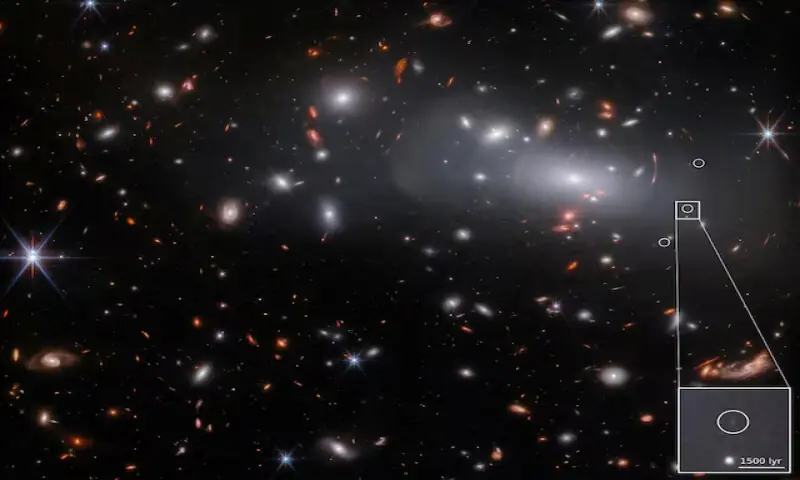
Astronomers have released the largest two-dimensional map of the universe so far, cataloguing about 4 billion stars, galaxies, black holes, asteroids and other celestial objects across roughly three-quarters of the night sky.
Built from more than 13 years of observations, the map combines visible and near-infrared data to provide a detailed view of parts of the cosmos that are not hidden by dust or gas.
Because of its enormous scale, the map cannot be displayed as a single image.
Instead, researchers have made it available through the free Legacy Survey Sky Browser, allowing scientists and the public to explore the mapped regions of the cosmos.
The project brings together observations from three major ground-based sky surveys using telescopes operated by the National Science Foundation (NSF) and the University of Arizona, supplemented by years of data from NASA’s Wide-field Infrared Survey Explorer (WISE) satellite.
NSF officials from NOIRLab said the map could help astronomers and citizen scientists combine its data with their own observations to gain a better understanding of the universe.
Researchers can use the map to search for rare phenomena such as gravitational lenses and track short-lived events including supernovae.
It could also help scientists investigate dark matter, the invisible substance believed to account for most of the universe’s mass, and dark energy, which is driving the accelerating expansion of the universe.
Previous versions of the map have already contributed to at least 1,800 scientific papers, according to NOIRLab.
Scientists expect the new map to support upcoming observing projects, including the Vera C. Rubin Observatory and NASA’s Nancy Grace Roman Space Telescope.
The surveys also provided the foundation for the Dark Energy Spectroscopic Instrument (DESI), which is building a three-dimensional map of the universe by measuring the light from celestial objects to determine their distances.
DESI completed its first five-year survey in April, with early findings raising the possibility that dark energy may be weakening over time.
Researchers are expected to receive improved results from the first five years of observations next year, while DESI’s broader survey is scheduled to continue through 2028.
The three main telescopes used to compile the new map were the Dark Energy Camera on the NSF’s Victor M. Blanco 4-metre Telescope in Chile, the NSF Nicholas U. Mayall 4-metre Telescope at Kitt Peak National Observatory in Arizona, and the University of Arizona’s Bok 2.3-metre Telescope, also at Kitt Peak.
For the latest news, follow us on Twitter @Aaj_Urdu. We are also on Facebook, Instagram and YouTube.