


US Senate passes $70 billion ICE funding; fails to ban Trump's 'anti-weaponization' fund
4 min read



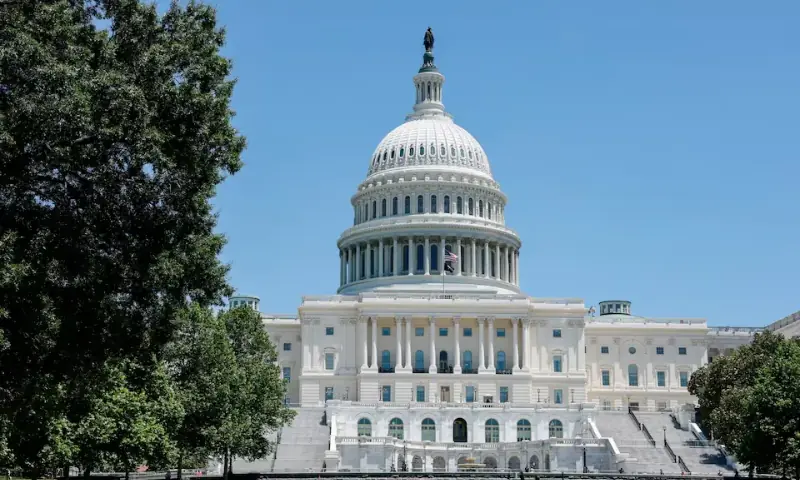
The US Senate handed President Donald Trump a victory early Friday morning, passing a bill that would provide the Department of Homeland Security with an additional $70 billion for immigration enforcement and sending it to the House of Representatives for final consideration.
The Senate voted 52-47 to approve the legislation, with no support from Democrats and no provision to ban a $1.8 billion “anti-weaponisation” fund that could compensate Trump’s political allies for allegations that the government mistreated them. One Republican voted against the bill.
Senate Republican Leader John Thune said the fund was a “settled issue,” citing acting Attorney General Todd Blanche’s congressional testimony this week that the Department of Justice would not move forward with it, though Democrats have said his word was insufficient.
Trump subsequently said he intended to nominate Blanche to lead the Justice Department - an action that would require Senate confirmation. Thune has indicated that it could be an uphill battle to get such a nomination approved in the Senate.
“I find it very hard to believe that they’re going to submit somebody who sat in front of a committee in the House and made definitive statements about this and then somehow all of a sudden turn around and go back on them,” Thune told reporters. “I don’t think that’s going to happen.”
Nonetheless, Trump himself on Wednesday said he thought the establishment of the fund was important.
Extra money for deportation crackdown
Republicans have accused Democrats of “defunding” Immigration and Customs Enforcement and Border Patrol, despite the agencies having a combined $100 billion in unspent funds that were part of a larger DHS spending package enacted last year by Republicans, who control Congress.
The House is not expected to take up the measure before next week.
Much of Thursday’s long debate over the ICE funding bill was overshadowed by efforts from Democrats and some Republicans to insert language unrelated to immigration. Those proposals revolved around prohibiting the use of federal funds and even private donations for building the lavish, 90,000 square-foot ballroom on White House grounds that Trump wants.
Senators also debated provisions making it illegal for federal dollars to be used for the “anti-weaponisation” fund. None of those amendments was approved.
The funding provided by the bill would help pay for Trump’s controversial migrant deportation crackdown over the next three years.
Lawmakers began voting on amendments to the immigration bill in a “vote-a-rama” session early on Thursday that culminated in the vote on the underlying measure in the early hours of Friday.
An initial move by Senate Democratic Leader Chuck Schumer to kill the “anti-weaponisation” fund, which Democrats call a “slush fund” for Trump’s allies, brought the session to a largely procedural halt for hours after Republican Senator Susan Collins voted for the motion. She was later joined by fellow Republicans Jon Husted and Dan Sullivan.
Schumer’s measure failed in a 50-49 vote but exposed the political turmoil among rank-and-file Senate Republicans. Some of them sought their own amendments to eliminate the fund permanently, five months before the November midterm elections.
Collins, Husted and Sullivan all face competitive races for reelection at a time when Trump’s approval rating is down, even among Republicans.
“Republicans refused to permanently outlaw Trump’s $2 billion slush fund, leaving taxpayers to rely on nothing more than a promise from Donald Trump’s personal fixer,” Schumer said in a statement after the final vote, referring to Blanche.
The fund has already been put on hold by the White House and the Justice Department.
But on Wednesday, Trump declined to say whether it had actually been terminated, telling reporters, “I love it. I think it’s so important.”
Republican Senator Thom Tillis, who opposed Schumer’s motion, told reporters he would not support passage of the funding bill without a Republican amendment vote to codify Blanche’s congressional testimony. Tillis argued that failing to do so would place a burden on congressional Republicans up for re-election in November who are worried about a voter backlash to the fund.
Opponents call Trump fund ‘immediate and dire threat’
Nearly all of the immigration bill’s funding would go to DHS’s ICE and Border Patrol agencies that are carrying out the Trump administration’s vigorous deportations throughout the United States.
Tillis later offered his own amendment to reallocate the controversial Trump fund’s resources to fraud-enforcement operations. It failed in an 84-15 vote, while garnering support from 12 Republicans.
Republican Senator Bill Cassidy, who proposed his own amendment to end the fund, joined Democratic Senator Cory Booker in a friend-of-the-court brief urging US District Judge Leonie Brinkema to maintain the block on Trump’s fund that she imposed last week.
They argued the fund “presents an immediate and dire threat to our constitutional order and the authority of Congress”.
A number of recent actions by Trump have prompted open criticism from some Republicans, from seeking $1 billion in taxpayer funding for a White House ballroom and security upgrades to his decision to nominate Blanche as attorney general and name political ally Bill Pulte as US intelligence chief.
For the latest news, follow us on Twitter @Aaj_Urdu. We are also on Facebook, Instagram and YouTube.














Comments are closed on this story.