


'Am I out?' Drought and rising costs from Iran war deepen pain for US farmers
5 min read



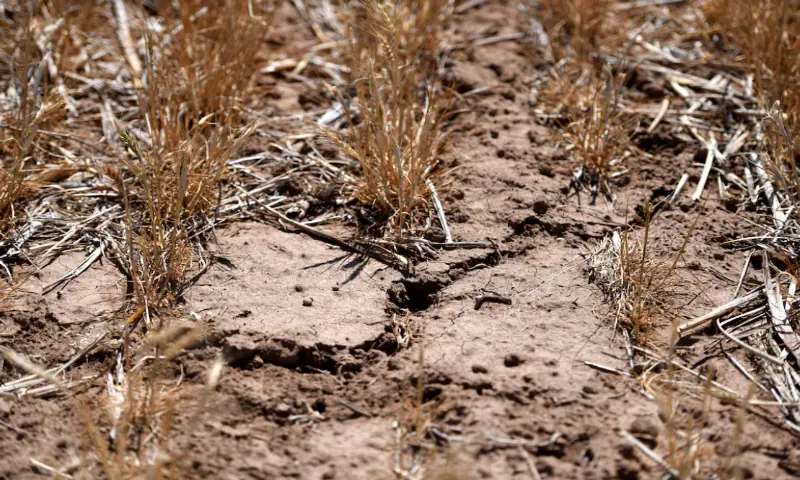
Scott Irlbeck crouched in a field of stunted wheat plants in a parched stretch of West Texas and slipped his hand into a crack wide enough to swallow it.
Last autumn, Irlbeck planted a crop that barely grew because rain never came. He now hopes his insurance adjuster will declare it a total loss so he will not need to spend money on pricey fuel to harvest it next month.
Soaring costs of fuel and commercial fertiliser, in the wake of the Iran war, are making hard times worse for farmers across the US Plains states of Texas, Kansas, Oklahoma, South Dakota and Nebraska.
Even before the war, farmers were struggling with a resurgent drought, high input costs, and the fallout from President Donald Trump’s trade policies, which hobbled export markets and drove down prices for their crops.
Since the closure of the Strait of Hormuz in late February, the cost of farm diesel has climbed 72%, the Kentucky Farm Bureau wrote in prepared testimony to a U.S. Senate agriculture committee hearing this month.
Urea prices, one of the major fertilisers produced in the Gulf region, were up 55%, while prices for another nitrogen-based fertiliser rose 33%, the farmers’ group said.
And yet, because of the drought, farmers are looking at the prospect of smaller harvests to pay for it all.
Irlbeck, who did not buy fertiliser supplies in advance for a sorghum crop he will plant this month, said he will probably not use any at all because of soaring prices and the pernicious drought reducing potential yields.
“There’s fuel, there’s drought, there’s fertiliser,” Irlbeck said, ticking off his challenges. “I’ve got three strikes. Am I out?”
Drought ravages wheat
Texas is the third-largest wheat-growing state in the country, second for sorghum and first for cotton.
Where Irlbeck farms near Tulia, wind gusted across dry, brown fields dotted with dirty clumps of cotton and brittle sorghum stalks left over from previous harvests.
U.S. farmers are expected to produce the smallest crop of hard red winter wheat, which is used to make bread, since 1957, according to the U.S. Department of Agriculture.
“I’m just waiting for it to die,” Irlbeck said.
More than 60% of the continental United States, an area with a population of about 153 million people, is experiencing drought, up from 43% at the start of 2026 and 33% a year ago, according to the most recent government US Drought Monitor report.
In Oklahoma, it may be too late for rain to help wheat in the hardest-hit areas, Amanda De Oliveira Silva, an Oklahoma State University agronomist, said in late April.
“Rain can help preserve what’s left, but it won’t reverse the damage already done.”
In South Dakota, farmers were rethinking plans to apply fertiliser to wheat they planted last fall due to high prices and bad growing conditions, said Clarence Winter, South Dakota State University extension agronomist.
When asked for comment on fertiliser costs, the US Department of Agriculture said in a statement to Reuters that the entire Trump administration was focused on ensuring greater domestic production of affordable fertiliser.
War raises costs
For farmers like Tommy Salisbury, who grows wheat, sorghum and soybeans in Tulsa County, Oklahoma, higher prices for inputs wiped out the benefits that flowed to individual operators under the Trump administration’s $12 billion aid package meant to offset the fallout from tariffs.
“We’re paying input prices of 2026, but we’re getting crop prices and grain prices of the 70s and 80s,” he said.
USDA Secretary Brooke Rollins acknowledged farmers were facing hardship.
“We are seeing significant price increases at a time when our farm economy is struggling,” she told a news conference on Tuesday.
In a post on X, last month, she said that about 80% of US farmers had locked in supplies last fall, well before the start of the war.
However, a survey by the American Farm Bureau Federation, the leading US farm lobby, found that most farmers could not afford all the fertiliser they need for this growing season.
Rates of advance purchases varied widely by region, the Farm Bureau said. While most farmers in the Midwest prebooked fertiliser for 2026, that was not the case in the Northeast or the South.
Advance buying is more common in the Midwest because many farmers rotate plantings between corn and soybeans, and make purchase decisions well ahead of planting, the Farm Bureau said. In the South, many farmers do not have storage facilities for fertiliser, the group said.
Asked for comment, USDA said it was continuing to evaluate the data on fertiliser usage.
Kody Carson, who farms in the West Texas city of Olton, said he did not buy fertiliser in advance and might not buy any at all for his 2,400 acres of cotton.
The drought decimated the yields of his winter wheat to an estimated 18 to 20 bushels per acre from his expectation of 80 bushels per acre, he said.
“How can I go out and be financially prudent and book this high-dollar fertiliser when I don’t even know if I’m going to make a crop?” Carson said.
Leaning on religion
Tom Gregory, who grows cotton, corn and sorghum in Petersburg, Texas, also did not buy fertiliser in advance.
By April, he said he was facing costs of $558 per ton, up from $402 per ton in February.
Gregory was trying to proceed with spring plantings anyway, he said, because farming is his livelihood and a family tradition. He said he intends to apply fertiliser as sparingly as possible.
In recent years, Gregory said he sought to counter increasing input costs by producing bigger crop yields.
His hopes eventually faded for that strategy, he said, first because of the drought and now because of higher fertiliser prices.
Gregory said he was leaning on his faith, family and exercise to make it through.
“I hope the good Lord takes care of us,” he said.
For the latest news, follow us on Twitter @Aaj_Urdu. We are also on Facebook, Instagram and YouTube.
















Comments are closed on this story.