
Live
Iran israel war
Live

Khamenei killing shatters Iran’s order, triggers high-stakes succession race

Published 02 Mar, 2026 01:38pm 0 min read
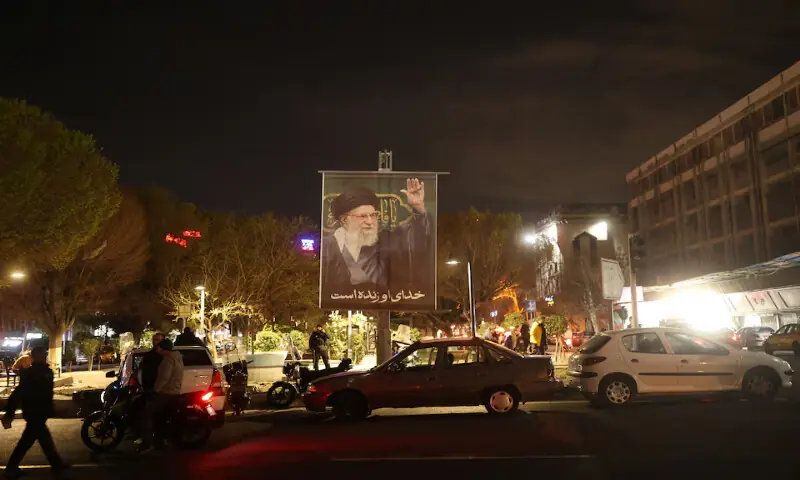
A banner of Iran’s Supreme Leader Ayatollah Ali Khamenei on a street in Tehran, Iran. – Reuters

The assassination of Iran’s Supreme Leader Ayatollah Ali Khamenei has plunged the Islamic Republic into its most perilous crisis since the 1979 revolution — confronting it with war on its own territory, an unresolved succession, and mounting internal strain.

Despite the shock of Khamenei’s killing, five regional officials and analysts cautioned against assuming a rapid collapse.

Iran’s political order, they said, was deliberately constructed to avoid reliance on a single leader, dispersing authority across clerical institutions, the security apparatus and power networks.

“The Iranian system is bigger than one man — removing Khamenei could harden the regime rather than weaken it,” said Danny Citrinowicz of the Atlantic Council.

“Iran was built to survive the loss of a leader,” added Ali Hashem, a research affiliate at Royal Holloway, University of London.

“The danger is not a vacuum. It’s whether war and pressure push the system past the point where that resilience holds.”

At the centre of that resilience is the elite Islamic Revolutionary Guards Corps (IRGC), long regarded as Iran’s true centre of gravity.

The balance of power now hinges on whether the Guards emerge weakened by battlefield losses and internal frictions — or more entrenched, closing ranks around a harder, more security-driven approach to governance.

“The real question is whether Khamenei’s death takes the air out of the IRGC — the force that actually runs Iran — or whether they close ranks and harden,” said Alex Vatanka, a senior fellow at the Middle East Institute.

“If rank-and-file officials decide there is no future here, I’m not sure even the Guards can keep the regime together.”

Regional officials say the Guards are unlikely to transform ideologically because their identity and mandate are rooted in protecting the revolution.

But they are capable of tactical evolution if the system requires it.

“They may evolve into a less hardline force…there are pragmatic mid-level members open to reducing tensions with the United States if necessary for the system’s survival,” said one regional official.

That conditional pragmatism makes the IRGC both the system’s shield and its key barometer.

Regime change?

Jonathan Panikoff, a former US deputy national intelligence officer for the Near East, said Washington and Israel appear to be pursuing a strategy aimed not only at degrading Iran’s military response capabilities, but at destabilising the regime itself by removing its senior leadership and testing the loyalty of the rank and file.

The success of that approach, he said, would ultimately depend on whether security forces stand aside or defect if public unrest resurfaces.

In the immediate aftermath, officials say Tehran’s overriding priority is to project continuity.

Operationally, Iran’s command structure continues to function, though under heavy pressure.

Missile forces, air defences and top commanders have been hit, but the system has so far absorbed the blows.

Iran now faces three intersecting tests, officials say: whether its security state can hold under fire; whether its embattled elite can agree on a successor or pivot to a new governing formula; and whether a shaken public pushes the crisis toward a deeper political rupture.

Veteran Iranian politician Ali Larijani, secretary of Iran’s Supreme National Security Council, announced on Sunday that a temporary leadership council would oversee the transitional period after Khamenei’s death.

Figures such as Larijani and Mohammad Baqer Qalibaf, the parliament speaker, are seen as potential bridge figures in such a phase, reflecting a security-oriented but pragmatic balancing approach.

Politically, Iran faces a succession process it has navigated only once before — and then under far more stable conditions.

The constitution assigns the task to the Assembly of Experts, an 88-member clerical body, but analysts say wartime pressures could push the process toward a more improvised outcome — either a quickly appointed successor or a temporary collective leadership centred on the security establishment.

They said Khamenei has sought to shape that outcome before his death.

Following a 12-day war with Israel in June last year that targeted him and his inner circle, he nominated preferred successors and ensured key military posts were filled with backup commanders.

The candidates he favoured included judiciary chief Gholam-Hossein Mohseni-Eje’i and Hassan Khomeini, a moderate cleric and grandson of the Islamic Republic’s late founder.

But officials say the clerical body may delay the selection of a successor to Khamenei for fear he will be killed.

Far from over?

Externally, Israel is signalling the campaign is far from over.

Two sources briefed on the operation said Israel intends to keep striking political and security institutions linked to Iran’s ruling establishment, as well as ballistic missile and launcher systems, in an effort to weaken the state and create conditions for regime change.

One source said Israel wants the campaign to continue at least until Iran’s missile capabilities are destroyed, but fears it could be cut short if Washington reaches an agreement with Tehran.

“The objective is very clear: to remove an existential threat to the State of Israel,” Israeli Foreign Ministry spokesperson Oren Marmorstein told Reuters in Tel Aviv.

“That threat is the Iranian regime. We have no quarrel with the Iranian people.”

A senior official with direct knowledge of joint Israeli-US military planning said it was too early to predict what political order might emerge in Iran, noting that the campaign was still in its early stages and outcomes would depend on developments on the ground.

Iranians must take their destiny into their own hands, the official said, adding that this might be easier once the US and Israel have achieved “air supremacy” over Iran.

Maintaining the tempo and intensity of strikes was seen as critical to exploiting fissures inside Iran and the IRGC following the killing of senior leaders, the official added, declining to elaborate on what a breakdown in command could look like.

The conflict has also opened new risks.

With foreign militaries operating over Iranian airspace and the state’s coercive capacity under strain, analysts say unrest could intensify if large-scale anti-government protests re-emerge, raising the prospect of defections within the security forces and giving prominence to civilian figures calling for change.

For the latest news, follow us on Twitter @Aaj_Urdu. We are also on Facebook, Instagram and YouTube.

Live

Army called in; three-day curfew imposed in Gilgit, Skardu

Published 02 Mar, 2026 01:11pm 0 min read
APP file
APP file

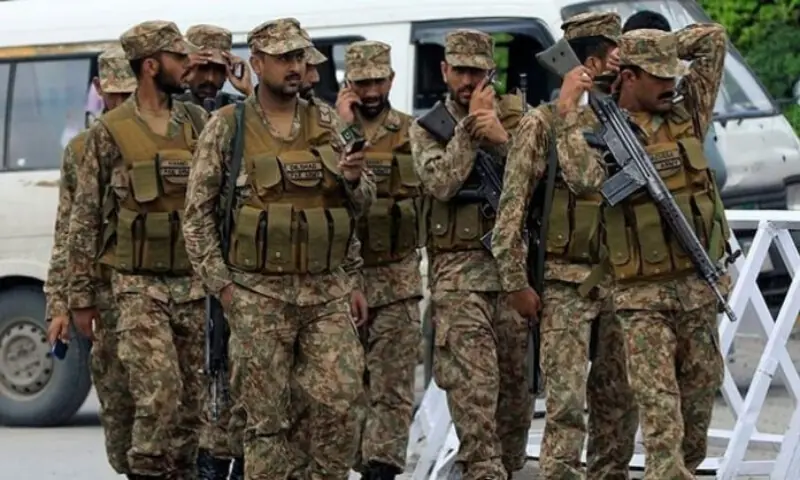
The Gilgit Baltistan government has imposed a three-day curfew in Gilgit and Skardu and sought the deployment of Pakistan Army troops in aid of civil authorities amid a deteriorating law and order situation following large-scale protests.

According to a notification issued by the Home and Prisons Department, the decision was taken in view of the “precarious” security situation in the region in the aftermath of protests triggered by the assassination of Iran’s Supreme Leader Ayatollah Ali Khamenei in US-Israeli air strikes.

The notification, addressed to the Force Commander, Force Command Northern Areas (FCNA), stated that there were fears the situation could further deteriorate, particularly in District Gilgit and Skardu.

It requested deployment of Pakistan Army troops in the two districts and imposition of curfew for an initial period of three days, March 2, 3 and 4, to prevent any untoward incident and safeguard human life and property.

According to the notification, a schedule for curfew and relaxation has also been issued.

Officials said security arrangements were being tightened across sensitive areas, while residents have been advised to remain indoors and cooperate with law enforcement agencies.

For the latest news, follow us on Twitter @Aaj_Urdu. We are also on Facebook, Instagram and YouTube.
Live

US embassy and consulates suspend routine services in Pakistan

Published 02 Mar, 2026 12:30pm 0 min read
File photo
File photo

The US Embassy in Islamabad and consulates in Karachi, Lahore, and Peshawar have temporarily suspended routine services, including visa appointments and consular assistance for US citizens, due to ongoing security concerns.

A spokesperson for the US Embassy confirmed that all appointments for visa and citizen services scheduled for March 2, 2026, have been put on hold.

New dates regarding the resumption of services will be provided later.

The spokesperson emphasised that the suspension is intended to ensure the safety of diplomatic staff and individuals accessing consular services.

Limited services may still be available for emergency cases.

The move comes amid heightened security concerns amid US-Israeli strikes in Iran.


For the latest news, follow us on Twitter @Aaj_Urdu. We are also on Facebook, Instagram and YouTube.

Live

Trading at stock exchange resumes after historic drop

Published 02 Mar, 2026 12:08pm 0 min read
File photo
File photo

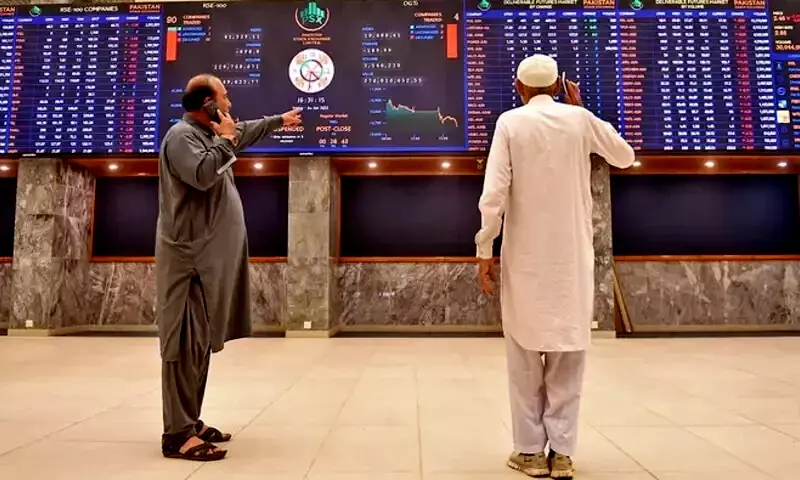
Trading resumed on the Pakistan Stock Exchange (PSX) after it was halted on Monday following a sharp market decline amid US and Israeli attacks on Iran.

When the trading resumed, the KSE 100 Index managed to recover, reaching the limit of 157,000 points.

Earlier, before the suspension, the KSE Index fell by 9.42%, triggering a 45-minute trading suspension on the first day of the business week.

During the session, the PSX benchmark KSE-100 Index dropped by 15,071 points, falling to 152,991 points.

The market opened under heavy selling pressure, recording its worst decline in history.

At the start of trading, the index fell to 152,940 points after a steep drop of 15,121 points.

During the session, the KSE-100 Index reached an intraday low of 152,717 points.

The index had closed at 168,062 points on the final trading day of last week.

Regional markets also experienced sharp declines.

Japan’s stock market fell 1.9%, with the Nikkei 225 Index down by 586 points to 58,264. South Korea’s stock market dropped 2%.

In India, the Bombay Stock Exchange’s Sensex fell 967 points to 80,320, while the Nifty 50 Index declined 213 points to 24,965.

For the latest news, follow us on Twitter @Aaj_Urdu. We are also on Facebook, Instagram and YouTube.
Live

Explosions rock Gulf cities and Israel amid Iranian strikes

Published 02 Mar, 2026 11:55am 0 min read
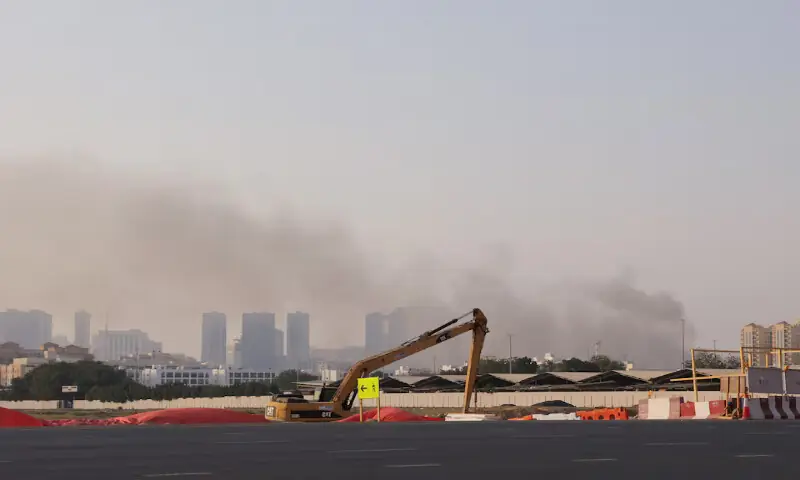
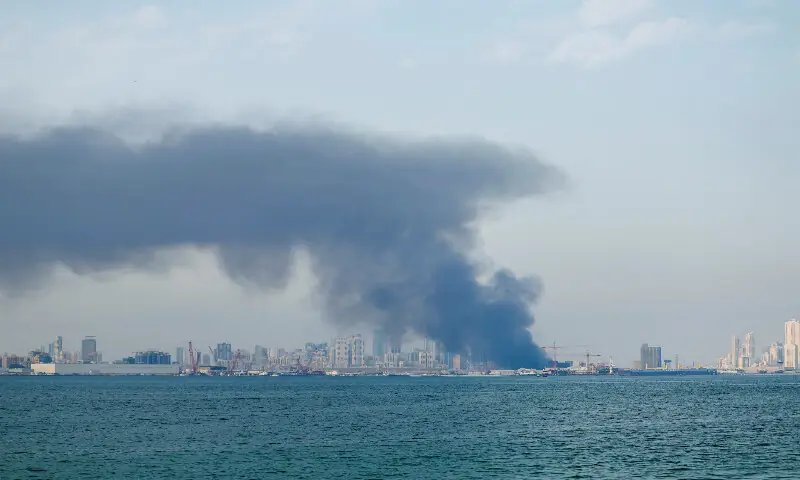
Smoke rises after an Iranian attack in Sharjah, United Arab Emirates. – Reuters

Loud explosions were reported across Gulf cities, including Dubai, Doha, and Manama, on Monday, as Iran resumed attacks on its Gulf neighbours in response to US-Israeli air raids.

Witnesses reported hearing multiple blasts in the hearts of Doha and Manama, and throughout parts of the United Arab Emirates, sending waves of shock through city streets.
Meanwhile,

Blasts heard in Israel

Loud explosions were reported above Jerusalem after the Israeli military said it had “identified missiles launched from Iran,” triggering air raid sirens across the city and parts of central Israel.

According to the Israel Defence Forces, the nation’s air defence systems were activated to intercept the incoming missiles and strike any threats as needed to protect civilians.

There were no immediate reports of direct impacts or casualties, and it remained unclear whether the explosions were caused by interceptions of the incoming projectiles.

For the latest news, follow us on Twitter @Aaj_Urdu. We are also on Facebook, Instagram and YouTube.
Live

Iran rules out negotiations with US as war expands across ME

Published 02 Mar, 2026 11:26am 0 min read
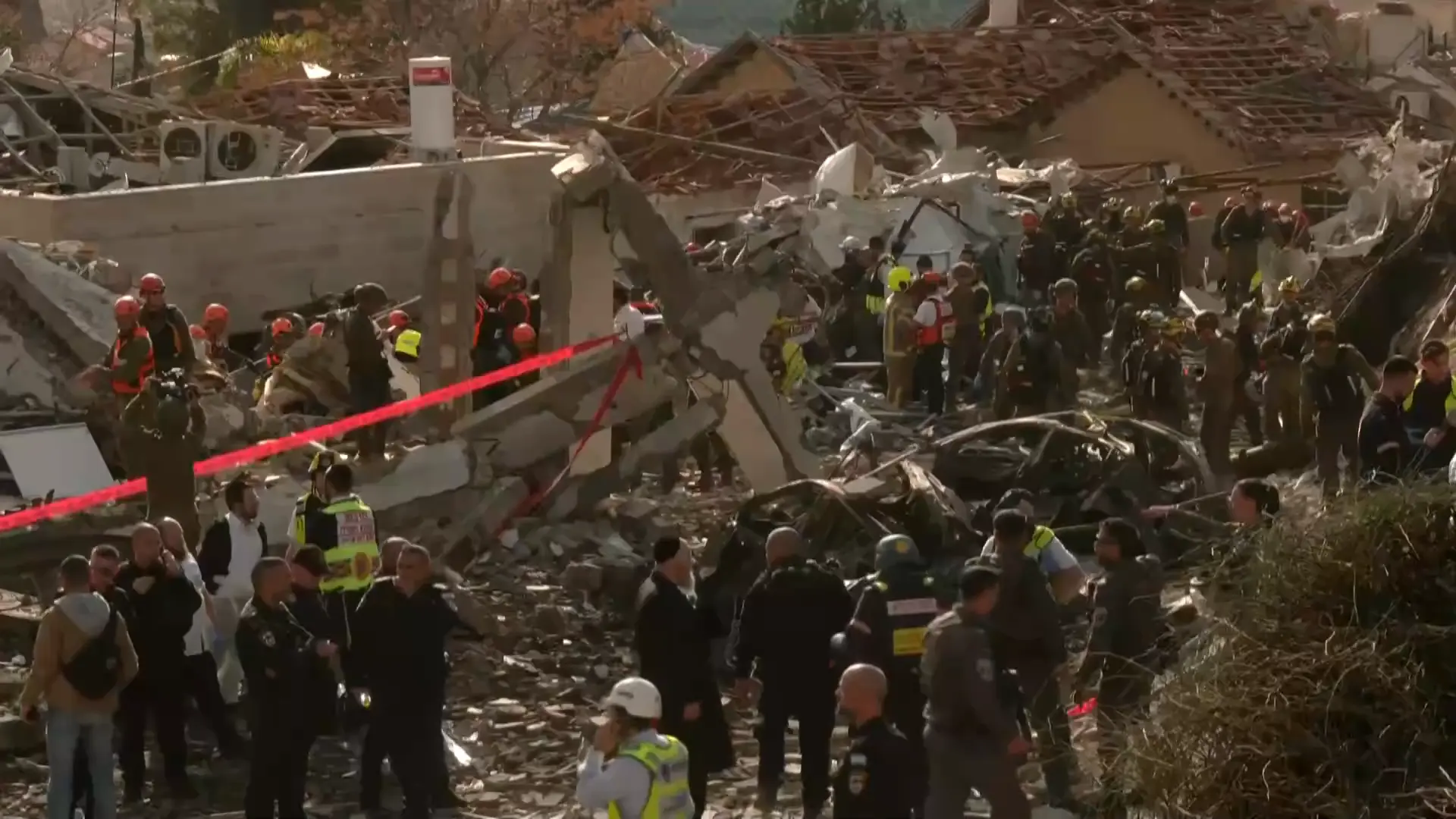
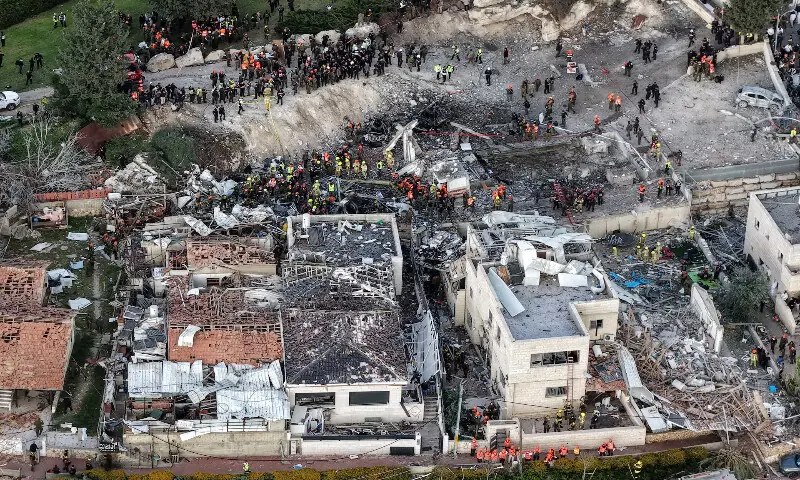
A drone view of the scene of a deadly Iranian missile strike in Beit Shemesh, Israel. – Reuters

Top Iranian security official Ali Larijani said on Monday that Iran will not negotiate with the United States, as Tehran fired missiles at Israel and Gulf Arab states.

Secretary of Iran’s National Security Council, Ali Larijani, made it clear on Monday that the country will not negotiate with the United States and is currently focused on defending itself.

Larijani stressed that Iran’s armed forces did not initiate the conflict, framing the military response as purely defensive.

“This is the very gist of the matter when it comes to Iran’s rhetoric over the past few days,” he said.

When asked about potential diplomatic engagement, a spokesperson from the Iranian Foreign Ministry told Al Jazeera that Tehran had already attempted negotiations twice: once in 2025, which was interrupted by Israeli air strikes, and now again, as Iran faces renewed attacks while awaiting planned talks with both the United States and the International Atomic Energy Agency (IAEA).

President Donald Trump, who had previously encouraged Iranians to challenge their government, indicated on Sunday that he remained open to dialogue with Iran’s new leadership.

Since the strikes that killed Supreme Leader Ali Khamenei and other senior officials, Iranian authorities say more than 200 people have died in the ongoing conflict.

For the latest news, follow us on Twitter @Aaj_Urdu. We are also on Facebook, Instagram and YouTube.
Live

Gulf states warn Iran of retaliation amid missile strikes

Published 02 Mar, 2026 10:49am 0 min read
Smoke rises after Iranian missile attacks in Manama, Bahrain. – Reuters

Member states of the Gulf Cooperation Council (GCC) have said they reserve the right to respond following Iranian attacks in Gulf countries amid escalating regional tensions.

In a joint statement issued after a meeting of foreign ministers from Gulf Cooperation Council member states — Saudi Arabia, the United Arab Emirates, Bahrain, Oman, Qatar and Kuwait — the bloc said it would take “all necessary measures” to safeguard security and stability, protect territories and ensure the safety of citizens and residents.

The statement emphasised that GCC countries reserve the right to respond to Iranian attacks in accordance with international law.

Saudi summons Iranian envoy

Separately, Saudi Arabia summoned Iran’s ambassador in Riyadh, Ali Reza Enayati, to protest against the strikes.

Saudi Deputy Foreign Minister Waleed bin Abdulkarim said attacks on Saudi Arabia and other Gulf states constituted “open aggression” that would not be tolerated.

He stressed that the kingdom would use “all available options” to defend its national security.

Relief for passengers

In the United Arab Emirates, authorities announced a major relief package for approximately 20,200 passengers stranded at airports following airspace closures linked to the Iranian attacks.

The UAE’s General Civil Aviation Authority said temporary accommodation, food and beverages had been provided, and that efforts were underway to restore travel operations as quickly as possible.

Attack thwarted

Meanwhile, the UAE Ministry of Defence said that since February 28, the country’s air force and air defence systems had intercepted 165 ballistic missiles, two cruise missiles and 541 drones launched during Iranian attacks.

According to the ministry, 152 ballistic missiles were destroyed mid-air, while 13 fell into the sea. Both cruise missiles were intercepted.

Of the drones launched, 506 were shot down, although some struck civilian areas, causing material damage.

Authorities said three people were killed and 58 others sustained minor injuries in the attacks.

The ministry added that the country’s air defence systems were fully capable of countering all forms of threats and that the protection of civilians remains a top priority.

For the latest news, follow us on Twitter @Aaj_Urdu. We are also on Facebook, Instagram and YouTube.
Live

Hegseth to hold first Pentagon briefing since Iran strikes

Published 02 Mar, 2026 09:52am 0 min read
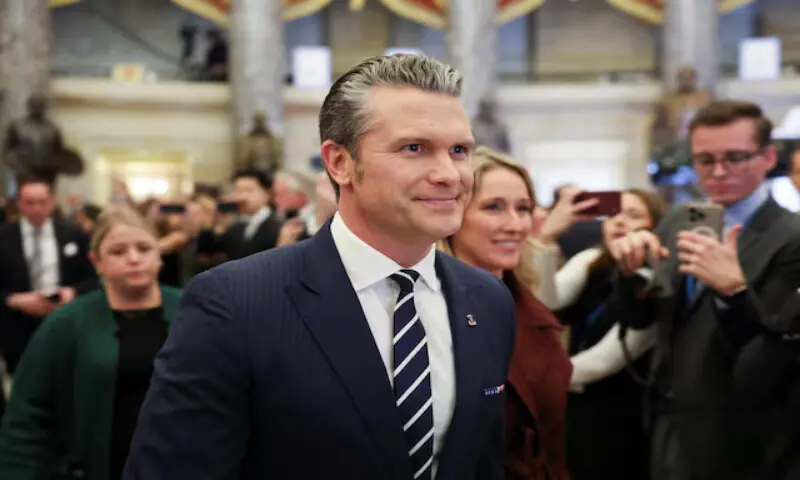
US Secretary of Defence Pete Hegseth. – Reuters

US Defence Secretary Pete Hegseth is set to hold a news conference on Monday morning – the first by a senior US official since the United States and Israel launched attacks on Iran.

The briefing is scheduled for 8am local time (13:00 GMT).

Hegseth will appear alongside Chairman of the Joint Chiefs of Staff John Caine.

According to the Pentagon, the two officials will discuss the US military operation targeting Iran, which has been named “Operation Epic Fury”.

Since the strikes began on Saturday, President Donald Trump has given several media interviews and released video addresses, but has not held a formal press conference.

For the latest news, follow us on Twitter @Aaj_Urdu. We are also on Facebook, Instagram and YouTube.
Live

Surrender or face death, Trump warns Iranian forces

Published 02 Mar, 2026 09:34am 0 min read
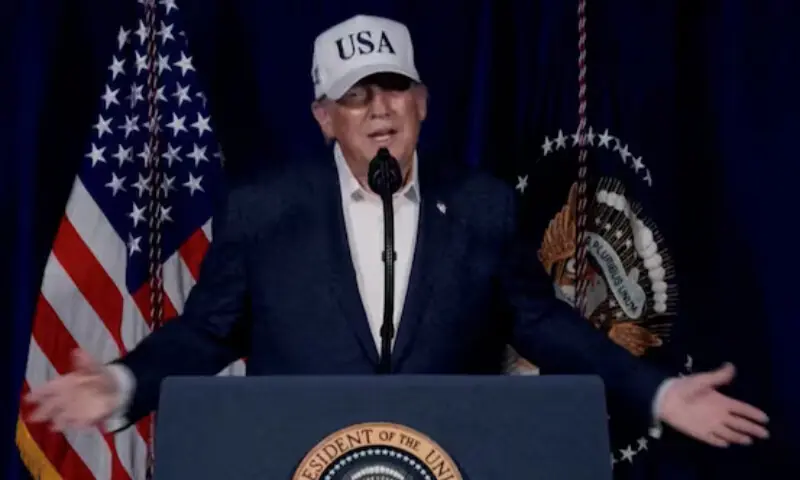
US President Donald Trump. – Reuters

US President Donald Trump has claimed that Iran’s military command structure has been “completely eliminated” in the ongoing American and Israeli strikes, warning Iranian forces to surrender or “face death”.

In a video address and media remarks, Trump said that US-Israeli forces targeted assets belonging to the Islamic Revolutionary Guard Corps (IRGC), Iran’s air defence systems, and a naval building, while nine naval vessels had also been destroyed.

He said that the operation against Iran would continue until objectives were achieved.

Referring to the death of US soldiers in Iranian strikes, Trump said, “We will avenge the killing of Americans,” acknowledging that three US service members had been killed in Iranian attacks and warning that further American casualties were possible.

The president said Iran’s military leadership had been wiped out and claimed that many within the ranks were seeking to surrender.

He warned the IRGC, the Iranian army and police that those who lay down their arms could receive immunity, but those who refused would “face death”.

Separately, in a telephone interview with a British newspaper, Trump said the conflict could last up to four weeks, though it might end sooner.

He claimed that 48 key Iranian figures had been killed so far and said hundreds of targets inside Iran had been struck.

Trump reiterated that Iran would not be allowed to acquire nuclear weapons and said he had spoken with leaders in Saudi Arabia, Bahrain, the United Arab Emirates, Qatar and Jordan about the crisis.

He expressed hope that “democracy will be established” in Iran after the war and urged Iranians to “take back their country”.

At the same time, Trump said he remained open to further negotiations with Iran’s new leadership, though he cautioned that talks might not happen soon.

Meanwhile, Iranian officials said that following the death of Supreme Leader Ayatollah Ali Khamenei, constitutional mechanisms are underway to appoint a successor through the Assembly of Experts, and a temporary leadership council has assumed authority.

Iranian Foreign Minister Abbas Araghchi said Tehran was prepared to engage in talks with Washington, but stressed that continued bombardment of the capital had not weakened Iran’s military capabilities.

Iranian officials have described Khamenei’s death as martyrdom that has made the situation more dangerous.

Despite US and Israeli air strikes on Tehran and other cities, Iranian leaders have vowed retaliation and insisted the country’s governing structure remains functional.

For the latest news, follow us on Twitter @Aaj_Urdu. We are also on Facebook, Instagram and YouTube.
Live

Iranian leaders close ranks after Khamenei assassination

Published 02 Mar, 2026 08:58am 0 min read
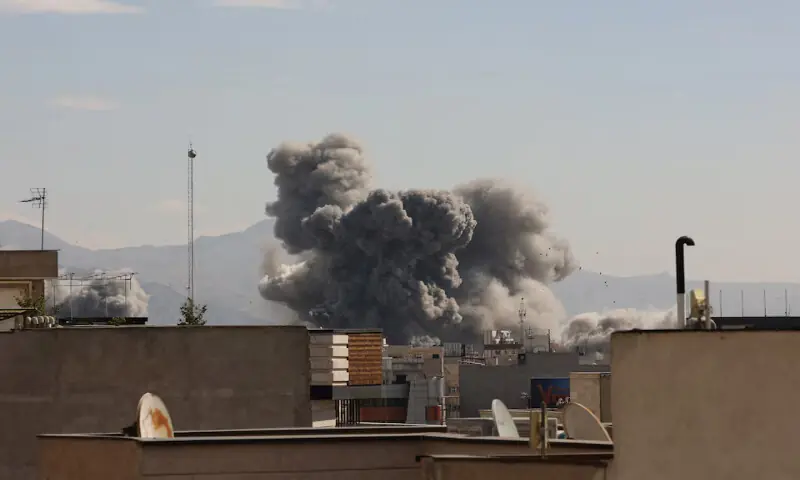
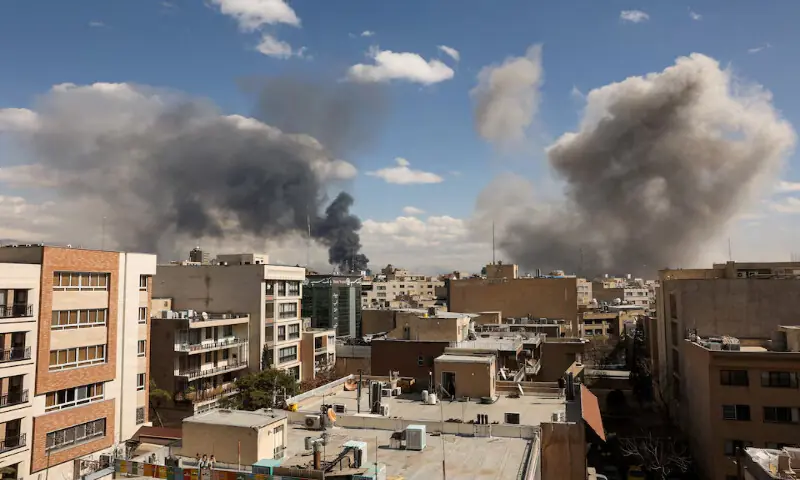
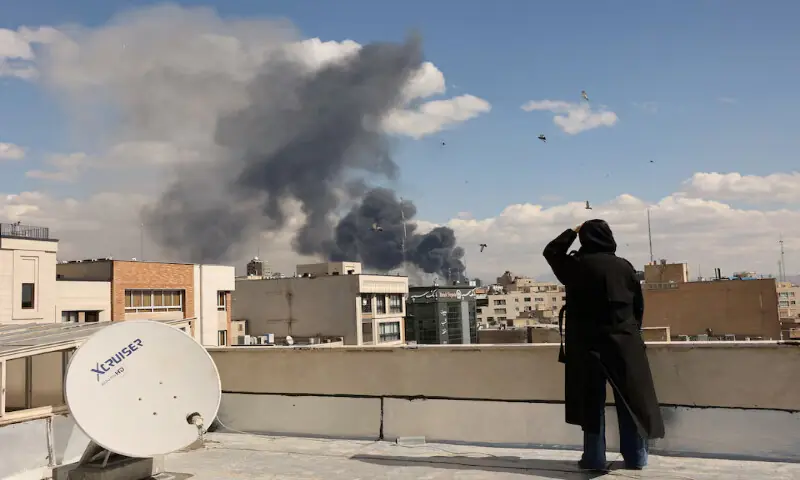
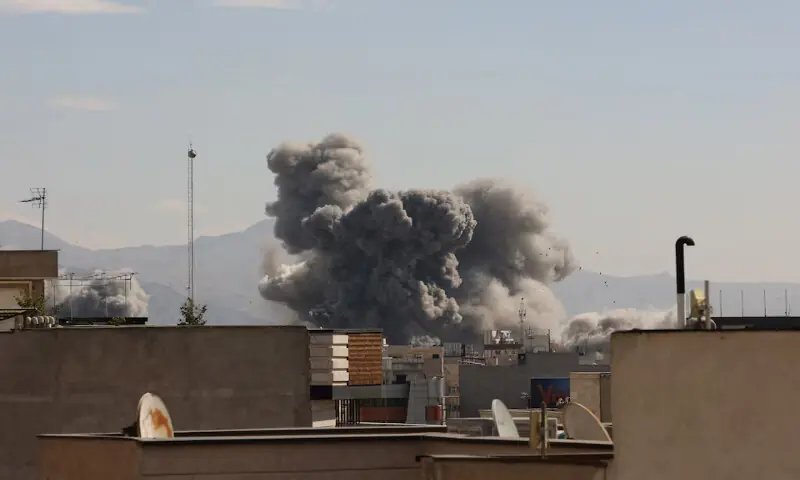
Smoke rises following an explosion in Tehran, Iran. – Reuters
Smoke rises following an explosion  in Tehran. – Reuters
Smoke rises following an explosion in Tehran. – Reuters
Smoke rises following an explosion in Tehran, Iran. – Reuters

Heavy air strikes by the United States and Israel continued to pound Tehran and other Iranian cities, as Iran’s political and military establishment scrambled to chart a path forward following the killing of Supreme Leader Ayatollah Ali Khamenei.

Several neighbourhoods in the capital were hit in successive waves of attacks, with the Israeli military saying it targeted military centres.

Iranian authorities have provided few details about the extent of the damage, and internet connectivity remained largely blocked for a second consecutive day.

Khamenei and several top commanders were killed in Tehran at the outset of the conflict on Saturday.

In response, senior officials moved swiftly to emphasise continuity within the Islamic Republic’s political system.

Under procedures established after Iran’s 1979 Islamic Revolution, the Assembly of Experts is responsible for selecting a new supreme leader.

President Masoud Pezeshkian said a new leadership council “has begun its work”, while Foreign Minister Abbas Araghchi said the process to appoint a successor could be completed within days.

Until then, a three-member council will govern. Alongside Pezeshkian, judiciary chief Gholam-Hossein Mohseni-Ejei and Alireza Arafi were named to the body.

Arafi is a member of the powerful Guardian Council, with the Expediency Council selecting the jurisprudence expert to serve as interim leader.

The powerful Islamic Revolutionary Guard Corps (IRGC) is also expected to play a decisive role.

Its commander-in-chief, Mohammad Pakpour, who had been appointed less than a year ago, was among those killed on Saturday.

Also reported killed were armed forces chief of staff Abdolrahim Mousavi, Defence Council head Ali Shamkhani and police intelligence chief Gholam-Reza Rezaeian.

The IRGC vowed retaliation, announcing what it described as “the heaviest offensive operations” in the country’s history against Israeli territory and US bases in the region.

Army chief Amir Hatami said Iranian forces would continue defending the country, while officials claimed fighter jets had carried out bombing runs against US positions without releasing evidence.

Police chief Ahmad-Reza Radan said security forces were prepared to maintain public order, as Washington and Israel publicly urged Iranians to take to the streets against the government.

Senior adviser Ali Larijani endorsed the constitutional transition process and sought to reassure neighbouring countries facing incoming Iranian missiles and drones.

Writing in Arabic on social media, he said Iran did not seek to target its neighbours but considered US bases there to be “American territory”.

In a separate English-language post, he warned of unprecedented retaliation.

Another senior official, Ali Akbar Ahmadian, said the Supreme Defence Council would continue functioning despite the loss of key members.

Prominent political and religious figures rallied around the system.

Hassan Khomeini, grandson of Islamic Republic founder Ruhollah Khomeini, praised Khamenei as a “hero” and stressed the need to defend the Islamic Republic.

Former presidents Hassan Rouhani and Mohammad Khatami also voiced support for the interim leadership while condemning the assassination.

Conflicting reports emerged over the fate of former president Mahmoud Ahmadinejad.

Some local outlets reported he had been killed in an Israeli strike in eastern Tehran, but the state-linked Iranian Labour News Agency denied the claim, citing an informed source.

Footage circulating online showed damage in Tehran’s Narmak district, including near 72 Square, where Ahmadinejad is reported to reside.

A nearby school was damaged, and at least two children were killed, local authorities said.

Separately, officials reported that more than 150 people, many of them children, died in a strike on a school in Minab in southern Iran.

US and Israeli officials have signalled that air operations could continue for days or weeks, targeting state and military infrastructure.

Inside Iran, the balance of power remains uncertain as the country absorbs the loss of a leader who had ruled unchallenged for 36 years.

The government has declared seven days of public holidays and 40 days of national mourning, with large gatherings organised across the country to commemorate Khamenei.

For the latest news, follow us on Twitter @Aaj_Urdu. We are also on Facebook, Instagram and YouTube.
Live

Israel strikes Beirut after Hezbollah missile and drone attack

Published 02 Mar, 2026 08:24am 0 min read
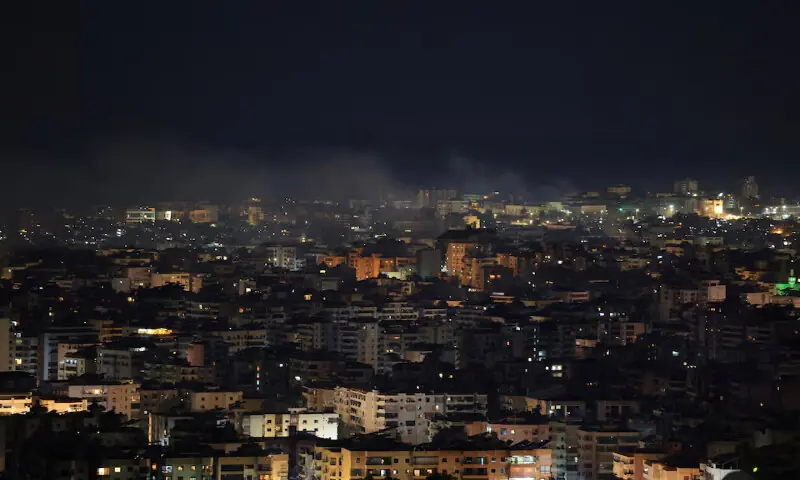
Smoke rises after Israeli strikes in Beirut’s southern suburbs, Lebanon. – Reuters
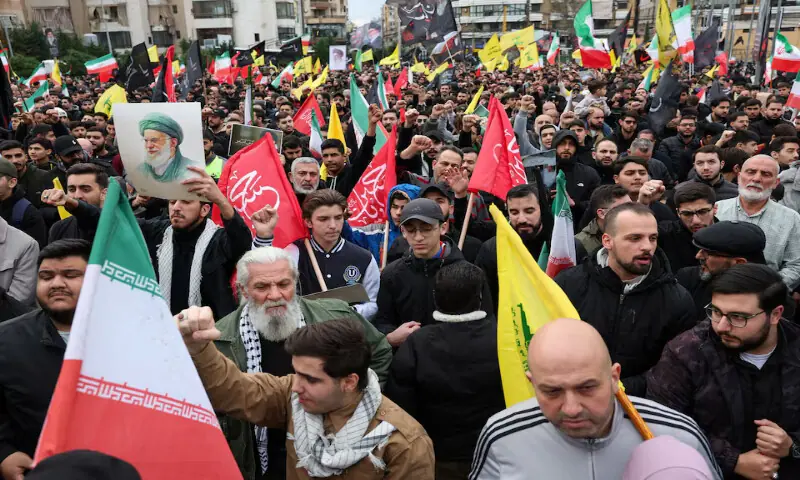
Hezbollah supporters rally in solidarity with Iran after US and Israeli strikes killed Iranian Supreme Leader Ayatollah Ali Khamenei, in Beirut, Lebanon. – Reuters

Israel carried out air strikes on the Hezbollah-controlled southern suburbs of Beirut on Monday, after the Iran-backed group launched missiles and drones towards Israel to avenge the killing of Iran’s Supreme Leader Ali Khamenei.

More than a dozen explosions rocked Beirut, in the most intensive strikes on the southern suburbs since a war between Israel and Hezbollah in 2024.

People fled on foot and by car, clogging the roads, after the series of strikes began around 2.40am.

The violence widened the conflict that has spread through the Middle East since the United States and Israel attacked Iran on Saturday.

Hezbollah, a group established by Iran’s Revolutionary Guards in 1982, is one of Tehran’s principal allies in the Middle East.

The Israeli military said it had begun striking Hezbollah targets across Lebanon, including senior Hezbollah members in the Beirut area.

Lebanese security sources said the airstrikes hit several areas of the southern suburbs, known as Dahiyeh.

“Hezbollah opened a campaign against Israel overnight, and is fully responsible for any escalation,” Israeli Chief of the General Staff, Eyal Zamir, said in a statement.

The Israeli military issued a warning ordering residents of dozens of villages in southern and eastern Lebanon to evacuate.

The Lebanese health ministry could not immediately be reached for a casualty toll.

The Israeli military said several projectiles that crossed from Lebanon fell in open areas and one was intercepted by the Israeli air force.

“No injuries or damages were reported,” it said.

Hezbollah claims attack

Hezbollah said it had targeted an Israeli military missile defence facility south of the city of Haifa in revenge for “the pure blood” of Khamenei and in response to what it described as repeated Israeli attacks.

It was the first time the group had carried out such an attack since the 2024 war.

“The resistance leadership has always emphasised that the continuation of Israeli attacks and the assassination of our leaders, youth, and people gives us the right to defend ourselves and respond at the appropriate time and place,” Hezbollah said in a statement.

Since a US-backed ceasefire between Israel and Lebanon in 2024, Israel has carried out regular strikes against what it has identified as Hezbollah targets in Lebanon, accusing the group of seeking to rearm.

It was Israel’s first attack on the southern suburbs since it killed the group’s top military official, Ali Tabtabai, in November.

Israel also carried out airstrikes in southern Lebanon and the Bekaa Valley in eastern Lebanon, the Lebanese security sources said.

Lebanese PM criticises firing of missiles

“The IDF (Israel Defence Forces) will operate against Hezbollah’s decision to join the campaign, and will not enable the organization to constitute a threat to the State of Israel,” the Israeli military said.

Israel and Lebanon agreed to a US-brokered ceasefire in 2024, ending more than a year of fighting between Israel and Lebanese group Hezbollah that had culminated in Israeli strikes that severely weakened the Iran-backed group.

Lebanese Prime Minister Nawaf Salam said the firing of projectiles from south Lebanon was irresponsible, calling it a suspicious act that jeopardised Lebanon’s security.

Lebanon’s presidency said on Saturday it had been told by the US ambassador that Israel would not escalate against Lebanon as long as there are no hostile acts from the Lebanese side.

Hezbollah has fought numerous conflicts with Israel, but was severely weakened by Israel in a war in 2024 when its leader Hassan Nasrallah was killed.

For the latest news, follow us on Twitter @Aaj_Urdu. We are also on Facebook, Instagram and YouTube.
Hospital in north Tehran hit as explosions rock Iranian capital

Published 02 Mar, 2026 01:16am 0 min read
Smoke rises following an explosion, after Israel and the U.S. launched strikes on Iran, in Tehran, Iran, on March 1, 2026. Reuters

Iranian news agencies reported on Saturday that Gandhi Hospital, located in northern Tehran, was hit in what they described as US and Israeli air strikes, as multiple explosions were heard across the Iranian capital.

According to ISNA, the hospital itself was directly targeted in the attack. The agency said debris was scattered inside the facility following the strike.

Iran’s Fars and Mizan news agencies released videos purportedly from inside the hospital, showing rubble strewn across floors and several empty wheelchairs, suggesting an emergency evacuation had taken place.

Separately, videos shared by TRT showed healthcare workers moving newborns to safety amid loud explosions. Witnesses cited by the broadcaster said the hospital sustained heavy damage and patients were being taken out of the building.

Meanwhile, the Israel Defence Forces said in a statement that it had struck targets linked to the Iranian government in the heart of Tehran.

The military said the Israeli Air Force launched a wave of attacks guided by military intelligence.

There was no immediate comment from US officials on the Iranian reports.

Reports from Tehran said blasts were heard in several parts of the city, heightening fears of further escalation as tensions continue to rise in the region.

For the latest news, follow us on Twitter @Aaj_Urdu. We are also on Facebook, Instagram and YouTube.
Three tankers damaged in Gulf and one seafarer killed as US-Iran conflict escalates

Published 02 Mar, 2026 12:43am 0 min read
Smoke billows from an oil tanker under U.S. sanctions, which was hit off Oman’s Musandam peninsula, in this screen grab from a video obtained by Reuters on March 1, 2026.

At least three tankers were damaged off the Gulf coast, and one seafarer was killed as Iranian retaliation for U.S. and Israeli strikes on Iran exposed ships to collateral damage, shipping sources and officials said on Sunday.

Risks to commercial shipping have surged in the past 24 hours, with more than 200 vessels, including oil and liquefied gas tankers, dropping anchor around the Strait of Hormuz and surrounding waters, shipping data showed on Sunday.

Iran has said it has closed navigation through the critical waterway, prompting Asian governments and refiners — key buyers — to assess oil stockpiles.

Major container shipping lines have rerouted round the Cape of Good Hope.

“The U.S.-Israeli attack on Iran dramatically increases the security risk to ships operating in the Persian Gulf and adjacent waters,” said Jakob Larsen, chief safety and security officer at shipping association BIMCO.

It was not immediately clear who launched the projectiles and drones that targeted or damaged ships on Sunday.

U.S. President Donald Trump said meanwhile that the United States had destroyed nine Iranian navy ships and pummelled Iran’s naval headquarters.

‘SHIPS MAY BE TARGETED DELIBERATELY OR IN ERROR’

“Ships with business connections to U.S. or Israeli interests are more likely to be targeted, but other ships may also be targeted deliberately or in error,” BIMCO’s Larsen said.

A projectile hit the Marshall Islands–flagged product tanker MKD VYOM, killing a crew member on board as the vessel sailed off the coast of Oman, vessel manager V.Ships said on Sunday.

“The vessel suffered an explosion and subsequent fire after being struck,” V.Ships Asia said in a statement.

“It is with great sadness that we confirm one crew member, who was in the engine room at the time of the incident, has died,” the statement said.

The International Maritime Organisation, the U.N.’s shipping agency, urged companies to avoid sailing through the affected area until conditions improved.

A Palau-flagged oil tanker under U.S. sanctions was also hit on Sunday off Oman’s Musandam peninsula, injuring four people, the country’s maritime security centre said without specifying what hit the vessel.

Another tanker in the UAE port of Jebel Ali was almost damaged by falling debris from an aerial interception after overnight Iranian attacks targeting Gulf states, maritime security sources said.

A third oil-bunkering tanker was damaged off the UAE coast, two shipping sources said.

A fourth vessel, an oil products tanker, was targeted with a drone off the coast of the UAE, although it managed to sail without being damaged, maritime security sources said.

Port operations at Jebel Ali have been paused due to the situation, officials said on Sunday.

RISK OF MINES

Vessels were advised to keep clear of the Strait of Hormuz and wider Gulf of Oman because of the risk of retaliatory strikes by Iran, the U.S. transport ministry’s Maritime Administration said separately in a note on Saturday.

“Any U.S.-flagged, owned or crewed commercial vessels that are operating in these areas should maintain a standoff of 30 nautical miles from U.S. military vessels to reduce the risk of being mistaken as a threat,” it said.

There was also the potential risk of mines being laid by Iranian forces in the narrow lanes within the Strait of Hormuz, security sources said.

The Iranian military loaded naval mines on vessels in the Persian Gulf in June, heightening concern in Washington that Tehran was gearing up to establish a Strait of Hormuz blockade, two U.S. officials told Reuters in July.

Maritime sources said they expected war risk insurance rates to surge when underwriters reviewed cover on Monday.

War risk cover is required when sailing into perilous areas, and the Lloyd’s of London market has already listed Iran, the Gulf and parts of the Gulf of Oman as high-risk.

“We would estimate that near-term rate increases for marine hull insurance in the Gulf could range from 25% to 50%,” said Dylan Mortimer at insurance broker Marsh.

For the latest news, follow us on Twitter @Aaj_Urdu. We are also on Facebook, Instagram and YouTube.
UAE shuts embassy in Tehran, recalls ambassador after Iranian missile attacks

Published 02 Mar, 2026 12:30am 0 min read
A representational image. File photo

The United Arab Emirates has announced the closure of its embassy in Tehran and the recall of its ambassador and diplomatic staff, citing Iranian missile attacks that targeted Emirati territory.

In a statement posted on X, the UAE Ministry of Foreign Affairs said the decision was taken in response to what it described as blatant missile strikes by Iran.

The ministry said all members of the diplomatic mission in Tehran were being withdrawn with immediate effect.

Afra Al Hameli, Director of Strategic Communication at the foreign ministry, strongly condemned the attacks, saying they struck civilian locations and endangered innocent lives. She said residential areas, airports, ports and service facilities were among the sites affected.

“The attacks constitute a serious and irresponsible escalation, a flagrant violation of national sovereignty, and a clear breach of international law and the Charter of the United Nations,” Al Hameli said in her statement.

The ministry said the move reflected the UAE’s firm stance against any aggression that threatens its security and sovereignty.

It added that continued hostile and provocative actions were undermining de-escalation efforts and pushing the region toward a dangerous trajectory.

The development is expected to further strain UAE-Iran relations and has raised fresh concerns about regional peace and stability in the Gulf, as well as broader implications for energy security and the global economy.

For the latest news, follow us on Twitter @Aaj_Urdu. We are also on Facebook, Instagram and YouTube.
US destroys nine Iranian warships, Trump says

Updated 02 Mar, 2026 01:20am 0 min read
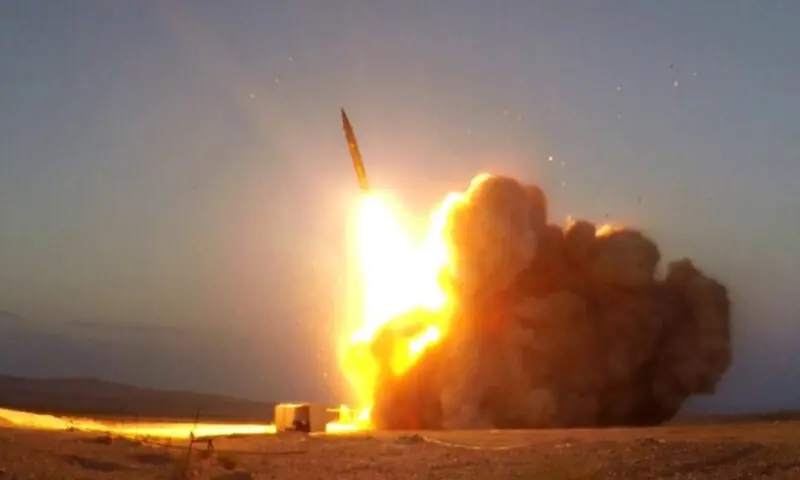
An Iranian missile is launched during a military exercise in an undisclosed location in Iran, on August 20, 2025. Reuters file

U.S. President Donald Trump announced on Sunday that the U.S. military was sinking Iran’s Navy, having destroyed nine Iranian warships so far and “going after the rest.”

Trump made the announcement in a social media post as the Pentagon intensified its bombings of Iran’s military, deploying B-2 stealth bombers from the U.S. to strike at hardened, underground Iranian missile facilities with 2,000-lb bombs.

U.S. strikes also pummeled Iran’s naval headquarters, largely destroying it, Trump said.

Iran’s military is retaliating with hundreds of missile and drone attacks, and the U.S. confirmed the first three deaths of U.S. servicemembers killed in combat on Sunday.

Another five have been seriously wounded during the conflict, the U.S. military’s Central Command said.

Trump, who announced plans to completely destroy Iran’s Navy, said the remaining Iranian warships would soon be sunk.

“They will soon be floating at the bottom of the sea,” Trump said.

“Other than that, their Navy is doing very well!”

For the latest news, follow us on Twitter @Aaj_Urdu. We are also on Facebook, Instagram and YouTube.
Pakistan missions in UAE suspend consular services amid regional security concerns

Published 01 Mar, 2026 11:01pm 0 min read

Pakistan’s diplomatic missions in the United Arab Emirates have temporarily suspended consular services for Pakistani nationals, citing heightened regional security concerns and precautionary measures to ensure staff and public safety.

In separate public advisories, the Embassy of Pakistan in Abu Dhabi and the Consulate General of Pakistan in Dubai announced that all routine consular services would remain suspended until March 3, 2026.

The missions said the decision followed security advisories issued by the UAE’s Ministry of Human Resources and Emiratisation, amid the evolving regional situation.

Officials described the move as a precautionary step aimed at safeguarding embassy personnel and visitors.

Consular operations will resume once conditions stabilise, with updated information to be shared through official channels.

Pakistani nationals residing in the UAE have been advised to strictly follow local authorities’ instructions and remain alert to official safety announcements.

Both missions also issued emergency contact numbers, urging citizens facing urgent situations to reach out for immediate assistance while routine public services remain temporarily halted.

For the latest news, follow us on Twitter @Aaj_Urdu. We are also on Facebook, Instagram and YouTube.
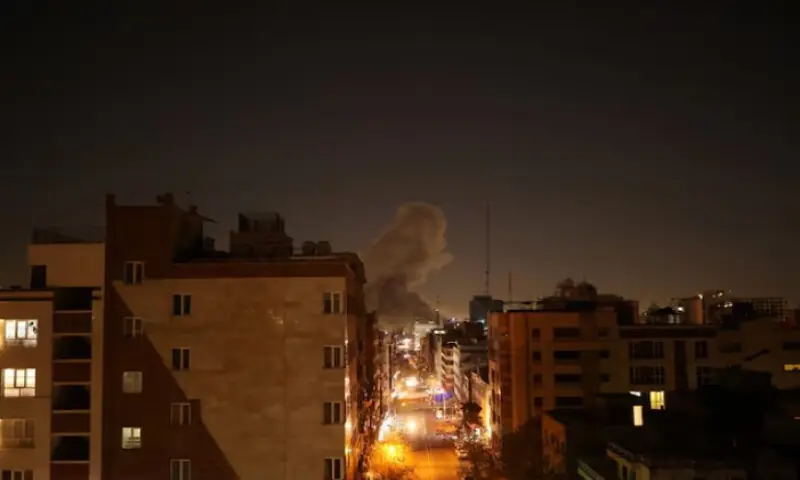
Oil jumps 10% on Iran conflict and could spike to $100 a barrel, analysts say

Published 01 Mar, 2026 10:24pm 0 min read
Oil tankers pass through the Strait of Hormuz, on December 21, 2018. Reuters

Brent crude jumped 10% to about $80 a barrel over the counter on Sunday, oil traders said, while analysts predicted that prices could climb as high as $100 after U.S. and Israeli strikes on Iran plunged the Middle East into a new war.

The global oil benchmark has rallied this year and reached $73 a barrel on Friday for its highest since July, buoyed by growing concern over the potential attacks that arrived a day later. Futures trading is closed over the weekend.

“While the military attacks are themselves supportive for oil prices, the key factor here is the closing of the Strait of Hormuz,” said Ajay Parmar, director of energy and refining at ICIS.

Most tanker owners, oil majors and trading houses have suspended crude oil, fuel and liquefied natural gas shipments via the Strait of Hormuz, trade sources said, after Tehran warned ships against moving through the waterway. More than 20% of global oil is moved through the Strait of Hormuz.

“We expect prices to open (after the weekend) much closer to $100 a barrel and perhaps exceed that level if we see a prolonged outage of the Strait,” Parmar said.

Middle East leaders have warned Washington that a war on Iran could lead to oil prices jumping to more than $100 a barrel, said RBC analyst Helima Croft. Rabobank analysts slightly less bullish, seeing prices holding above $90 a barrel in the near term.

The OPEC+ group of oil producers agreed on Sunday to raise output by 206,000 barrels per day (bpd) from April, a modest increase representing less than 0.2% of global demand.

While some alternate infrastructure could be used to bypass the Strait of Hormuz, the net impact from its closure would be a loss of 8 million to 10 million bpd of crude oil supply even after diverting some flows through Saudi Arabia’s East-West pipeline and Abu Dhabi’s pipeline, said Rystad energy economist Jorge Leon.

Rystad expects prices to rise by $20 to about $92 a barrel when trade opens.

The Iran crisis also prompted Asian governments and refiners to assess oil stockpiles and alternative shipping routes and supplies.

Kpler analysts said in a webinar on Sunday that India might turn to Russian oil to make up for potential Middle East supply loss.

For the latest news, follow us on Twitter @Aaj_Urdu. We are also on Facebook, Instagram and YouTube.
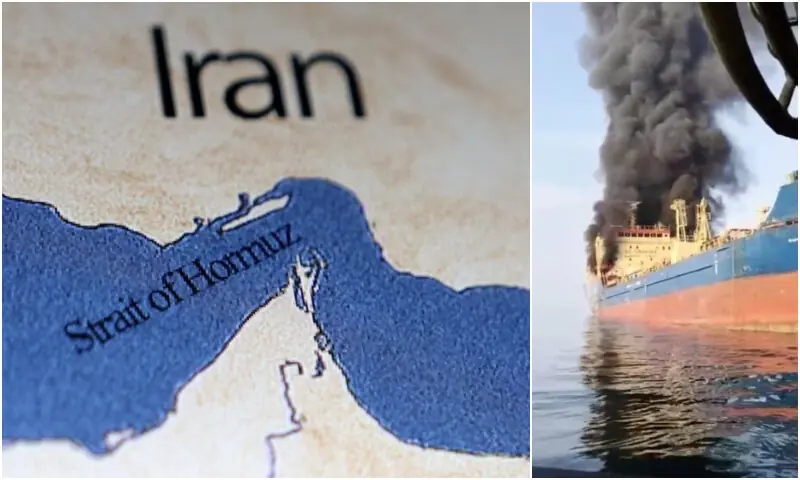
Trump says new Iranian leaders want to talk

Updated 01 Mar, 2026 11:58pm 0 min read
US President Donald Trump. File photo

U.S. President Donald Trump said on Sunday that Iran’s new leadership wants to talk to him and that he has agreed, according to an interview with the Atlantic magazine.

“They want to talk, and I have agreed to talk, so I will be talking to them. They should have done it sooner. They should have given what was very practical and easy to do sooner. They waited too long,” Trump said in the interview from his Florida residence.

Trump did not specify who he would be speaking with or say whether it would occur on Sunday or Monday.

Iranian President Masoud Pezeshkian said a leadership council composed of himself, the judiciary head and a member of the powerful Guardians Council had temporarily assumed the duties of the supreme leader following the death of Ayatollah Ali Khamenei.

Trump said some of the people who were involved in recent talks with the U.S. are no longer alive.

“Most of those people are gone. Some of the people we were dealing with are gone, because that was a big — that was a big hit,” he was quoted as saying in the interview with Atlantic staff writer Michael Scherer.

“They should have done it sooner, Michael. They could have made a deal. They should’ve done it sooner. They played too cute.”

Iran open to efforts for de-escalation, Oman says

Iran’s Foreign Minister, Abbas Araqchi, told his Omani counterpart, Badr Albusaidi, in a phone call that Tehran is open to any serious efforts at de-escalation after the Israeli and U.S. attacks over the weekend, according to a statement by Oman’s foreign ministry on Sunday.

Oman has been acting as a mediator in nuclear talks between the U.S. and Iran.

For the latest news, follow us on Twitter @Aaj_Urdu. We are also on Facebook, Instagram and YouTube.
Live

Iran retaliates with missiles as Israel strikes Tehran

Published 01 Mar, 2026 09:36pm 0 min read
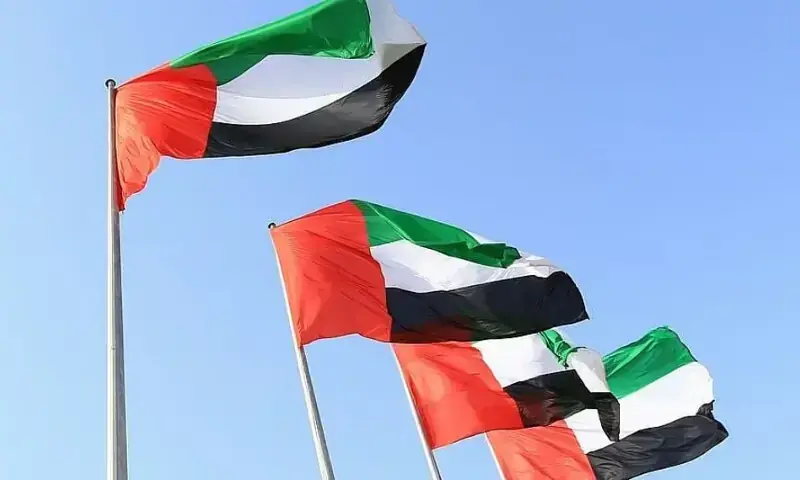
Smoke rises following an explosion, after Israel and the U.S. launched strikes on Iran, in Tehran, on March 1, 2026. Reuters

Israel launched a new wave of strikes on Tehran on Sunday, saying it aimed to dominate the skies after killing Iran’s supreme leader and leaving the Islamic Republic grappling to rebuild its leadership amid its biggest test in five decades.

U.S. and Israeli strikes — and Iranian retaliation — sent shockwaves through sectors from shipping to air travel to oil, amid warnings of rising energy costs and disruption to business in the Gulf, a strategic waterway and global trade hub.

Iranian President Masoud Pezeshkian said a leadership council composed of himself, the judiciary head and a member of the powerful Guardians Council had temporarily assumed the duties of Supreme Leader following the death of Ayatollah Ali Khamenei.

The U.S. military said it had sunk an Iranian ship, while Iran’s Revolutionary Guard Corps (IRGC) said they had launched an attack on the U.S. aircraft carrier Abraham Lincoln with four ballistic missiles, state media reported.

However, U.S. Central Command on Sunday rejected the IRGC claims.

“Iran’s IRGC claims to have struck USS Abraham Lincoln with ballistic missiles. LIE,” U.S. Central Command said in a post on X.

In a sign of widening turmoil, Israel’s ambulance service said nine people were killed by a missile strike in the town of Beit Shemesh, the United Arab Emirates said Iranian attacks killed three people, and Kuwait reported one dead in Iranian raids.

The Israeli military said that over the past day, Israeli planes had conducted strikes to open the “path to Tehran”, and the majority of aerial defence systems in western and central Iran had been dismantled.

It added: “Ali Khamenei was targeted in a precise, large-scale operation carried out by the Israeli Air Force, guided by accurate IDF intelligence, while he was in his central leadership compound in the heart of Tehran, where he was together with additional senior officials”.

Israeli military spokesperson Lieutenant Colonel Nadav Shoshani said many targets remained, including sites of military‑industrial production.

“We have the capabilities and the targets to keep going on for as long as necessary,” he said.

GROUND FORCES NOT BEING CONSIDERED, ISRAEL SAYS

Asked if Israel was considering deploying ground forces, Shoshani said that was not under consideration even though U.S. President Donald Trump and Israeli Prime Minister Benjamin Netanyahu have urged Iranians to seize a rare opportunity to topple their leaders.

Hours after the U.S. and Israel said an air strike killed Khamenei, Iran’s state media confirmed the 86-year-old leader had died.

Inside Iran, some grieved for Khamenei while others celebrated his death, exposing a deep fault line in a country stunned by the sudden demise of the man who ruled for decades.

Thousands of Iranians were killed in a crackdown authorised by Khamenei against anti-government protests in January, the deadliest wave of unrest since the Islamic Revolution of 1979.

Footage from Tehran showed mourners packed into a square, dressed in black and many of them weeping.

But videos posted on social media also showed joy and defiance elsewhere, with people cheering as a statue was toppled in the city of Dehloran in Ilam province, dancing in the streets of Karaj city, near Tehran in Alborz province, and celebrating in the streets of Izeh in Khuzestan province. Reuters has verified the locations of these videos.

Two U.S. sources and a U.S. official familiar with the matter said Israel and the U.S. timed their attack on Saturday to coincide with a meeting Khamenei was holding with top aides.

Experts said that while his death and those of other Iranian leaders would deal Iran a major blow, it would not necessarily spell the end of Iran’s entrenched clerical rule or the sway of the elite Revolutionary Guards over the population.

As supreme leader, Khamenei held ultimate power in Iran, acting as commander-in-chief of the armed forces and deciding on the direction of foreign policy, defined largely by confrontation with the United States and Israel.

‘GO BACK TO YOUR SENSES’, UAE ADVISER TELLS IRAN

Russian President Vladimir Putin denounced Khamenei’s death as a cynical murder and China’s Foreign Minister Wang Yi described it as “blatant killing”, while European Union foreign policy chief Kaja Kallas said the death of Khamenei was “a defining moment in Iran’s history”.

After Iran retaliated with airstrikes around the Gulf, Anwar Gargash, adviser to the president of U.S. ally and oil power the United Arab Emirates, urged Tehran to “go back to your senses”, saying the war is not with Iran’s Gulf Arab neighbours. The UAE has so far borne the brunt of Iran’s retaliation.

Trump warned on Sunday that the U.S. would hit Iran “with a force that has never been seen before” if it strikes back after the attacks on it.

IRAN VOWS ‘TERRIFYING BLOWS’

In a sign of disruption to energy supplies, at least 150 tankers, including crude oil and liquefied natural gas vessels, dropped anchor in open Gulf waters beyond the Strait of Hormuz and dozens more were stationary on the other side of the chokepoint, shipping data showed on Sunday, after the U.S and Israeli strikes.

The oil tankers were clustered in open waters off the coasts of major Gulf oil producers, including Iraq and Saudi Arabia, as well as LNG giant Qatar, according to Reuters estimates based on ship-tracking data from the MarineTraffic platform.

BLASES HEARD IN DUBAI, DOHA

Global air travel remained heavily disrupted as continued air strikes kept major Middle Eastern airports, including Dubai — the world’s busiest international hub — closed in one of the biggest aviation interruptions in recent years.

Several blasts were heard for a second day in Dubai and over Qatar’s capital of Doha, witnesses said. Dark smoke rose over Dubai’s Jebel Ali port, one of the busiest in the Middle East.

Iran, which had said it would target U.S. bases if attacked, hit a range of other targets, keeping the Gulf on edge.

Trump said the air strikes aimed to end a decades-long threat from Iran and ensure it could not develop a nuclear weapon. He also sought to justify a risky gambit that seemed to contradict his professed opposition to American involvement in complex overseas conflicts.

For the latest news, follow us on Twitter @Aaj_Urdu. We are also on Facebook, Instagram and YouTube.
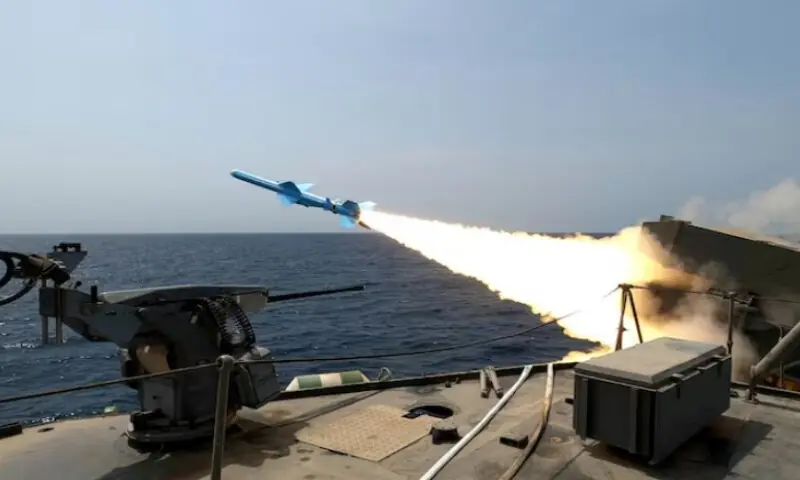
US confirms three troops killed, sinks Iranian warship

Published 01 Mar, 2026 08:30pm 0 min read
A representational image. Reuters file

The United States has confirmed the deaths of three American service members and injuries to several others following Iranian attacks, as fighting between the two sides intensifies in the region.

The U.S. Central Command (CENTCOM) said the casualties occurred during ongoing military operations against Iran under Operation Epic Fury.

Five American troops sustained serious injuries, while several others were treated and returned to duty after receiving medical care.

CENTCOM reaffirmed that military operations against Iran would continue despite the losses.

In a separate development, the command announced that US naval forces sank an Iranian Jamaran-class corvette at a pier in Chabahar, located along the Gulf of Oman.

In a post on X, CENTCOM reiterated remarks attributed to US President Donald Trump, calling on members of Iran’s armed forces, the Islamic Revolutionary Guard Corps (IRGC), and police units to lay down their weapons and abandon resistance.

For the latest news, follow us on Twitter @Aaj_Urdu. We are also on Facebook, Instagram and YouTube.
Live

8 killed in missile strike on Israel’s Bet Shemesh

Updated 01 Mar, 2026 07:29pm 0 min read
Screengrab.
Screengrab.

Eight people were killed in a missile strike on Sunday in the town of Bet Shemesh, west of Jerusalem, Israeli ambulance services said.

The attack, attributed to Iranian forces, struck residential areas near Tel Aviv, destroying multiple buildings and vehicles. Several others were injured, officials said.

Iranian missiles have continued targeting locations in Israel, with authorities reporting significant damage in Bet Shemesh.

For the latest news, follow us on Twitter @Aaj_Urdu. We are also on Facebook, Instagram and YouTube.
Live

Protests erupts accross Pakistan over loss of Ali Khamenei

Updated 01 Mar, 2026 06:23pm 0 min read
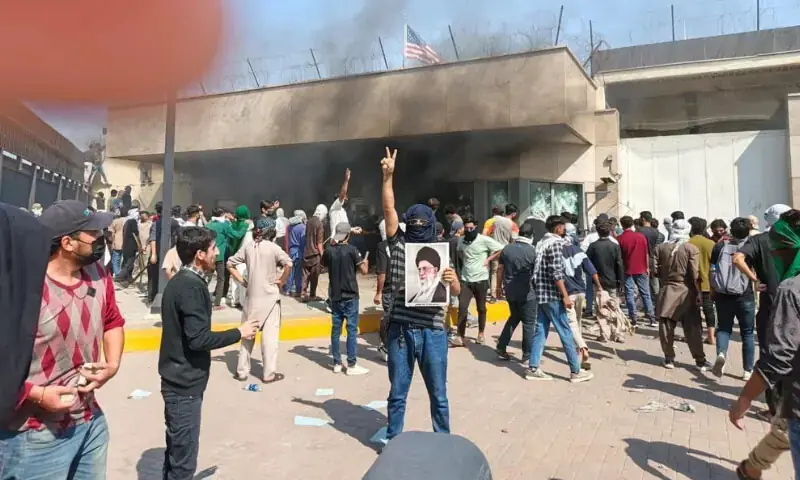
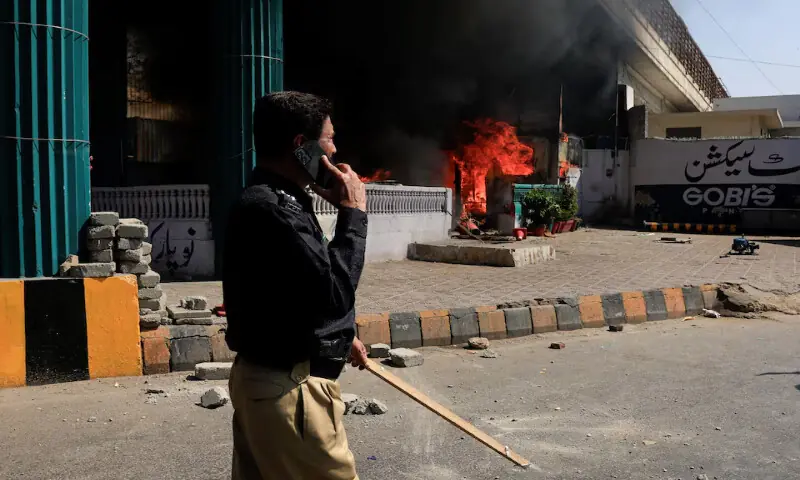
A police officer walks next to a checkpost set ablaze in a protest outside the US Consulate General in Karachi on Sunday. – Reuters

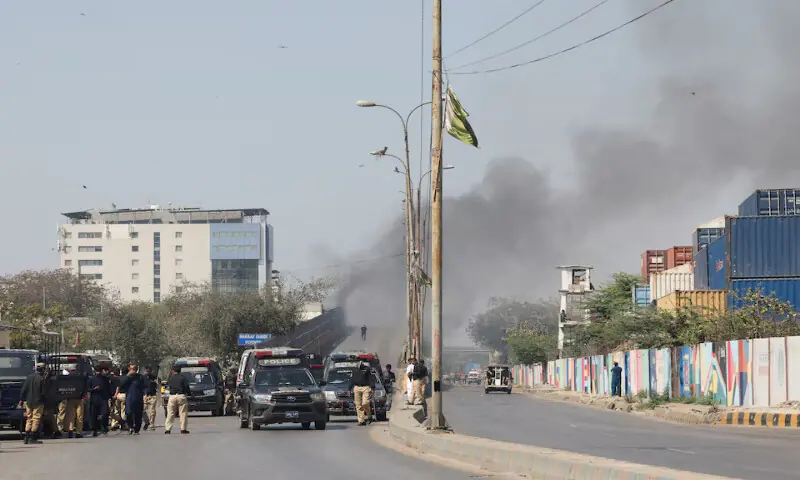
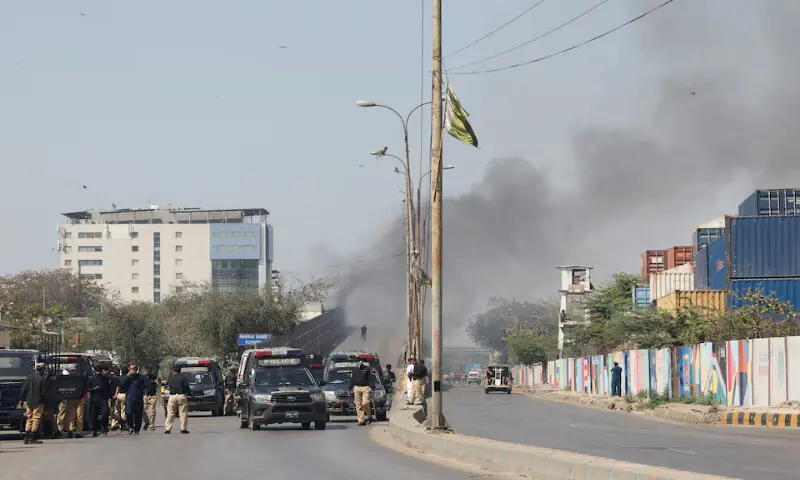
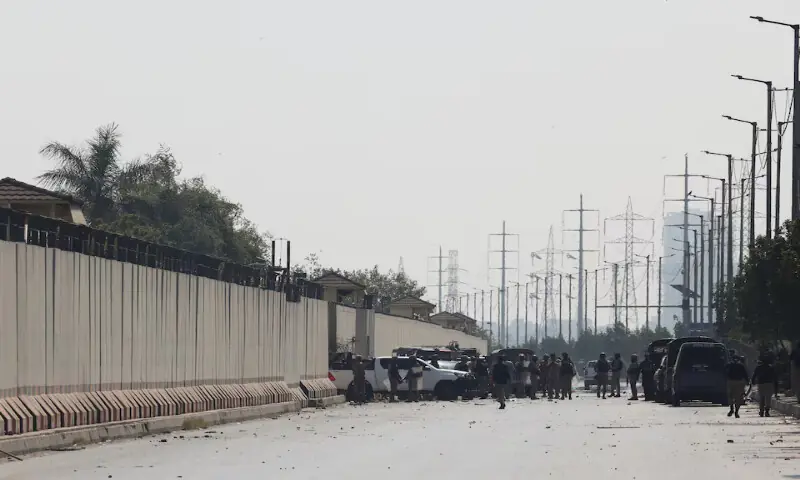
At least ten people were killed, and 34 were injured in clashes between protesters and law enforcement personnel near Karachi’s US Consulate situated on Mai Kolachi Road on Sunday.

Protests broke out across several areas of Karachi on Sunday over the death of Iran’s Supreme Leader Ayatollah Ali Khamenei in the US-Israeli air strikes.

Angry protesters staged a demonstration at the US Consulate during which some of the protesters attacked the building, damaged property and set fire to a portion of the property.

According to officials, protesters gathered near the American Consulate on Mai Kolachi Road and tried to force their way into the premises, pelting stones at security personnel.

Police and Rangers responded by pushing the demonstrators back and using tear gas to disperse the crowd.

Tensions were reported in several parts of the city, with large gatherings at key locations, including Numaish Chowrangi, Abbas Town, and the Tower area.

Protesters marched on the streets, chanting slogans against the killing of Iran’s Supreme Leader.

Eyewitnesses said demonstrators later moved toward the US Consulate, where security had been heightened.

Some protesters reportedly threw stones, and there were also unconfirmed reports of gunfire.

Heavy shelling was reported near MT Khan Road following continued stone-throwing by protesters.

A traffic police checkpoint under the Sultanabad Bridge was also set on fire during the unrest.

Rescue authorities said injured individuals were shifted to the hospital for treatment, where the condition of six injured was stated to be critical.

Police officials stated that additional personnel have been deployed to control the situation.

Traffic in several parts of the city was severely disrupted due to the protests.

Roads leading to Numaish Chowrangi were closed, while demonstrations at the Native Jetty Bridge near the Custom House affected the flow of vehicles.

Additional police personnel were deployed on Maulvi Tamizuddin Road, while the road from Sultanabad to Mai Kolachi was shut.

According to the traffic police, vehicles coming from Jinnah Bridge were diverted toward I.I. Chundrigar Road.

Traffic from Boat Basin was turned back at the Mai Kolachi crossing, while vehicles arriving from the PIDC House were redirected.

Meanwhile, DIG East Dr Farrukh Ali said the situation is now under control and protesters outside the US Consulate have been dispersed.

“No one will be allowed to take the law into their own hands,” he said, adding that security at sensitive installations and the Red Zone has been further tightened.

Authorities urged citizens to remain calm, avoid spreading or reacting to rumours, and said that the situation was being closely monitored.

Protests outside US consulate in Lahore

A large number of protesters gathered outside the US Consulate in Lahore on Sunday to protest the reported assassination of Iran’s Supreme Leader Ayatollah Ali Khamenei.

Section 144 in Islamabad

The district administration in Islamabad has imposed Section 144, prohibiting all forms of public gatherings, protests, and demonstrations across the federal capital.

Deputy Commissioner of Islamabad, Irfan Nawaz Memon, posted a message on X on Sunday, stating that under Section 144, all gatherings will be considered illegal.

Citizens were urged not to participate in any assemblies or public gatherings.

According to the district administration, strict legal action will be taken against anyone found organising or taking part in protests, demonstrations, or other assemblies.

Authorities appealed to the public to fully comply with the code of conduct to help maintain peace and order in the city.

Protests in Gilgit-Baltistan

The situation in all four districts of Gilgit-Baltistan has turned tense following reports of the assassination of Iranian Supreme Leader Ayatollah Ali Khamenei in an attack carried out by the US and Israel, with protests ongoing in several areas on Sunday.

The Karakoram Highway has been closed to all vehicular traffic due to demonstrations at multiple locations, while protests are also underway in Hunza and Nagar.

In Skardu, businesses remain shut following a shutdown strike, and shutdown and wheel-jam strikes are continuing across the region.

Gilgit also witnessed protests over the reported killing of Iran’s Supreme Leader Ayatollah Ali Khamenei, during which six people were killed, and several others were injured after being fired on by demonstrators.

Protests in Khyber Pakhtunkhwa

Protests were held in several cities across Pakistan’s Khyber Pakhtunkhwa province, including Peshawar, following the assassination of Iranian Supreme Leader Ayatollah Ali Khamenei.

In Peshawar, a demonstration organised by Millat Islamia Pakistan began outside the Peshawar Press Club and later moved along Sher Shah Suri Road to Aman Chowk.

Protesters raised slogans against Israel and the United States. Police fired shells to disperse the crowd at Aman Chowk, leaving several demonstrators unconscious.

Authorities restricted protesters to a distance of 200 meters from the Iranian consulate. The protest concluded peacefully after recordings were taken by officials.

Protests were also reported in Abbottabad, Dera Ismail Khan, Hangu, Orakzai, and Parachinar. Addressing a press conference at the Abbottabad Press Club, Jahanzeb Ali Jafari, provincial organiser of Majlis Wahdat Muslimeen, Khyber Pakhtunkhwa, said Syed Ali Khamenei dedicated his life to Islam and the oppressed, calling his assassination a “great tragedy for the entire Islamic world.” Officials of Majlis-e-Wahdat-e-Muslimeen in Abbottabad expressed solidarity with the Iranian people.

In Dera Ismail Khan, a procession moved from Circular Road Imamia Gate to Fawara Chowk, with demonstrators raising slogans in favour of Iran and against the United States and Israel.

Protests also took place in Kalay and Orakzai, with participants condemning what they described as American aggression and calling for revenge for Khamenei’s assassination.

For the latest news, follow us on Twitter @Aaj_Urdu. We are also on Facebook, Instagram and YouTube.

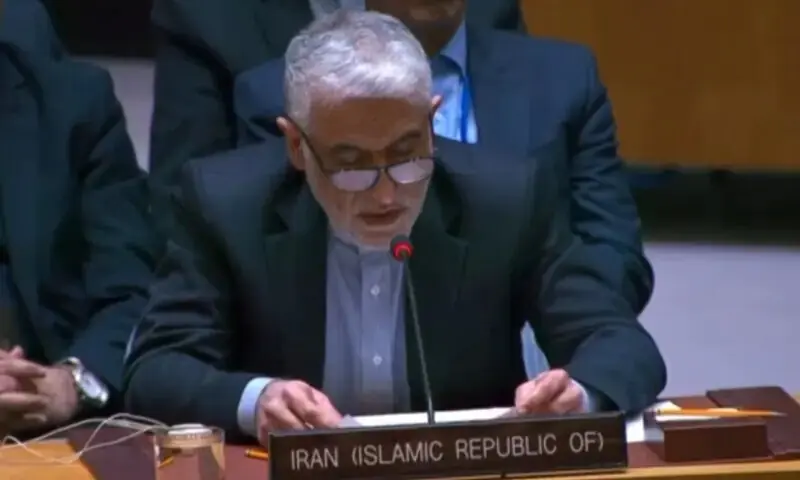
Iran thanks Pakistan for support at UN following attacks

Published 01 Mar, 2026 04:02pm 0 min read
Screen grab
Screen grab

Tehran has expressed special gratitude to Pakistan for its support at the United Nations after US-Israeli attacks on Iran.

Addressing a UN meeting, the Iranian Permanent Representative said that alongside Russia and China, Pakistan had backed Iran’s position, and appealed to all religious groups and citizens within Pakistan to remain calm and control their emotions.

The official highlighted that Pakistan had provided Iran with every possible diplomatic and moral support and had openly condemned the attacks at the UN.

The Iranian diplomat warned that turning protests in Pakistan toward violence or disturbing peace and order would strengthen the plans of Iran’s enemies.

The Iranian official urged citizens in Pakistan to exercise patience and wisdom, and to avoid creating any law-and-order situation in the country.

For the latest news, follow us on Twitter @Aaj_Urdu. We are also on Facebook, Instagram and YouTube.
Live

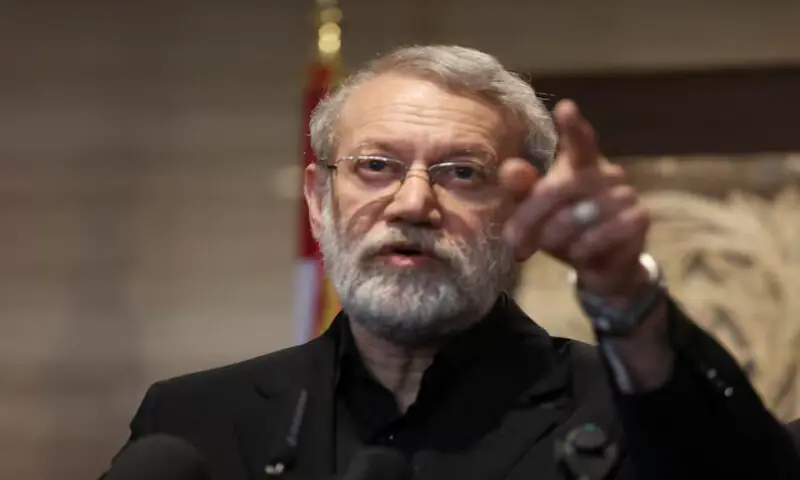
Pragmatist Larijani emerges as power broker in Iran

Published 01 Mar, 2026 03:34pm 0 min read
Ali Larijani. – Reuters

Veteran Iranian politician Ali Larijani, who said on Sunday a temporary leadership council would be set up after an air strike killed Supreme Leader Ayatollah Ali Khamenei, reemerged last year as one of the most powerful figures in the security hierarchy.

He has been managing a broad portfolio from nuclear negotiations to Tehran’s regional ties to its violent suppression of internal unrest.

An establishment insider who hails from one of the country’s leading clerical families, Larijani had been overseeing Iran’s efforts to reach a nuclear deal with the United States — just a month after Washington sanctioned him in January for allegedly directing a deadly crackdown on anti-government protests.

He accused the United States and Israel of trying to plunder and disintegrate Iran and warned “secessionist groups” of a harsh response if they attempted any action, state television said on Sunday, nearly 24 hours after they began a wave of attacks on Iran.

Iran’s Armed Forces Chief of Staff Abdolrahim Mousavi was also killed in strikes, broadcaster Iran TV said.

Appointed in August as Secretary of the Supreme National Security Council (SNSC), Larijani has held senior jobs throughout a career marked by loyalty to Khamenei and a reputation for pragmatic relations with the system’s often-rival factions.

His status as a trusted Khamenei strategist was underscored last month by a trip to mediator Oman to prepare for indirect nuclear talks with the US, as Washington built up its military forces in the Middle East to try to force concessions from Iran ahead of the strikes.

Larijani had also made several trips to key ally Moscow in recent months to discuss a range of security ties, in a further sign of his return to high-level diplomacy.

Nuclear issue

Larijani, who had an earlier stint heading the SNSC 20 years ago, resumed its leadership following last year’s 12-day air war between Iran and Israel that was joined by the US, returning formally to the heart of Iran’s security establishment.

Some of his public statements on the nuclear issue struck a pragmatic tone.

“In my view, this issue is resolvable,” Larijani told Oman state television last month, referring to the talks with the US “If the Americans’ concern is that Iran should not move toward acquiring a nuclear weapon, that can be addressed.”

But in the wake of January’s outpouring of anti-government anger, his security council role was denounced by Washington.

According to a US government announcement detailing sanctions against him and other officials in response to the crackdown, Larijani was at the forefront of efforts to crush the series of demonstrations that swept Iran in January.

“Larijani was one of the first Iranian leaders to call for violence in response to the legitimate demands of the Iranian people,” a US Treasury statement said on January 15, saying Larijani had acted at Khamenei’s behest.

Rights groups say thousands of people were killed in a crackdown on the protests, the worst domestic unrest in Iran since the era of its 1979 Islamic Revolution.

‘A pearl for a candy bar’

Like other Iranian officials, Larijani expressed understanding for demonstrations staged in protest at economic hardship. But he condemned armed actions he alleged were fomented by Iran’s arch-enemy Israel.

“Popular protests must be completely separated from these terrorist-similar groups,” state media reports published on January 10 quoted him as saying.

“The rioters are an urban quasi-terrorist group,” he was quoted as saying on January 26.

A former member of Iran’s Revolutionary Guards, Larijani served as chief nuclear negotiator from 2005-2007, defending what Tehran says is its right to enrich uranium.

He once likened European incentives to abandon nuclear fuel production to “exchanging a pearl for a candy bar”.

Back then, Iranian analysts said he sought to persuade the West through diplomacy and was regarded as a pragmatist.

The US and Israel believe Iran aspires to build a nuclear weapon that could threaten Israel’s existence.

Iran says its nuclear programme is purely peaceful.

Larijani was parliament speaker from 2008 to 2020.

During that posting, Iran struck a nuclear deal with six world powers in 2015 after almost two years of delicate negotiations.

President Donald Trump withdrew the US from the hard-fought agreement during his first term in 2018.

Engaging with Putin

Larijani has cautioned that Iran’s nuclear programme “can never be destroyed”.

“Because once you have discovered a technology, they can’t take the discovery away,” he told PBS Frontline in September 2025.

“It’s as if you are the inventor of some machine, and the machine is stolen from you. You can still make it again.”

Larijani has made repeated visits to Moscow and met President Vladimir Putin, helping Khamenei manage a key ally and world power that acts as a counterweight to pressure from Trump.

Larijani was also tasked with advancing negotiations with China, which led to a 25-year cooperation agreement in 2021.

He ran unsuccessfully for president in 2005.

He later sought to contest the 2021 and 2024 presidential elections but was barred both times by the Guardian Council, which cited issues including lifestyle standards and family ties abroad.

Born in Najaf, Iraq, in 1958 to a leading Iranian clerical family, Larijani moved to Iran as a child and went on to earn a philosophy PhD.

Several of his brothers have also held senior establishment jobs, including in the judiciary and foreign ministry.

One of Larijani’s daughters was dismissed in January from a medical teaching position at Emory University in the US following protests by Iranian-American activists angered by his role in the suppression of that month’s demonstrations.

For the latest news, follow us on Twitter @Aaj_Urdu. We are also on Facebook, Instagram and YouTube.